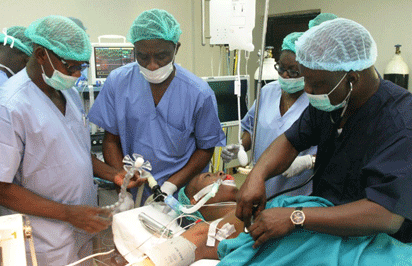
By Femi Omigbodun
Survival chances for many recent deaths in Nigeria would have been greatly improved had we been blessed with top notch intensive care services.
 Many Nigerians have needed intensive care, passed through it ( or a semblance of it) or have sought intensive care to no avail.
They, their families and carers have suddenly realized what many in the healthcare industry have known for a long time: that intensive care in Nigeria needs IMMEDIATE ATTENTION!
What is Intensive Care or Intensive Therapy Unit?
ICUs are also sometimes known as critical care units (CCU) or intensive therapy units (ITU).
A person in an ICU needs constant medical attention and support to keep their body functioning.
They may be unable to breathe on their own and have multiple organ failure. Medical equipment will take the place of these functions while the person recovers.
It should not be confused with an High Dependency Unit or HDU which is more like a step down from ICU or a step up from a ward or recovery room area.
ICU beds are expensive and limited because they provide specialized monitoring equipment,a high degree of medical expertise and constant access to highly trained nurses (usually one nurse for each bed).
A person may need an ICU bed after surgery, following an accident or severe illness or when one or more organ systems, (heart, lungs, kidneys or even digestive system ) has failed.
What can cause these organs to fail?
Some of the most common causes of organ failure include:a serious accident – such as a road accident or a severe head injurya serious acute (short-term) health condition – such as a heart attack (where the supply of blood to the heart is suddenly blocked), or a stroke (where the blood supply to the brain is interrupted) a serious infection – such as a severe case of pneumonia (inflammation of the lungs) or sepsis (blood poisoning) major surgery – this can either be a planned admission to an ICU as part of your recovery after surgery or an emergency measure if there are complications during surgery
Scary environment
The ICU can be a scary environment for the patient, their family and friends.
Patients in ICUs are often prescribed painkillers and medication that can make them drowsy (sedatives) because some of the equipment used can be very uncomfortable.
A series of tubes, wires and cables connect the patient to this equipment, which may look alarming at first.
Surprisingly, equipment, per se, is not the problem in Nigeria. The funds are there; in government treasuries and with the many potential private investors in this country. It is the expertise, both medical and nursing, that is a challenge.In addition, ALL payers ( patients, Governments, Insurance companies) need to know that Intensive Care COSTS money.
When an individual requires intensive care, it is classified urgent or emergent in medical practice. For those who think they can be whisked overseas, there is often no time to transfer abroad or such transfer may not be clinically safe for the patient, with the condition worsening significantly before arriving at the magical medical destination.
Rather than exporting patients that need ICU, we need to IMPORT ICU training and practice here. There are numerous Nigerian doctors and nurses working, managing and leading such units in the best medical centers around the world.
Trainees can only learn and understand intensive care in a true ICU environment. Government, corporations and wealthy private individuals should provide the infrastructure for intensive care units and actively fund training and education of ALL staff of such units.
The rewards are simple: Intensive care units can save lives! And it could be yours.
Disclaimer
Comments expressed here do not reflect the opinions of Vanguard newspapers or any employee thereof.