By BABAJIDE KOMOLAFE
The 2015 annual seminar for finance correspondents and business editors organised by the Central Bank of Nigeria (CBN) provided another opportunities for journalists and economic experts to assess developments in the nation’s foreign exchange market in the last 12 months. The theme for the seminar, “The Impact of Crude Oil Prices on External Reserves and Exchange Management in Nigeria” was informed by the  declining crude oil prices from over $100 to $56 per barrel in the last 12 months, leading to decline in the nation’s external reserves and over 20 percent devaluation of the naira as well as the various policy measures introduced by the CBN to manage the situation.
According to Akinsowon Dawodu, Managing Director/Chief Executive, Citi Bank Nigeria and Bismarck Rewane, Managing Director/Chief Executive, Financial Derivative Company, what happened in the last 12 months has been the trend since the early 1970s when oil overtook agriculture has the country’s number one foreign exchange earner.
Oil dependence
“The exchange rate generally mirrored the movements in oil prices as a result of Nigeria’s reliance on oil”, Rewane noted. “Oil accounts for over 90 percent of foreign exchange revenue. As a result Nigeria experiences exchange rate stability in period of high crude oil prices while there is volatility and reserve depletion visible in period of low oil prices”, noted Dawodu
Similarly, Moses Tule, Director, Monetary Policy Department, CBN, explained that, “A rapid fall in crude oil prices threatens Nigeria’s macroeconomic stability because foreign exchange earnings, government revenue and domestic money supply are largely dependent on receipts from crude oil exports. For the CBN, falling prices pose concerns for external reserves, inflation and the exchange rate of the Naira.
Lamido Yuguda, Director, Reserve Management Department, CBN, also explained that due to its impact on the external reserves, the price of crude oil also influence inflow or outflow of foreign investment (capital) in or out of the country. “A robust level of external reserves provides confidence to the international community that the country can meet its international obligations, hence, the higher the level of external reserve holdings by a country, the more capital it will be able to attract.
“Thus when crude oil prices were high, and external reserves were high, foreign investment inflow was high but when reserves are low due to decline oil prices, foreign investment flows out of the economy,” he explained. This overdependence of the economy on crude oil for foreign exchange earnings, according to Tule, is aggravated by the country’s huge demand for imports. He said these two factors combined together makes management of the exchange rate of the naira, challenging for the CBN.
“The best CBN can do when there is decline in crude oil prices, is to manage the situation to minimize the impact of the economy”, This, he said, is the rationale for the various measures introduced by the CBN since November last year, including closure of the official foreign exchange market (Retail Dutch Auction System or RDAS) and the exclusion of 41 items from access to dollars in the nation’s foreign exchange market.
How to value the naira
Dawodu and Rewane however averred that more needs to be done to minimise the impact of crude oil prices on the economy and the value of the naira. Dawodu for example, though commended the closure of the RDAS, saying it is another step towards a floating exchange rate regime, he averred that the CBN needs to complement this by reducing the frequency of its intervention in the interbank market.
“CBN should reduce intervention in the foreign exchange market to achieve policy credibility, he said. He added that though empirical evidence on the effectiveness of intervention on exchange rate stability are mixed, the impact of CBN intervention on exchange rate level is often short-lived and increase volatility.
“CBN should be selective in its interventions and be frugal with the use of the reserve. RDAS closure is the first step toward a complete liberalization of the foreign exchange market. Autonomous market needs to be opened to allow flexibility in exchange rate movement. Investors will remain wary until this is done. However, it might be happening a few years too early as the market depth is not enough to absorb the total yearly demand. Economic transformation must precede total liberalization”, he added.
Rewane on his part averred that the issue is not the value of the naira but determination of the value of the naira. “The CBN needs to put in place a framework for determining the value of the naira that is transparent and credible. All the various exchange rate policy measures since the introduction of SAP in 1986 revolve around this problem”, he said.
He noted that today Nigeria has a currency crisis, because the price of the naira and value of the naira are at tangents. This, he said is because, adjustments to the exchange rate of the naira in response to declining crude oil prices, and reserves are usually delayed. This delay, he argued always result into severe adjustment or devaluation of the naira as experienced in the last 12 months.
He noted that presently, the naira, using the Purchasing Power Parity (PPP) exchange rate model, should be trading at N186 to the dollar, implying that the nation’s currency is undervalued. “Using the PPP formula, the true value of the naira should be N186.75. The difference between this rate and N230 (as obtained in the parallel market) is the fear factor. The naira will not appreciate to N186 because of: The inflation/interest rate differential and Speculative pressure,” he said.
Fuel subsidy must go
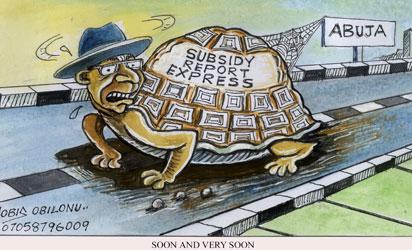
In addition to the need for timely adjustment of the exchange rate, Rewane also pointed out the need to address leakages in the foreign exchange market. He said the two major sources of leakages are exchange rate subsidy and fuel subsidy, adding that while the closure of the RDAS/official market has eliminated leakages from exchange rate, the federal government must complement this by removing the fuel subsidy.
Fuel subsidy, he noted, constitutes 30 percent of Nigeria’s import bill, adding that by remove subsidies, aberrational demand (for dollars) pressure will disappear in the foreign exchange market, and reduce import bill of bogus demand by 15 to 20 percent. Rewane noted that though President Buhari seems not disposed to removing fuel subsidy, he averred that removal of subsidy is not a matter of ‘if’ but ‘when’.
“The truth is that refineries were producing before subsidies were introduced. Subsidies are a gap between the price and the cost. Even if you produce at the refineries and you are selling at below the cost of production, then you create a subsidy. “Subsidies are distortionary: first of all, get rid of the system so it doesn’t breed corruption and if there are no subsidies, with the price of oil today at $52 per barrel, this means that you might actually find that the price of petrol may be lower than what it is today.
“So there’s no question – and let us separate the issues – the subsidy is a number; the subsidy system is a system that breeds corruption, get rid of the subsidy system and then the number will be an efficient number,” he said. He added that the removal of fuel subsidy is critical to how much the naira would trade against the dollar in the coming months.
He noted that though notable international organisations like the Bank of America, Recap and Economic Intelligence Unit (EIU) have predicted further devaluation of the naira, to between N215 per dollar and 235 per dollar in the next six to 12 months, the possibility of these predictions coming to pass will be determined by government’s decision on the removal of fuel subsidy. “The reality is, if crude oil price falls below the present level, another adjustment (devaluation) of the naira will be imminent. The adjustment will be minimal if fuel subsidy is removed, the adjustment will be minimal but if fuel subsidy is maintained, the adjustment will be severe”, he warned.
Disclaimer
Comments expressed here do not reflect the opinions of Vanguard newspapers or any employee thereof.