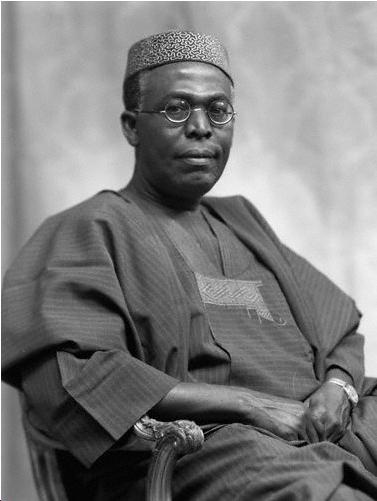
Chief Awolowo
By Gboyega Amoboye
The late Chief Obafemi Awolowo and President Muhammadu Buhari might have lived at different times but, like identical twins, possess many things in common-dynamism, pragmatism, integrity, self- discipline, vision and passion-to make Nigeria work. The impeccable past of these tested leaders has proved that the bane of the country’s slow development since independence has been lack of purposeful leadership.

Chief Awolowo
Unlike the reluctant leaders who had been imposed on us, Awolowo and Buhari, both armed with impeccable records of performance, the former as Premier of the old Western Region as well as Vice Chairman of the Federal Executive Council in the regime of Gen. Yakubu Gowon, and the latter, as a military Head of State, etc, adequately prepared for the leadership of Nigeria. Three times were each unsuccessful- Awolowo in 1959, 1979, 1983 and President Buhari in 2003, 2007 and 20011.
Their paths might have crossed in one form or the other, that may been the unseen hand of God in their lives preparatory to the task ahead that :”You Obafemi Awolowo is my Moses and you Muhammadu Buhari, my Joshua, for the libration of your people from the ‘rats and mosquitoes’ of your country”. Or could it be by sheer coincidence that, for the first time since independence, both the North and the South West are in effective political alliance? The Thomas’s may continue to doubt.
Like the Nostradamus that he was, Awolowo, in a paper delivered in Kano in 1970,had proposed a seven- point agenda which he called national objectives that should be implemented simultaneously in all the states of the federation for the rapid and even development of the country. He explained that the revenue allocation formula should be based on the implementation of the seven objectives and, by so doing, put an end to the “endless search for the appropriate allocation formula”. He was speaking in a paper titled, Revenue Allocation Must be Based on Even Progress and Needs, delivered in his capacity as the Federal Commissioner of Finance, to the annual conference of state commissioners of finance.

President-elect Muhammadu Buhari reviews a document in Abuja on April 1, 2015. Nigeria’s new president-elect Muhammadu Buhari hailed polls that will lead to the first democratic change of power in Africa’s most populous nation as “historic” hours after he secured a decisive victory. AFP PHOTO
As if confirming the link between these great national heroes, Buhari recently implemented item seven of the Awolowo’s seven- point objectives for national development of 45 years ago and, by so doing, been praised for “bailing” out states that could not pay workers salaries. The late sage had said under this item that it was imperative to put the federal government in sufficient funds to enable it not only to perform its allotted functions but also to come readily to the aid of any state in need while arguing: “But perchance any state falls on evil day, it would be the duty of the federal government, acting as an accredited agent of all the states, to come to the aid of such a needy state without delay…Before leaving this topic , one may ask Buhari’s critics where they were when former President Goodluck Jonathan granted some members of the private sector a bail out. For instance, Arik Airline got 600m dollars, Aero -200m dollars, Air Nigeria-225.8mdollars, Chachangi-55m dollars etc.(AMCON) in addition to an attempt to buy aircrafts for them but for adverse public opinion.
Revisiting the Awo agenda
If one of Awolowo’s seven objectives has been considered well enough for implementation, the remaining six, which may equally be as good, are therefore presented though in abridged form, for consideration by Mr. President. They are…
Read the fuller version of this story on our website tomorrow.
Disclaimer
Comments expressed here do not reflect the opinions of Vanguard newspapers or any employee thereof.