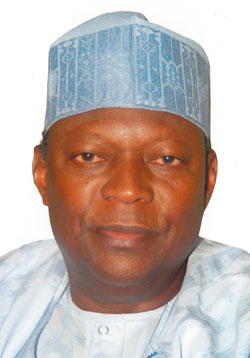
Abubakar NSITF boss
By Leke Adeseri
THE widespread poverty occasioned by massive unemployment especially amongst youths, rising cases of workplace injury and elderly lacking access to basic necessities of life combine to make adoption of social security an imperative.
With many migrating into the poverty population, governments in most parts of the world are introducing social security to lift their citizens off the lowest part of social floor even as the popularity of social security in West Africa sub-region is still abysmally low.
While there are different reasons adduced by various governments for the low penetration of social security in the sub-region, which ranges from lack of resources to finance the programme to its expensive nature, the need to have one form of social security or the other especially for the vulnerable groups cannot be totally discountenanced.

Abubakar NSITF boss
Indeed, the International Social Security Association (ISSA) defines social security as any programme of social protection established by legislation, or any other mandatory arrangement, that provides individuals with a degree of income security when faced with the contingencies of old age, survivorship, incapacity, disability, unemployment or rearing children. It may also offer access to curative or preventive medical care.
Preventive medical care
The technical seminar tagged, “impact of new information and communication technology in the performance of social security institutions” slated for Abuja this Wednesday and Thursday is organized by the ISSA Liaison Office for West Africa and hosted by the Nigeria Social Insurance Trust Fund (NSITF).
Given the dynamics of socio-economic problems, the creation of an inclusive and easily accessible social security for all has become a priority for all countries. This effort is further justified in light of the low coverage rates in sub-Saharan Africa. Improving both access to, and the quality of, services are concerns that must be addressed to promote social justice.
ISSA said in recent years, social security organizations have taken concrete action to extend social coverage, facilitate access to rights and strengthen obligations of employers and the insured and improve service quality. In this context and in response to these emerging trends, the need to reinforce the role of ICT in the operations of social security institutions is greater than ever. This capacity enhancement must be in line with the actual needs of the populations and the capabilities of the social security institutions.
Objectives of the technical seminar is to identify the impact of using new information and communication technology to manage social security institutions and client satisfaction and will have its main focus on allocation of resources to ICT, service quality and impact on contribution collection.
While explaining why Nigeria is hosting the event, the Managing Director of NSITF, Munir Abubakar said it is indeed a big step for the Fund in many respects.
“First, our Information and Communication Technology (ICT) has just taken off and secondly, the Employees Compensation Scheme (ECS) is ICT driven. These are the two principal reasons why the seminar is very important for us. During the operations of the defunct NSITF scheme between 1994 and 2004, one of the biggest challenges we faced was the computerization of our records. In fact, this took us into warpath with employers because they did not want to be part of the scheme because of the lack of computerization of our system,” he explained.
The NSITF boss stressed that Nigeria presently implements one of the nine social security arms and the immediate National Assembly has expanded that mandate by extending provision of social security to all Nigerians and that cannot be done that if there is no internationalized ICT, saying, “by the time the law is signed by the present government, implementation of additional mandates will be an easy ride for us because we are fully ready.”
Additional mandates
He explained that the ICT expansion into all the NSITF offices nationwide would be done in phases with the ICT component of the head office now completed, adding, “the next stage is to finish the ICT in our big offices in Lagos, Port Harcourt and Kano. Lagos is almost completed now. The plan is to have every office in the country linked up with the head office.”
The NSITF boss also highlighted that it is not safe to have ICT installed in rented offices as currently happening in most state offices hinting that plans are underway to acquire buildings in the states to ensure security of information in the care of the Fund.
Abubakar, who lauded the Nigerian Employers Consultative Association (NECA) and Nigeria Labour Congress (NLC), said the two organizations contributed immensely to understanding of what the scheme is about within the stakeholders.
Though he said state governments are still not reluctant to adopt the scheme, the NSITF helmsman revealed that the Fund is adopting fresh strategies to ensure compliance by state governments.
He stated that the conference would present West African countries opportunity to share experiences on how to engender the faster ways of implementation of social security schemes’ in the sub-region.
On mainstreaming ICT into the operations of the NSITF, the General Manager, ICT of NSITF, Mrs. Catherine Ugbe, said since 2012, the Fund decided to draw up strategies for its ICT implementation confronting formidable stumbling blocks as the implementation processes progressed.
She highlighted that the Fund decided to adopt the ISO-270001 ahead of other standards to ensure safeguarding of information; making it available for those who need it at the time it is needed by all the stakeholders, adding that for an ICT system to work properly in terms of security and reliability, governance procedure needed to be put in place.
She hinted that NSITF prioritized three key services that included registration, notification and claim processing in its website to assist employers register their workers seamlessly without physical contact with the office.
She added that since the website became functional, the Fund has witnessed about 80% increment in the usage of emails for communication.
Mrs. Ugbe hinted the establishment of an information security forum where all head of departments come to discuss matters relating to information security.
Disclaimer
Comments expressed here do not reflect the opinions of Vanguard newspapers or any employee thereof.