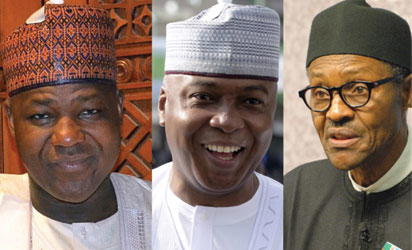
Speaker of the House of Representatives, Hon. Yakubu Dogara; Senate President, Dr. Bukola Saraki and President Muhammadu Buhari
By Emmanuel Aziken, Political Editor
The hope that today’s resumption of the House of Representatives would proceed on a peaceful note was hinged on a positive outcome from last night’s meeting between President Muhammadu Buhari and members of the All Progressives Congress, APC caucus in the House. That meeting was yet to commence as at press time yesterday.

Rowdy session in the House of Representatives
After earlier separate meetings with Speaker Yakubu Dogara and his rival, Femi Gbajabiamila, President Muhammadu Buhari was last night expected to have the first formal joint meeting with the members of the two camps of the party in the House. The outcome of that meeting which was yet to commence as at press time would inevitably determine what will happen at the formal resumption of the legislative body today.
It is the first time that the president would have met the two tendencies in the House together since the leadership contest that eventually saw Dogara trounce Gbajabiamila on June 9.
Perhaps in adherence to his pledge of non partisanship, Buhari had demurred from openly intervening into the matter. However, suspicion of the president’s partisan leaning was always an issue especially given the frontal role of Nasiru Zango Daura, the man who represents the president’s Daura federal constituency, as spokesman of the Gbajabiamila group. Besides Daura, many members of the Katsina delegation to the House of Representatives were almost all in the Gbajabiamila camp until recently.
Latitude for maneouvre
At yesterday’s meeting the president was expected to play the leader’s role in quieting the mutterings of both camps. His intervention may have become crucial given the bad image the crisis in the two houses of the National Assembly has given his party.
However, the president’s latitude for manoeuvre are as almost everyone knows limited, given the ascendancy of the Dogara camp in the House. As at press time, the Gbajabiamila camp was bleeding as reality dawned on many supporters of Gbajabiamila that Dogara’s position as speaker had remained unassailable and many of them in furtherance of their own political interests were now coming to pay loyalty to the speaker.
However, Dogara’s own charismatic charm, especially his offer of four of the principal positions to the Gbajabiamila camp turned into a political masterstroke that helped to weaken the strength of his rival. That offer, which precluded Gbajabiamila as House Leader on the assertion that the Gbajabiamila’s Southwest geopolitical zone already produced the deputy speaker, helped to fragment the unity of his opponents.
The president was expected to build on that yesterday towards ensuring that today’s session of the House does not degenerate to another round of violence in the chamber.
Violence in the chamber
In the Senate, matters are a little more difficult given the emergence of Senator Ike Ekweremadu as the deputy president of the Senate. The president, according to many sources is peeved by the development and it is not surprising that he is not meeting with the two camps of the APC caucus in the Senate.
The president’s room for agitation is, however, even more limited given the elevated position of the Senate in guiding his legislative agenda.
That reality was echoed in the police investigations into the alleged forgery of the 2015 Standing Rule of the Senate. The claim by some APC senators opposed to the emergence of Senator Bukola Saraki as Senate President, according to the police report, could either be a criminal development or an internal affair of the Senate.
Many senators are, however, bent on keeping their issues internal and would not want to expose their affairs to public ridicule.
The assertion by the Senate Clerk, Mr. Ben Efeturi in his deposition to the police team that the evolvement of the 2015 Senate Standing Order followed the same way that was used in bringing to life the 2003, 2007 and 2011 Standing Rules should be of some interest to the president. This is especially so given Mr. Efeturi’s standing as one of the most experienced legislative experts in the country. Mr. Efeturi whose experience spans from the Second Republic National Assembly was at the commencement of the Fourth Republic the Clerk of the Senate Committee on Business and Rules, following which he became the deputy clerk of the Senate.
President’s interest
Given his experience in the birthing of all the past Standing Rules his deposition to the police investigating team should arouse the president’s interest.
The president’s perceived angst against the emergence of Senator Ekweremadu as deputy president of the Senate could be understandable given the fact that Ekweremadu belongs to the PDP and is driving the momentum for the reinvention of the party. However, President Buhari it is argued had claimed that he would work with anyone as presiding officer of the National Assembly.
If the emergence of Ekweremadu is a fait accompli, the president it is argued, should move forward to embrace the National Assembly leadership as partners in progress otherwise he stands the position of damaging his own legislative agenda.
Former presidents including President Olusegun Obasanjo had to stomach personal hurts in dealing with National Assembly leaders and members. Obasanjo was even at one time forced to feed Speaker Ghali Naaba in 2002 with a cake!
It is tempting to believe that by unbending that President Buhari may be caving in to the demons of the past that stifled the country’s development. He certainly does not need to do that and is well advised that the issues of today are only teething signs as more challenges may indeed be ahead.
Disclaimer
Comments expressed here do not reflect the opinions of Vanguard newspapers or any employee thereof.