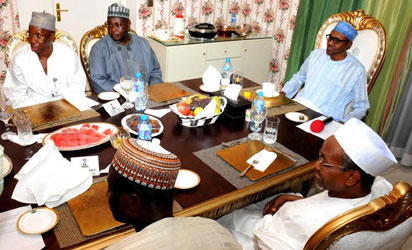
PRESIDENT MUHAMMADU BUHARI (R) WITH THE CLERK OF THE NATIONAL ASSEMBLY, SALISU MAIKASUWA AND SOME PERMANENT SECRETARIES DURING BREAKING OF RAMADAN FAST AT THE PRESIDENTIAL VILLA ABUJA ON MONDAY
Within this period when we are about to bid Ramadan good bye, the issue of Zakatul-fitr is paramount. We have to keep emphasising it as much as to touch all aspect of it. Yesterday we discussed some vital areas of importance even as we cannot exhaust it, we also have give ample time to look at other areas such as what kind of food, calculation and the discourse on whether we can give it in money.
We have been taught that one Saa is for one person. But what is a Saa? A Saa was and still is a measurement of volume, similar to the size of a medium bowl. It is made up of four mudds, and a mudd is a smaller container, close to the size of a small bowl. The mudd is not simply a double-handful. A mudd is an actual physical container (like a small bowl or pot, or a large cup), a standardized unit of measurement, one that was widely in use in the time of the Prophet (s.a.w)
The contemporary equivalent of the mudd can be found in most local mosques. All you need do is to ask your local imam for one. We have said earlier on this column that it has to be given in staple food common in your area or that which is loved by your prospective recipients. In essence, one Saa or four mudds should be given on one person. If you have a family of five for example, (father, mother, two children and one domestic servant); what you will give is 20 mudds of the staple food you have chosen. If your mother is not living with you but asks you to pay on her behalf, it becomes obligatory on you to do that.
It should be noted that the measurement must be correct because the Prophet prescribed it as an amount of food which fulfills the needs of one family for at least a day.
Anyhow, this is the obligatory amount which every Muslim should pay. It is better and recommended that one pays an extra amount, particularly for those who are wealthy, for they will be rewarded for it.
Payment in money
The Hanafis school of thought permitted the payment of Zakat-ul-Fitr in money. However, the other three schools did not permit this. Their argument is that the Prophet did not do so and hence its payment in money contradicts the Sunnah of the Prophet. But some contemporary scholars support the Hanafi’s view since people may still need money to process the food and if the recipient has no money, the purpose of given the food may not be realised. Again, since the purpose of Zakat-ul-Fitr is to fulfill the needs of the poor, this can also be achieved in money especially if the recipient needs money more. They further submitted that the period of famine was more useful for the payer to give it in foods, that if money is more useful, then its payment in money is better. These divergent opinions have also continued till date. Even in our own environment, scholars are divided on the issue. But suffice to say that we should consider the position of the prophet on giving it in food first, and if the need for money for the recipient becomes imperative, then money equivalent becomes necessary.
Disclaimer
Comments expressed here do not reflect the opinions of Vanguard newspapers or any employee thereof.