By Yinka Ajayi
Since the global human rights watchdog, Amnesty International (AI), released its latest report on the Nigerian military, calling for the heads of nine military commanders and condemning the rank and file for alleged war crimes, things appear to have fallen apart for it. Stung by what they called the obvious biases and inconsistencies in the report which reduced the ongoing counter-terrorism war to an attack by the Nigerian Army, Navy and Air Force on innocent and law-abiding citizens in Nigeria’s North-East, many civil society and human rights organisations across the country have been staging demonstrations calling for the probe of the AI in Nigeria and expressing solidarity with the armed forces over the perceived campaign of calumny by the global watchdog.“
They wondered why AI would always play the spoiler whenever the military was recording a major success against Boko Haram, while keeping quiet whenever the terror group slaughtered innocent Nigerians in its infamous bid to impose its own brand of Sharia law on Nigerians. Meanwhile, group of analysts fingered the AI report as part of the bid of the Western powers to ensure that Nigeria ceases to exist, saying that negative newspaper reports about the Nigerian military were a continuation of war by other means. They cited a story by NBC news (nbcnews.com), entitled, “Boko Haram is winning, say official”, as part of the campaign of calumny against Nigeria.“The story, which dismissed the military campaign against Boko Haram as ineffective and hopeless, apparently celebrated what it called the terror group’s initiative.
The story said, “Boko Haram is winning. That’s the assessment of both US counter terrorism officials and many experts who cover Africa. After several months of optimism, and military successes by Chadian and Nigerian forces, Boko Haram has taken the initiative.”“The story cited John Campbell, the Ralph Buche Centre director at the Council on Foreign Relations and a former US Ambassador to Nigeria, as saying that Western observers had exaggerated the military gains against Boko Haram. It cited an unnamed US counter-terrorism official as saying that “There have been successes, but it’s a whack mole. Boko Haram does strategic retreats.”
But this left Nigerians wondering why the opinions of the people directly involved in, and affected by the insurgency did not matter to the foreign denigrators. “For instance, Bishop Emeritus Emmanuel Kana Mani of the Anglican Church berated the global watchdog for being more concerned with the human rights of murderers than those of the victims of the carnage in the North-East. He wondered why the group, which claimed to have used Google satellite maps to trace locations of Nigerian soldiers murdering suspects, could not use the same device to trace the missing Chibok girls or the Malaysian Flight MH 370. In particular, he wondered why AI, if it was really concerned about the safety of Nigerians living in the North-East, could not use Google map to trace and betray Boko Haram movements to the military.“His words: “It is curious that Amnesty International can use Google satellite map to trace where Nigerian soldiers are killing Boko Haram suspects but cannot use that to trace the missing Malaysian Flight MH 370 which has been missing, or the innocent Chibok girls who were abducted by these elements, or better still, use that to track the movement of Boko Haram terrorists that move freely in columns of vehicles of 20 to 30 from Niger Republic, Cameroon and Chad to Nigeria to kill innocent children, women and the elderly. Are the lives of Boko Haram members more sacred than the lives of their innocent victims?”“
The last poser raised by Mani has indeed agitated the minds of many Nigerians who are asking why a human rights agency would canvass the human rights of terrorists while ignoring those of the thousands of Nigerian men and women slaughtered in cold blood, or of young girls raped to death by the Boko Haram maniacs. Colonel Iliyasu Ahmed (retd) raised similar sentiment. He said: “The lives of the innocent victims of Boko Haram terrorist attack and the previous Nigerian Military men and women are as important if not more important than Boko Haram terrorists who have decided of their own volition to live by and die by the sword . Because the Nigeria Military killed 600 terrorists in a single combat, AI is raising eye brows. Does it know how many innocent souls and soldiers have been killed in Baga and Bama and other places by Boko Haram? Amnesty International should hold its peace and leave the Nigerian military to do its job. The American and British soldiers have killed similar terrorists in Afghanistan, Pakistan, Iraq and Iran. Did AI go to investigate those ones? The Nigerian Military must win this war against Boko Haram and their sponsors, the sabotage within notwithstanding.”“

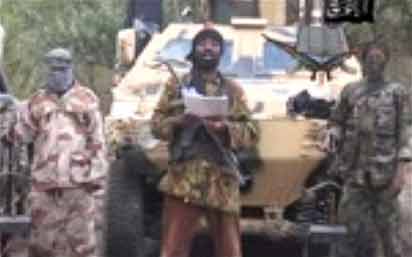
FILE PHOTO: Suspected terrorists arrested while attempting to escape into Cameroon through Taraba and Gumti, Adamawa State.
A university lecturer, Mallam Kachallah Bolori, tasked the AI on the reason it was not busy in the US and Europe, where the weapons and machines used by Boko Haram are manufactured. He wanted to know why the AI had not called for the trial of President Barack Obama, Prime Minister David Cameron and other western leaders, together with their military commanders, for their sins in Libya, Syria, Iraq, Afghanistan, Pakistan, Somalia, Yemen and Ukraine. He wondered if the AI could help the Nigerian Army in the front lines by identifying Boko Haram members, to make things easy for the soldiers fighting the terrorists.“> Bolori advised that AI should not limit itself to sneaking around detention facilities, liberated villages, towns, and stop giving dollar bills to poor people to come up with scripted stories drafted in Amnesty office. He said: “AI loves crisis, wars, conflicts and chaos. Many reports have been made in our newspapers and television; can it claim to know more than our reporters?”“
A former Delta State Commissioner for Youths Development, Comrade Omolubi Newuwumi, condemned, in the strongest terms, the AI’s allegation of genocide against Nigeria Army, saying the organisation had lost relevance and credibility with the lopsided and outright blackmail against the army. Omolubi asked the organization to define what genocide is and tell the world when it became an offence for a nation to defend itself against external and internal aggression, and fight a group which has killed, maimed and destroyed thousands of people and properties without any just cause.“Similarly, the Coalition of Civil Society Group (COSG) rubbished the AI report. Speaking when it paid a solidarity visit to the Defence Headquarters (DHQ) in Abuja, president of COSG, Etuk Bassey Williams, said after their own analysis and assessment, the coalition came out with the verdict that the report was devoid of truth, and aimed at discrediting the Nigerian military war against terrorism.
On its part, a pro-democracy and human right group, Community Agenda for Peace (CAP), berated AI, describing the report as a tacit means to destabilise and demoralise the soldiers battling Boko Haram in the North-East.
Boko Haram insurgency in Nigeria: 2013 fatalities
January 1 – Nigerian Army raid kills 13 militants.
January 4 – Ogun prison break, 15 inmates are freed in a prison break in Ogun State. Boko Haram is not suspected to be involved in the attack.
February 8 – Attack on polio vaccinators kills 9 women.
March 18 – 2013 Kano bus bombing, between 22 and 65 people are killed in Kano by a car bombing.
April 16 – 2013 Baga massacre, 187 people are killed in Baga in Borno State. It is unclear whether the Nigerian military or Boko Haram is responsible for the massacre.
June – 9 children are killed in Maiduguri and 13 students and teachers are killed in Damaturu by Boko Haram.
June 30 – Ondo prison break, 2 people are killed and 121 inmates escape following a prison break in Ondo State. Claims that Boko Haram took part in the attack are dispelled.
July 6 – Yobe State school shooting, more than 42 are killed by Boko Haram gunmen in a Yobe State school.
August 12 – 56 people are killed by Boko Haram in a Maiduguri mosque.
September 12 – Ambush by Boko Haram leaves 40 soldiers dead.
September 12–18 – An offensive by Nigerian Army leaves 150 Islamists and 16 soldiers dead.
September 19 – Benisheik attacks, 161 are killed in attacks blamed on Boko Haram.
September 20 – An Abuja shootout leaves 7 killed.
September 29 – Gujba college massacre, more than 50 students are killed in Yobe State by Boko Haram gunmen.
October 10 – An attack at Damboa leaves at least 20 killed (15 suspected militants and 5 civilians)
October – Government forces raid rebel camps, killing around 101 Boko Haram fighters.
October 29 – Boko Haram raids Damaturu. At least 128 people are killed (95 militants, 23 soldiers, 8 policemen, and 2 civilians).
2014 fatalities
January 14–30 people are killed in a bombing by Boko Haram militants in Maiduguri, Borno State.
January 26 – January 2014 Northern Nigeria attacks, 138 killed in total
January 31 – 11 Christians killed in Chakawa by Boko Haram militants.
February 14 – Borno Massacre, 121 Christian villagers killed by Boko Haram militants in Konduga, Borno State.
February 15 – Izghe attack, 106 killed the village of Izghe, Borno State by Boko Haram gunmen.
February 15 – 90 Christians and 9 Nigerian soldiers are killed in Gwosa by Boko Haram.
February 24 – Dozens killed as Boko Haram again raids Izghe.
February 25 – Federal Government College attack, 59 students killed in a school massacre in Yobe State.
March 14 – Boko Haram attacks the heavily fortified Giwa military barracks in Maiduguri, freeing comrades from a detention facility. The military then executes about 600 unarmed recaptured detainees, according to Amnesty International.
April 14 – April 2014 Abuja bombing, over 88 people killed in a twin bombing attack in Abuja.
April 15 – Chibok schoolgirls kidnapping, 276 female students in Borno State are kidnapped by Boko Haram.
May 1 – May 2014 Abuja bombing, 19 killed in Abuja by a car bomb.
May 5 – 2014 Gamboru Ngala attack, at least 300 people are killed in the twin towns of Gamboru and Ngala in Borno State by Boko Haram militants.
May 20 – 2014 Jos bombings, at least 118 villagers are killed by car bombs in the city of Jos.
May 21 – 27 villagers are killed by Boko Haram gunmen in northeastern Nigeria.
May 27 – May 2014 Buni Yadi attack, 49 security personnel and 9 civilians are killed during a Boko Haram attack on a military base in Yobe State.
May 30 – The third emir of Gwoza, Idrissa Timta, is assassinated during a Boko Haram ambush.
June 1 – 2014 Mubi bombing, at least 40 people are killed by a bomb in Mubi, Adamawa State.
June 2 – Gwoza massacre, at least 200, mostly Christians, are killed in several villages in Borno State by Boko Haram.
June 20–23 – June 2014 Borno State attacks, at 70 people are killed and 91 women and children kidnapped by Boko Haram militants in Borno State.
June 23–25 – June 2014 central Nigeria attacks, around 171 people are killed in a series of attacks in the Middle Belt of Nigeria.
June 26 – Over 100 militants are killed by the Nigerian military during a raid on two Boko Haram camps.
June 28 – 11 people are killed by a bomb in Bauchi.
July 18 – At least 18 are killed by a Boko Haram attack in Damboa, leaving the town almost destroyed.
July 22 – 51 people are killed by Boko Haram in Chibok.
September 19 – Around 30 people are killed by Boko Haram militants at a busy market in Mainok, Borno State.
October 10 – Lagos prison break, one inmate is killed following a failed attack to free inmates in a Lagos prison. Boko Haram is not suspected to be involved in the attack.
October 31 – At least 4 people are killed, 32 injured and 13 vehicles destroyed by an explosion at a bus station in Gombe.
November 2 – Kogi prison break, 99 inmates in Kogi State are freed by suspected Boko Haram rebels.
November 3–10 – 2014 Yobe State attacks, a double suicide bombing in Yobe State kills 15 Shiites on the 3rd and 46 students on the 10th.
November 25 – Over 45 people are killed by two suicide bombers in Maiduguri, Borno State.
November 27 – Around 50 people are killed in Damasak by Boko Haram militants.
November 28 – 2014 Kano bombing, at least 120 Muslim followers of the Emir of Kano, Muhammad Sanusi II, are killed during a suicide bombing and gun attack by Boko Haram. The 4 gunmen are subsequently killed by an angry mob.
November 30 – Ekiti prison break, 274 inmates escape a prison in Ekiti. Claims that Boko Haram perpetrated the attack are refuted.
December 1– 5 people are killed by two female suicide bombers who detonated explosions at a crowded market place in Maiduguri, Borno State.
December 6 – Minna prison break, 270 prisoners are freed from a prison in Minna. Boko Haram is not suspected to be involved in the attack.
December 10 – At least 4 people are killed and 7 injured by female suicide bombers near a market in Kano.
December 11–30 people are killed and houses are destroyed by Boko Haram militants in Gajiganna, Borno State.
December 13 – 2014 Gumsuri kidnappings, between 32 and 35 are killed and between 172 and 185 are kidnapped by Boko Haram in Borno State.
December 22 – 2014 Gombe bus station bombing, at least 27 people are killed at a bus station by a bomb in Gombe State.
December 28–29 – December 2014 Cameroon clashes, 85 civilians, 94 militants, and 2 Cameroonian soldiers are killed following a failed Boko Haram offensive into Cameroon’s Far North Region.
2015 fatalities
January 2 – Boko Haram militants attack a bus in Waza, Cameroon, killing eleven people and injuring six.]
January 3–7 – 2015 Baga massacre, Boko Haram militants raze the entire town of Baga in north-east Nigeria. Bodies lay strewn on Baga’s streets with as many as 2,000 people having been killed. Boko Haram now controls 70% of Borno State, which is the worst-affected by the insurgency.
January 3 – Fleeing villagers from a remote part of the Borno State report that Boko Haram had three days prior kidnapped around 40 boys and young men.
January 5 – News emerges that two days prior hundreds of Boko Haram militants had overrun several towns in northeast Nigeria and captured the military base in Baga.
January 9 – Refugees flee Nigeria’s Borno State following the Boko Haram massacre in the town of Baga. 7,300 flee to neighbouring Chad while over 1,000 are trapped on the island of Kangala in Lake Chad. Nigeria’s army vows to recapture the town, while Niger and Chad withdraw their forces from a transnational force tasked with combating militants.
January 10 – A female suicide bomber, believed to be aged around 10-years-old, kills herself and 19 others, possibly against her will, at a market in the northeastern city of Maiduguri, Nigeria.
January 11 – More female suicide bombers, this time two, and again each believed to be around 10 years old, kill themselves and three others at a market in the northeastern city of Potiskum, Nigeria.
January 12 – January 2015 Kolofata raid, Boko Haram militants launch a failed raid on Kolofata in Cameroon. The Cameroonian military claims the army lost only one officer while the Islamic group lost between 143-300 rebels.
January 16 – The Military of Chad enters Cameroon to assist in fighting against Boko Haram insurgents.
January 17 – Following the January 16 Chad authorities decision to send troops to Nigeria and Cameroon to fight Boko Haram militants, the Russian ambassador to the country pledges to supply Cameroon with more modern weapons to combat the Islamist insurgents.
January 18 – Boko Haram militants kidnap 80 people and kill three others from villages in north Cameroon.
January 20 – Boko Haram leader Abubakar Shekau claims responsibility for the attack on the town of Baga, Nigeria in which an unknown number of civilians were killed.
January 24 – 15 people are killed as Boko Haram gunmen attempt to burn down the village of Kambari near Maidaguri.
January 25 – Boko Haram rebels launch a large offensive against Nigerian forces in Maiduguri, the capital of Borno State, leading to the deaths of at least 8 civilians, up to 53 militants, and an unknown number of soldiers. Although the attack fails, the rebels manage to capture the nearby strategic town of Monguno. The status of the 1,400 soldiers stationed in Monguno is unknown. As a result of these attacks, Boko Haram now controls four out of five roads leading into the major city, prompting fears that it will be taken as well.
January 28 – Boko Haram fighters killed 40 people while on a rampage in Adamawa State.
January 29 – The Nigerian military, in collaboration with Chadian soldiers, captures the border town of Michika from Boko Haram rebels.
January 31 – The African Union pledges to send up to 7,500 international soldiers to aid Nigeria’s fight against Boko Haram. Chadian forces claim to have killed 120 Boko Haram fighters while losing only 3 soldiers of their own during fighting in the north of Cameroon.
February 1 – Boko Haram again attacks the capital city of Borno State, Maiduguri. This time, the city is attacked from four out of the five sides. The attack is unsuccessful, but many civilians inside the city panic.
Also, a suspected Boko Haram suicide bomber kills himself and eight others at the residence of a politician in Potiskum. Another suicide bomber kills five people outside a mosque in Gombe.
February 2 – A female suicide bomber attacks minutes after the President of Nigeria leaves an election rally in the city of Gombe resulting in at least one death and eighteen people injured.
February 4 – Boko Haram militants reportedly raid the Cameroonian town of Fotokol in Cameroon’s Far North Region with scores of people killed. Also on February 4th, the Chad Army claims to have killed 200 militants and lost nine soldiers while capturing the border town of Gamboru Ngala.[58][59]
February 6 – 2015 Niger raid, Boko Haram forces launch raids on the towns of Bosso and Diffa, both in Niger, marking the first time that the group has attacked the country. The Chadian military assists the Nigerien Armed Forces in repelling the attack. 5 Nigeriens are killed while the government claims 109 Boko Haram militants are killed as well.
February 7 – Nigeria postpones its general election for six weeks to allow its armed forces to control parts of the country currently controlled by Boko Haram.
February 9 – Boko Haram launch a raid on a prison in the town of Diffa in Niger. Authorities repel the attack.
February 12 – The West African Allied Forces, led by Nigeria and supported by Cameroon, Chad, and Niger, invade the Sambisa Forest in Borno State, a stronghold of Boko Haram, killing scores of the insurgents. Elsewhere, the town of Mbuta, 15 miles northeast of Maiduguri, is raided by Boko Haram, resulting in the deaths of 8 residents. A dozen people are also killed in a suicide blast at Biu, 100 miles southwest of Maiduguri.
February 13 – Boko Haram militants attack Chad for the first time after 30 fighters crossed Lake Chad in four motorboats and attacked the village of Ngouboua. Chad recently joined Nigeria, Niger, and Cameroon in a military coalition against Boko Haram.
February 14 – Boko Haram forces assault Gombe, the capital city of Gombe State, for the first time. The Nigerian military repels the attack, although the militants managed to overrun a checkpoint on the edge of the city before retreating. The attack coincides with the beginning of a Nigerian offensive to rollback Boko Haram forces around the northeast.
February 15 – A suicide bomber kills 16 and wounds 30 in the Nigerian city of Damaturu.
February 16 – Nigeria regains the key town of Monguno from Boko Haram. The town had previously fallen to the militants on January 25th.
February 18 – The Nigerian Army claims to have killed 300 militants in northeastern Nigeria. A warplane bombs a funeral ceremony in Niger killing 37 civilians. The warplane remains unidentified, with the Nigerian government denying responsibility.
February 20 – Boko Haram militants kill 34 people in attacks across Borno State, 21 from the town of Chibok.
February 21 – Nigerian army retakes Baga, which had fallen to Boko Haram on January 3rd.
February 22 – A suicide bomber kills five and wounds dozens outside a market in Potiskum.
February 24 – Two suicide bombers kill at least 27 people at bus stations in Potiskum and Kano.
February 24 – Chadian soldiers kill over 200 Boko Haram fighters in a clash near the town of Garambu, close to Nigeria’s border with Cameroon. One Chad Army soldier is killed and nine are wounded.
February 26 – At least 35 people are killed in two attacks targeting the cities of Biu and Jos.
February 28 – Two female suicide bombers kill up to four civilians near Damaturu.
March 2 – A senior military officer claims that 73 Boko Haram militants disguised as herders were killed near Kondunga town in Borno State. In addition, the Chadian military recaptures the town of Dikwa, also in Borno State.
March 7 – Five suicide bomb blasts leave 54 dead and 143 wounded in Maiduguri. After the explosions, Boko Haram formally declares allegiance to Islamic State.
March 8 – Forces from Niger and Chad launch a ground and air offensive against Boko Haram Islamist militants in northeastern Nigeria.
March 9 – Chadian and Nigerien forces retake the towns of Malam Fatouri and Damasak in northeastern Nigeria.
March 13 – The Nigerian government admits to using foreign mercenaries in the fight against Boko Haram.
March 16 – Nigeria, Chad, and Niger begin a battle to liberate Damasak from Boko Haram militants.
March 17 – The Nigerian military reclaims the small city of Bama from Boko Haram.
March 18 – Niger and Chad capture the city of Damasak following a successful battle. A mass grave of 90 people is discovered in the city.
March 21 – Chadian forces establish a presence in the border town of Gamboru following recent attacks there by Boko Haram gunmen that killed 11 people.
March 27 – The town of Gwoza is recaptured by the Nigerian military.
March 28 – Voters in Nigeria go to the polls for a general election. Gunmen kill at least 15 voters including an opposition house of assembly candidate for Dukku in Gombe.
March 29 – Voting in the Nigerian general election is delayed for a second day due to delays and malfunctioning equipment. So far, 43 people have died in Boko Haram attacks.
April 24 – Last area controlled in Nigeria by Boko Haram’s forces is in the Sambisa forest.
June 12 – Several days of nighttime raids on six remote villages that left at least 37 people dead in Northeastern Nigeria.
June 16 – Twin Suicide Bomb attacks in Chad capital – twin suicide bombings blamed on Boko Haram jihadists killed 24 people and wounded more than 100 in the first such attacks in Chad’s capital N’Djamena. Monday’s attacks, which targeted the police headquarters and a police academy, were the first in the capital.
Disclaimer
Comments expressed here do not reflect the opinions of Vanguard newspapers or any employee thereof.