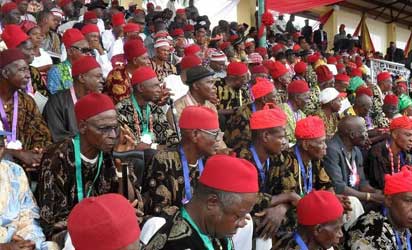
Igbo Chiefs
By Douglas Anele
As a result, they casually downplay the significance of the civil war for national integration or mischievously misinterpret any reference to its impact on Igboland and the need for restitution as an attempt to create division among Nigerians. But how many Nigerians have thought about the implications of the fact, noted by Prof. Achebe, that there were more small arms used on Biafran soil than during the entire five-year period of the Second World War or that there were one hundred thousand casualties on the much larger Nigerian side compared with more than two million – mainly children – Biafrans killed? If Gowon was serious about his “no victor, no vanquished” slogan and genuinely wanted reconciliation with the defeated Biafrans, why did his government implement extremely harsh measures against Ndigbo after the conflict? For Ndigbo who suffered the greatest from the civil war, whose land was strafed, bombed and devastated, the terrible experiences of 1966 to 1970 remain a recurrent source of sadness and inspiration simultaneously: sadness, because they were the ones that lost almost everything; inspiration, given the inherent capacity of humans to turn adversity into opportunity.
No matter how Igbophobic Nigerians feel about it, Ndigbo will never allowtheir collective memory of the civil war vanish into historical oblivion because it is the single most traumatic event in their over six thousand years history. Keep in mind that despite the Nuremberg trials which bought some former Nazi officials to justice, continuing efforts by the West led by the United States to protect Israel, and the relatively cordial relationship between Germany and the Jewish nation presently, no Israeli would dream of forgetting the Nazi holocaust that took place over seventy years ago, or belittle its significance in shaping the future of Israel. Ndigbo must take a cue from the Jews: they must never stop talking about their horrifying experiences during the pogroms and the civil war until justice, though belated, is done or, at the very least, some restitution is made by the Nigerian state. They must continue to remind fellow Nigerians of the genocide against Biafrans and the need to correct historical injustices meted out to them so that the process of national healing and reconciliation can truly begin.
But how can justice be done to the Igbo, considering the corrosive effect of time and the fact that some of the key players on both sides of the conflict are dead? Ideally, the starting point is to prosecute those who took part in the was – both military and civilian – at the International Court of Justice for war crimes, especially against Biafrans. However, I know that will never happen:Nigeria is yet to evolve the appropriate ethnically neutral political consciousness and moral stamina required to carry through such a noble task. In addition, leading world powers that supported the federal forces during the war, especially Britain and the United States, will definitely subvert such a move; it is in their interest that Nigeria remains politically unstable and economically dependent on the West.
A strong, politically mature and industrialised black African country would deflate the myth of white supremacy and realign existing power relations in the international plane. I submit that the single most important lesson from Walter Rodney’s provocative book, How Europe Underdeveloped Africa, is that the Western world will not voluntarily allow any black nation to emerge as a world power. The current lopsided international system in which Nigeria and other African countries are economically and industrially tied to the apron strings of the West, euphemistically called globalisation, is consonant with its covert white supremacist ideology.
 Therefore, the high-level representation of Britain and America during the inauguration ceremonies of President Muhammadu Buhari recently is largely a public relations display intended to hoodwink the unwary. From experience, the two countries facetiously make gestures of goodwill towards every new administration in Nigeria, with the exception of late Gen. Sani Abacha’sgovernment. Yet, when it comes to concrete steps to offer real assistancethat would really transform the fundamentals of Nigeria’s economy, theyuse subterfuges to avoid such responsibility. I predict that if Buhari’s government for whatever reason draws closer to China and Russia, America and Britain would orchestrate one crisis or another to frustrate it.
Going back to the question of justice for the Igbo and her neighbours, since prosecuting perpetrators of genocide against Biafrans is out of the question, the more realistic option is for the federal government to formulate a master plan for massive infrastructural and industrial development of the Biafran enclave. After all, Gen. Gowon’s post-war policy of Reconstruction, Rehabilitation and Reconstruction was never really implemented. As a result, even forty-five years after the civil war ended, the South-East geopolitical zone has the least federal presence, in terms of developmental projects and heavy industries, in the country. That said, it is still possible to invoke the three R’s as a principle for something like a Marshall Plan for Igboland.
Now, my concept of Igboland is more extensive geographically than the current South-East, the latter being apremeditated emasculation and falsification of the true size of the Igbo inNigeria. Authentically, Igboland extends from the five South-Eastern statesto all the Igbo-speaking areas in Rivers, Delta, Bayelsa and Cross River states, never mind the misguided attempts by Northern dominated military regimes to marginalise Ndigbo territorially. Considering that, I must express profound disappointment with prominent and influential Igbo leaders for not embarking on consciousness-raising activism to use Biafra as a rallying symbol for Igbo renaissance. What I advocate is different from organisations such as Mass Mobilisation for the Actualisation of the Sovereign State of Biafra (MASSOB), Ohaneze Ndigbo and Aka Ikenga which have become tools used by some Igbo for selfish survivalist political and economic negotiations in the existing lopsided federation.
In my humble opinion, the spirit of Biafra can be creatively adapted by Ndigbo to ignite positive psychological and ideological revolution in all Igbo-speaking areas of the former Eastern region, which would also be extended to their close neighbours. For the Igbo to occupy their rightful place in Nigeria, all Igbo speaking communities must set aside artificial animosities and cleavages deliberately orchestrated by Igbo haters to divide them and forge a collective vision for Igbo renaissance preferably within Nigeria. My call for unification of Ndigbo wherever they might be may seem far-fetched and unrealistic considering the ugly divisive experiences of Biafran war and sustained efforts beginning from Gowon’s administration to put a wedge between Igbo communities in the present South-South states and their brothers and sisters in the South-East geopolitical zone.
Still, with creative imagination, clear vision, and selfless service by prominent Igbo sons and daughters, the vision of a resurgent Igbo nation living in peace and harmony with fellow Nigerians is realisable. Unfortunately, progressively since the civil war ended, Igbo leaders have failed to fashion a realistic and workable blueprint for collective Igbo unity. The unflattering condition of Ndigbo in the present scheme of things is partly due to the selfishness and narrow-mindedness of so-called Igbo leaders of thought. But the voting pattern in the last presidential election has proved that, despite their inherent individualism and republicanism encapsulated in the expression, Igbo enwe eze, Ndigbo can come together and reach a consensus on any issue when their collective interest is at stake. It has also blown to smithereens the false claim that the Igbo intend to dominate their close neighbours. Considering the way different ethnic groups voted and the outcome of the March 28 election, Nigeria is back to the pre-civil war political situation. Therefore, the real question is – have we learnt from our past mistakes? Concluded.
Disclaimer
Comments expressed here do not reflect the opinions of Vanguard newspapers or any employee thereof.