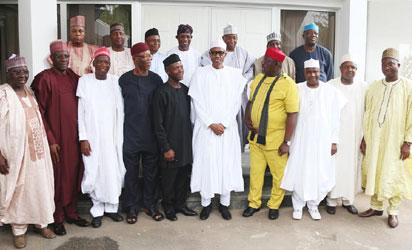
BUHARI MEETS APC GOVS/GOVS-ELECT—Front row from left: Govs Tanko Al-Makura (Nasarawa); AbdulFattah Ahmed (Kwara); Abdullahi Umaru Ganduje (Kano); National Chairman APC; Chief John Odigie Oyegun; Vice President-elect, Prof Yemi Osinbajo; President-Elect; Gen. Muhammadu Buhari; Gov. Rochas Okorocha (Imo); Speaker and Sokoto Governor Elect, Aminu Tambuwal; Kebbi Governor-Elect Senator Abubakar Bagaudu Atiku and Deputy Governor-Elect, Ngeri. Back row: Governor Kashim Shettima (Borno); Muhammad Bundow Jubrilla (Adamawa); Kaduna State Governor-Elect, Nasir El-Rufai; Governor Rauf Aregbesola (Osun); Governor Mohammad Abubakar (Bauchi); Plateau State Governor-Elect, Simon Lalong and former Governor of Ekiti State Dr. Kayode Fayemi when the President-Elect met APC governors and governors-elect, yesterday in Abuja to kick-start the new government as May 29 hand-over date approaches. Photo: Sunday Aghaeze.
By Ochereome Nnanna
The All Progressives Congress, APC, is the new ruling party in Nigeria, right? Yes and no. Yes, because it is the party that defeated the Peoples Democratic Party, PDP, at the 2015 general elections, winning the Presidency and installing governors in 22 of the 36 states of the federation. It is the party with majority of members in both the Senate and House of Representatives. It will consummate the mandate of the electorate and call the shots for the next four years.
Again, yes, because it is a duly registered political party. But in truth, the APC is still a coalition or a gang-up which hurriedly came together to get the former ruling PDP, which had become internally decadent, out of power. But this coalition, after coming together to slay the elephant, could not install its carefully handpicked candidates to head the Senate and House of Representatives. Its national leadership was irreverently defied by forces within the party. The leadership threatened fire and brimstone, but at the end of it all, found itself impotent to reverse what happened. It eventually ate the humble pie and accepted defeat. What manner of political party is that which has no control over its members? The answer is quite simple. The APC is not yet a political party. It is still only the coalition that pushed out the former behemoth, the PDP.
A political party’s primary attribute is that it is a congre-gation of like-minds. There must be over-riding common interests for which its members come together to contest for power. Take these samplers. The defunct National Council of Nigerian Citizens, NCNC, was formed primarily as a nationalist and Pan-Africanist vanguard to drive away the colonialists and build a nation in which tribe, religion and region would not be a hindrance to the aspiration of any Nigerian. It was supposed to bring the re-enactment of the American dream here in Nigeria and Africa.
The Action Group, AG, was meant to give the Yorubas a strong place in an independent true Nigerian federation, where each federating unit would be free to aspire to its dreams at its own pace, unhindered by how others chose to proceed. The Northern People’s Congress, NPC, was formed to unite the North under the sophisticated Muslim empire, the Sokoto Caliphate founded by Sheikh Usman Dan Fodio, to ensure that the North capitalised on its geopolitical advantages to dominate an independent Nigeria. The Northern Elements Progressives Union, NEPU, was formed to cater for the interests of the lower classes and the downtrodden, especially in the North.
The PDP and APC, being political parties that took their roots after a hurried military transition to civil rule in 1999, have no such vision and mission. The PDP’s take-off as a political party was truncated by the imposition of General Olusegun Obasanjo, who converted it into a mere election-winning machine without a purpose in government and power. Whoever failed to win PDP’s ticket ran away to look for one in another party, and whether they won or lost, they returned to the PDP, at least to ensure their future prospects of remaining in power.
The APC is still at its rawest form. Beyond the fact that it was able to mob the PDP out of power, there is very little in it to call it a “party”. What the National Publicity Secretary of the APC, Alhaji Lai Mohammed, glibly kept referring to as “the party” was nothing but merely a section of the APC which is in control of its national secretariat. That section is controlled by men implanted by the National Leader of the APC, Alhaji Bola Ahmed Tinubu, with the tacit approval of President Muhammadu Buhari.
The reason why Tinubu’s section of the party failed to install Ahmed Lawan as the President of the Senate and Femi Gbajabiamila as the Speaker, House of Representatives, was because he failed to accommodate the interests of the “new” PDP (nPDP) faction of the APC, and the latter pulled its strings. The lesson that “the party” (Tinubu and his men in the national executive of the APC) must learn from now henceforth, is to carry all the factions of APC along in all their power-sharing activities. After all, it was because of this power that they all came together to shove aside PDP. Tinubu must remain acutely aware that in the APC, there are the Action Congress of Nigeria, ACN; the All Nigerian Peoples Party, ANPP; the Congress for Progressive Change, CPC; the nPDP and other fringe elements belonging to Governors Adams Oshiomhole of Edo State, Rochas Okorocha of Imo State and former governors Chris Ngige of Anambra State and Rotimi Amaechi of Rivers State.
Tinubu must now consult and negotiate with these groups and ensure they are given a sense of belonging or they will gang-up against him. Tinubu will increasingly become the butt of envious conspiracies, and the impulse to “cut him to size” will become increasingly irresistible, especially seeing how easily he was beaten in the sharing of the Senate and House positions. Tinubu must rebrand himself and let people who depict him as a self-centred, acquisitive and power-hungry leader know they are mistaken.
APC can still become a true political party beyond being a mere election-winning platform. As time goes on, the party is likely to split. Atiku Abubakar’s unbridled ambition could lead him to take a large section of the nPDP with him back to PDP sometime around 2017 in readiness to challenge Buhari in 2019. The rest of the party will cluster around President Buhari, the “man with the yam and knife”. When that happens, most of the Northern politicians now hiding in the shadows would come into the limelight to paddle the canoe of the Buhari APC. When that time comes, even some of today’s “Tinubu boys” who rose to be governors and occupied various high positions in government on his ticket will be in the Buhari APC boat paddled by Northerners.
Don’t say I did not tell you.
Disclaimer
Comments expressed here do not reflect the opinions of Vanguard newspapers or any employee thereof.