By Emma Amazie, Emman Ovuakporie & Johnbosco Agbarakwu
ABUJA—The House of Representatives, yesterday, passed the Petroleum Industry Bill, PIB, on the last legislative day of the Seventh National Assembly. However, the failure of the Senate to give its concurrence made the epochal decision of the House of Representatives of no effect. Senate Leader, Senator Victor Ndoma-Egba, SAN told Vanguard last night that the failure of the Senate made the development in the House of Representatives of no effect.

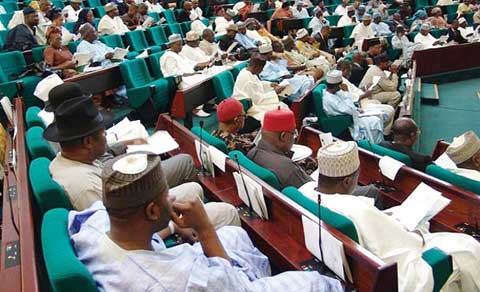
House of Representatives during plenary
The House had, Tuesday, suspended the consideration of clause 209 of the PIB, due to contentious issues. But on resumption of the consideration of the ad-hoc committee’s report, the outgoing members chorused ‘aye’ when the Deputy Speaker, Emeka Ihedioha, put the questions on each of the clauses.
He said that the House took painstaking steps in constituting the ad-hoc committee on PIB to reflect the diverse interests of the country. “I want to believe that the House has done its best and represented our constituencies very well. Barring last minute unforeseen circumstances, today may be our last sitting day.”
Ihedioha had, Tuesday, expressed displeasure over the politicking during debate on the bill during the consideration of some of the clauses. Vanguard recalls that the PIB was killed on the last legislative day of the 6th Assembly in 2011. The ad hoc committee led by the House Chief Whip, Rep Ishaku Mohammed Bawa, PDP, Taraba had presented the report, in March 2015 after almost three years.
The committee had scrutinised the 363 sections and annexure of the original bill and made some amendments and recommendations. The 23-member ad hoc committee had held public hearings in the six geopolitical zones, including the Federal Capital Territory, FCT, which afforded stakeholders and general public the opportunity to make contributions to the proposed law.
The original bill covered salient areas such as establishment of the Petroleum Equalisation Fund, incorporation of National Gas Company, establishment of petroleum directorate and National Asset Management Company as well as imposition of new tax regime such as Nigeria Carbon Tax. In the report, the committee recommended the “complete removal” of section 191 of the bill that gives the president discretional powers to grant petroleum licences and lease and instead proposed biddings for the award of licences.
The bill in its original objectives had sought to create a conducive environment for the industry, to optimise domestic gas supplies and promote community-industry relations, among others. Reacting to the development, yesterday, Rep. Friday Itulah, PDP, Edo State, described PIB as good as dead since both legislative houses did not harmonise it.
“Though we recommended that the 8th Assembly should continue from where we stopped, it is not binding on them. “We can’t impose it on the 8th House, but if they choose to continue that will be just okay.” Speaking on why the Senate could not pass the bill, Senator Ndoma-Egba, the Senate Leader said that the Senate commenced deliberation on the bill quite later than the House of Representatives.
He said the passage by the House was of no effect. Senator Babafemi Ojudu, All Progressive Congress, APC, Ekiti said that the Senate did not pass the PIB because it was not brought up and the Senate did not have it.
Reactions
Mixed reactions last night trailed the passage of the PIB by the House of Representatives. National coordinator of the Host Communities Producing Oil and Gas, HOSTCOM, Prince Maikpobi Okareme, said, “On behalf of the host communities, I commend the House of Representatives for passing the PIB.”
He, however, said the 7.5 per cent Host Community Fund, HCF, approved for host communities fell short of the 10 per cent recommended by a joint committee of the Senate and House of Representatives on the PIB.
“My position is that the next Senate should adopt the 10 per cent proposed by the joint committee of the two lawmaking chambers because the outgoing Senate amended its rules for it to inherit all bills. “The next Senate should continue from where the former stopped with the third reading,” he added.
The Ijaw Youth Congress, IYC, speaking through its spokesperson, Mr. Eric Omare, said the PIB passed by the House of Representatives was of no consequence to the people of Niger-Delta.
He urged the Senate to reject the PIB as passed by the House of Representatives because it does not represent the wishes of the people. Omare said the House of Representatives also redefined host communities to mean any community that oil pipeline traverses in the country, saying, “this is contrary to the definition of host communities in the NDDC Act.”
Disclaimer
Comments expressed here do not reflect the opinions of Vanguard newspapers or any employee thereof.