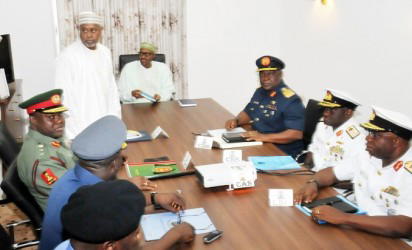
FILE: PRESIDENT MUHAMMADU BUHARI WITH SERVICE CHIEFS DURING A MEETING AT THE DEFENCE GUEST HOUSE IN ABUJA ON TUESDAY
By Is’haq Modibbo Kawu
I attended Kashim Shettima’s inauguration for a second term as governor of Borno State last weekend in Maiduguri. There was colour as to be expected of Borno; but there was also a somber thread to Governor Shettima’s thought as expressed in the opening sequence of his speech.
It was understandable against the backdrop of a six-year insurgency and the indescribable levels of destruction of lives and property that Borno has witnessed. How the people have managed to continue to get by, smile and laugh, hope and work, must be great advertisement for the human spirit.

PRESIDENT MUHAMMADU BUHARI WITH SERVICE CHIEFS DURING A MEETING AT THE DEFENCE GUEST HOUSE IN ABUJA ON TUESDAY
They even put up the famous Borno Durbar on Saturday but the backdrop had been two hours of firing of mortars and anti-aircraft weapons into Maiduguri, between midnight and 2am. By Saturday afternoon, Maiduguri witnessed two suicide bombings and the casualty figure began to mount.
It seemed Boko Haram had chosen to test the resolve of Nigeria’s new president, Muhammadu Buhari. He, afterall, had vowed to crush the insurgency and security would become a major item in what must be a full in-box for the new president.
But things had appeared too slow at the beginning when there were no announcements of the first appointments of aides by the President within the first 48 hours. Thankfully by late Sunday evening, we knew the spokespersons and the Chief of Protocol.
For Buhari, not even the best preparation can be enough to take in the enormity of troubles that Nigeria can throw at its president. Unlike when he first came to power in December 1983, Nigeria of 2015 possesses a completely different picture in practically every endeavour. There is first of all the issue of demography; 75% of the population is under the age of 35.
Incredibly enough, this is the majority of our population that chose to believe in Buhari’s message of change; they were his often, unpaid advocates and defenders in cyberspace and it was this generation of Nigerians in the main, who also voted massively and whose votes midwifed the administration of change! Buhari must discover the creativity to keep the young on side by making their aspirations for education, skills and jobs the central concern of his administration. Unfortunately, these cannot be easy, given the depth of rot that he has inherited.
This is the reason why I do feel worried for him.In the age of social media and of very restive youth, the honeymoon period for the administration cannot be very long.
To underline the central place of security in the new architecture of governance, Buhari met the security chiefs by Tuesday this week and would be setting out into our neighbouring countries of Niger and Chad, without doubt, to strengthen regional cooperation in the fight against the Boko Haram insurgency.
It is heartwarming that Buhari chose the “near abroad” as the first places to visit, thus setting a tone for what hopefully, might likely become a trend into the future. Buhari’s presidency must deliver on security, which was one of the central points that he canvassed during the campaign.
The Chibok Girls must return home so that we can find closure; the Nigerian armed forces should be given a new fillip in order to finish off the insurgency and the decision to move the command centre of the counterinsurgency to Borno is a most useful step in that direction. Nigerians want to see resolve and a much better managed security system that will reflect the military background and know-how of the new president.
This will include managing the resistance that could ensue from a military/security system that has an entrenched interest in keeping things going as they have so disastrously gone, under the Goodluck Jonathan administration.
If the security reform envisaged can be described as a familiar terrain for President Buhari, it is clear that his most difficult decisions will have to be made in re-positioning the economy. Nigeria is in a very bad way economically and there can be no prettifying the position.
This is where Buhari will deal with the largest collection of banana peels. Can we get by with an economic structure programmed to create the levels of inequalities and frightening destitution that are the hallmarks of Nigeria’s social existence today? And can the uncritical surrender to the market and neo-liberal orthodoxy (in short, more of the same)be the way to pull out of the current crises that we face? Or will the Buhari administration find other pro-people means to stem the slide into an anarchic state of nature? How will the interests of the imperialist powers influence choices made in economic management? This isn’t an idle question because, on Sunday, President Buhari will be travelling out to attendthe G7 summit holding in Germany.
The British Prime Minister David Cameron had in fact urged Buhari to come to the summit with a “wish list”. But it was also reported that Cameron also sought Buhari’s “backing” for “free trade”, which the President’s office described as having the support of a number of countries.
But “free trade” as sought is actually not in our interest, since the Economic Partnership Agreement, EPA, between the EU and African countries seeks that African countries open up to 83% of their markets to European imports. African countries cannot compete with Europe, meaning that these imports will clearly destroy existing and future industries in Africa, including Nigeria, if Buhari accepts the invitation to “support free trade”. President Buhari is beginning to come to terms with governance.
The work at hand demands that everybody pulls in the same direction to succeed; but the political situation conditions every decision that will be made and that is never easy given the various tendencies at work!
Remembering the struggle in Western Sahara
Abuja, our nation’s capital, has this week been hosting an International Conference on Western Sahara. Titled “Towards the Liberation of Africa’s last Colony”, the conference brought progressive intellectuals, students and leaders of the Nigerian working class movement together with delegates from around the world. The African Union was there and for the first time in a long time, the world converged in Abuja for a very worthy cause in support of African liberation.
The struggle of the people of Western Sahara, officially known as Saharawi Arab Democratic Republic, SADR, is the last issue on the African Agenda of anti-colonial independence. It is a shame and a blot on the humanity of all of us, that the people of that phosphate and fisheries rich country have remained colonised, not by the Spanish, that were the original colonizers, but another African country, Morocco.
Morocco’s intransigent refusal to withdraw from its illegal annexation of Western Sahara, backed by the imperialist powers and reactionary Arab countries such as Saudi Arabia, has prolonged the suffering of the heroic Saharawi people, who have refused to accept annexation as the end of their long struggle for independence, which had a fierce armed phase, that was suspended, in pursuit of a peaceful route towards decolonisation.
This week’s international conference has come at a most poignant moment in Nigeria’s own history and it possesses a remarkably symbolic element that we must not lose sight of. It was during his first coming as Nigeria’s military Head of State, that General Buhari recognised the Saharawi Arab Democratic Republic, SADR.
Nigeria’s proactive recognition of the Saharawi struggle as basically a decolonisation issue, helped to ginger African support for SADR and the country was admitted into the Organisation of African Unity, OAU and its successor body, the African Union, AU. Nigeria’s Foreign Minister at the time, who spearheaded the recognition of SADR, was Professor Ibrahim Gambari, who would go on to post a very distinguished international diplomatic career in the United Nations system. It was Professor Gambari that delivered the keynote address at this week’s international conference.
The fact that the conference has held and has been so well attended, reflects the new dawn in Nigeria and the possibility that Nigerian Foreign Policy might be coming back to its old tradition of support for progressive human endeavours, but especially a more activist leadership for issues that affect the African continent and its peoples. Under the Jonathan administration, Nigerian Foreign Policy, if it ever really existed, had departed from its traditions of independence and support for anti-imperialist struggles. Goodluck Jonathan opposed the African consensus, by supporting the imperialists’ (USA, Britain and France) bombing of Libya in 2011, much to the chagrin of other African countries.
Blinded by his servile groveling surrender to imperialist diktat, Jonathan could not see the interconnectedness between the opening of the road to hell, which the Libyan invasion represented and the proliferation of sophisticated arms in West Africa, including inside Nigeria with the sophistication that the Boko Haram insurgency assumed after Ghadaffi was overthrown in Libya.
The same man would bow to the diktat of the Zionist state of Israel, when a mere telephone call from the utterly reactionary Israeli Prime Minister, Benjamin Netanyahu, led Jonathan to betray the Palestinian people in a vote at the United Nations.
Progressive humanity has converged in Abuja this week to remind us all that for as long as a part of the African continent is occupied, then no African country or the individual African for that matter, can claim to be free. We worked collectively to end the intransigence of apartheid and imperialism in Southern Africa, and one after the other, colonies like Mozambique, Angola, Guinea Bissau, Zimbabwe and Namibia gained independence. Similarly, the African and international resolve terminated apartheid.
The only part of our continent remaining under colonisation is Western Sahara(SADR). The new turn in Nigerian life has provided a progressive backdrop for Africans to work in a determined manner to ensure that we collectively help to ensure the complete decolonisation of the Saharawi Arab Democratic Republic. In 2009, I travelled in the camps of Southern Algeria as well as the liberated areas of Sahara to get a first hand account of the position of the Saharawi people.
What I took away from that trip was the sacredness of hope that liberation will eventually come to its people as well as the anger of the youth of Sahara, that the world is not pressurizing the Moroccans as much as they should, to end the incongruity of an African country becoming the colonizer of another African people. We must therefore assist the process that will end this blot on our collective conscience.
This week in Abuja, Nigerian students, progressive intellectuals and working people picketed the Moroccan Embassy, as part of actions in support of decolonisation of Western Sahara. It will be noted around the world, that Africans have not abandoned the Saharawi people!
Disclaimer
Comments expressed here do not reflect the opinions of Vanguard newspapers or any employee thereof.