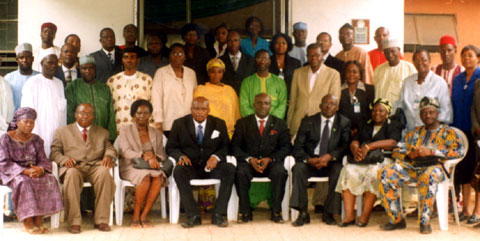
A group photograph of stakeholders.
By Amaka Abayomi & Laju Iren
Anyone familiar with the Nigeria sphere will agree that when it comes to policies, the issue is hardly ever with the policies themselves, but in the implementation. This is especially true of the education sector which, over the past few years, has seen a myriad of positive changes on paper, but an even greater avalanche of negative features in practice.

A group photograph of stakeholders.
The Basic Education Curriculum, which focuses on the first nine years of education in the 9-3-4 system, has been posited by the National Education Research and Development Council, NERDC, since 2005.
The immediate past Chief Executive Officer of NERDC, Prof. Godswill Obioma, then laid out an action plan for the implementation of the new curriculum such that, by end of school year 2015, the entire curriculum would have been implemented for all pupils and classes.
NERDC planned to commence with a new curriculum in primary one in September 2007 and gradually phase out the old primary school curriculum by 2012. It also implied that schools would concurrently commence with new curriculum in JSS 1 in September 2007 and gradually phase out old JSS curriculum by 2010. There were plans to review old school texts in compliance with the new curriculum, print and distribute necessary materials by September 2007.
There were also plans to develop new texts for new subjects and distribute such materials by September 2008. The NERDC had plans to, in collaboration with other relevant bodies, commence sensitisation of teachers and stakeholders as regards the contents of the new curriculum. But it was not to be, at least, not within the stipulated time frame. The new curriculum commenced in primary schools only last year, as a result, the old one will be not be phased out until 2020 – five years later than was originally planned.
Ironically, the NERDC, instead of resting on its oars, still seems resilient in its duty to ‘preach the gospel’ of the new BEC across the country. The Council is not alone as stakeholders, both in the public and private sectors, have their hands on deck as well. This was evident during the recently held LEARN Africa Mega Workshop for primary school teachers held in Lagos.
Director and Head, NERDC, South West Zone, Dr. Moses Salau, who was on hand to demystify the new curriculum to teachers, began by justifying the need to review the old curriculum. “We need to reduce the number of subjects these students are offering,” he said, “as it is primary school students in Nigeria are doing about 17-18 subjects which is work overload. At their level in the United States, students are taught 6 subjects, in Kenya, 7 subjects, in Uganda, 8, and in Malaysia and Indonesia, 10.
“There is also the need eliminate subjects that are now irrelevant, as well as to include and reflect national issues that are of concern in the basic education curriculum. Such issues include, Security Education, Disaster Risk Reduction Education, Climate change and Peace and Conflict Education. We have now revised the BEC into ten subjects to reduce redundancy.”
With the new development, students in primary one to four would be taught English Studies, Mathematics, Nigerian Languages, Basic Science and Technology, Pre Vocational Studies, Religion and Values Education, as well as Cultural and Creative Arts. Arabic language is also included, but as an optional subject. Students in Primary four to six will also learn the same subjects, but French Language would be included.
“The quality of education we are trying to promote at the basic level must include literacy, numeracy, manipulative, communication and life-long skills as well as a proper understanding of ethical, moral and civic values,” said Salau.
“We have had cases where people would have finished primary school but are unable to read a single sentence or solve a simple numerical sum. The issue of French Language is also pertinent because the only foreign language that most Nigerians speak is English, and that greatly limits our opportunities.”
Salau is however quick to hammer on the issue of implementation. “However beautiful the curriculum might be, if welfare and capacity building is not considered for teachers, the end result might be disastrous. In the case of not having qualified teachers to teach some new subjects, the Federal Government has to be blamed, because we gave the government enough time (since 2005) to prepare teachers for the new curriculum. We have to stop paying lip service to education else we would still continue to be in the fix we are in today.
“It is the NERDC’s mandate to put together the curriculum, government has had ample time to put the structures in place. However, despite the challenges, we will not rest but will continue pursuing the implementation with vigour. That’s why I am always enthusiastic about seminars like this to preach the gospel of the curriculum to those who are interested.”
LEARN Africa is largely responsible for development teaching and learning resources for the curriculum. MD/CEO, Mr. Segun Oladipo also agreed that teacher training is indispensable if the new curriculum is to succeed.
Disclaimer
Comments expressed here do not reflect the opinions of Vanguard newspapers or any employee thereof.