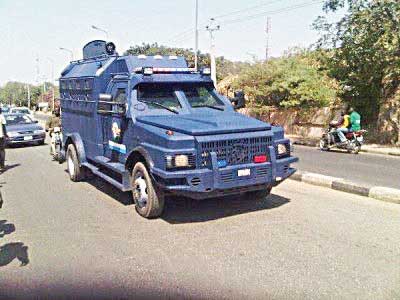
File photo: Bullion van
By JONAS AGWU
The appropriate road sign referred to by the regulations includes the maximum speed limit of 100km/ph reserved only for private cars and 90km/ph for taxis and buses while the speed limit for built up areas could be anything between 30 and 50km/ph or less.
Last week when I wrote a piece on the issue, reactions trailed it. While some commended the write-up with a reader describing bullion van drivers as indeed killers, Suleiman Sani Bala felt differently as he said, “I believe you are an official of the FRSC and you are in a position to speak on this issue. What is the position of the commission on this menace called bullion van? In your write up, you seem to be lamenting rather than proffering solution or the official position of the commission in respect of the subject. I believe that the FRSC head of media is reading this and would gladly respond to this concern.”
Meanwhile I wish to state clearly that when i set out to do this piece, my focus was to provide appropriate information as contained in the regulations to prove that bullion vans, like every other road user, must drive by the rules. That said, I can bet that, based on commentaries and observations, not one bullion van driver obeys the speed limit set for their operations; a challenge which I believe the commission must tackle through training and retraining and also through strict enforcement. No doubt, with the ongoing flying ticket campaign by the FRSC, meant to track speed limit infraction, bullion van drivers, I dare say, would populate the commission’s offenders’ database alongside other deadly drivers such as convoy drivers. I am also confident that the June 1, 2015 enforcement deadline for the use of speed limiters will tame these operators.

* Bullion vans
I must also state here that the regulations make provisions for other set of road users such as vehicles used in conveying goods. In sub section(3),it states that a person shall not ride or drive recklessly any vehicle or drive at a speed of more than 12.87 kilometres an hour, any vehicle carrying a load which projects 0.914 metres or more beyond either end of such vehicles. In keeping with best practices to cut excessive speeding which today constitutes a major challenge in our drive to cut down road traffic crashes, the regulations state that (4) a person shall not drive a vehicle on a public road which is not fitted with a speed limiter, noting in (5) that any person who acts in contravention of this regulation shall be guilty of any offence and liable on conviction to a fine or a term of imprisonment of three months or both.
Exception
There are, however, exceptions made in the regulations especially for security operatives and emergency service providers although with specific guidance. In section 153, it states that notwithstanding the provisions of sub-section (1) and (2) of section 152 of these regulations, the driver of a fire fighting vehicle, a rescue vehicle or an ambulance…,or an officer of the law who drives a vehicle while carrying out his duties or any person driving a vehicle while engaged in civil protection may exceed the prescribed speed limit provided that he drives the vehicle concerned with due regard to the safety of other road users. In the case of any such fire-fighting vehicle, rescue vehicle, ambulance or vehicle driven by a person while he is engaged in civil protection, such vehicle shall be fitted with a device capable of emitting a sound and with an identification lamp, as prescribed by the commission and such sound must be sounded and the lamp must be in operation while the vehicle is driven in excess of the applicable speed limit. I will skip the abuse of the use of siren for another day even though the recent visit of the corps marshal and chief executive of the FRSC to the Inspector General of Police and the concern raised over this trend by both excite me.
Dangerous driving
In section 167(1), the regulations address the second sore mannerism of bullion van drivers which is dangerous or reckless driving.It states clearly that a person who drives or operates a vehicle on a public road dangerously or recklessly commits an offence and shall be liable on conviction to a fine or to a term of two years imprisonment or both. Dangerous or reckless driving, according to the regulations, includes(a) causing such vehicle to travel backwards unless it can be done in safety, or cause it to run backwards for a distance or time longer than may be necessary for turning or other reasonable purpose, following another vehicle more closely than is reasonable and prudent, having regard to the speed of such other vehicle and the condition of the road, or more closely than is prescribed in the regulations and driving a vehicle between sunset and sunrise without the use of lighted lamps in addition to permitting any person, animal or object, to occupy any position on such vehicle which may prevent the driver thereof from exercising complete control over the movements of the vehicle or signaling his intention of stopping, slowing down or changing direction.
 Dangerous driving is also seen as a situation where, when driving such vehicle,the driver permits any person to take hold of or interfere with the steering or operating mechanism of the vehicle, or, when driving, occupy such position that he does not have complete control over the vehicle or does not have a full view of the road ahead. It also includes leaving the vehicle unattended on any public road with the engine running or quit the vehicle without having applied its brakes or adopting such other method as will effectively prevent the vehicle from moving from the position in which it is left and without taking precaution against the vehicle being started in his absence leaving the vehicle, if demobilised or broken down, on any public road except at the right or nearside or shoulder of the road.
There are other examples such as sleeping while driving sunset and sunrise;(i) permitting any person to ride on the wings, running boards, fender, or sides of the vehicle except for the purpose of testing the vehicle during repairs;(j) permitting, in the case of a commercial vehicle, any person to ride on the steps, tail-board, or roof of the vehicle or on any load or freight on the vehicle or on any trailer drawn thereby.
It explains it to include in (k); where a vehicle is being drawn by another vehicle, permitting any person to be carried in the vehicle being drawn except the person in charge;(l) if such vehicle is parked or is stationary at the side of the public road, driving the vehicle from that position unless he is able to do so without interfering with vehicles approaching from any direction and with safety to himself and other road users;(m) allowing any portion of his body to protrude beyond such vehicle while it is in motion on public road except for the purpose of giving any hand signal which he is required or authorised to give in terms of these regulation or unless he is engaged in examining or testing such vehicle;(n) causing or allowing the vehicle thereof to run in such manner that it emits excessive gas or fumes which would not be emitted if the engine were in good condition or ran in an efficient manner;(o) negligently or wilfully depositing or causing or permitting to be deposited any petrol or other liquid fuel or any oil or grease or other flammable or offensive matter, ashes or other refuse, of whatever nature, from such vehicle upon or alongside a public road;(p) causing or allowing the engine thereof to run while petrol or other flammable fuel is being delivered into the fuel tank of such vehicle or cause or allow such engine to be started up on before the delivery of the petrol or other flammable fuel into the fuel tank of such vehicle has been completed and the cover of such fuel tank has been replaced;(q) be asleep while driving or in control of a vehicle.
*Agwu is the spokesperson for the FRSC.
Disclaimer
Comments expressed here do not reflect the opinions of Vanguard newspapers or any employee thereof.