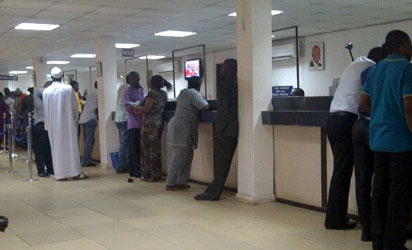
Banking hall
BY PETER EGWUATU
Standard Chartered Bank has forecast that Nigeria is likely to raise capital from the international debt market by the second half of the year, 2015 to meet some of its obligations. It also stated that Nigeria’s weakening fiscal buffers as a result of the sustained low oil price may result to a current account deficit in the country’s balance of payments this year.

The Managing Director/Head, Africa Research, Standard Chartered Bank, Razia Khan made the prediction during an interactive session with select journalists in Lagos recently. The economic analysts stressed that policy makers in the country failed to effectively utilise the opportunity created by the high crude oil prices in the past years, saying that it would be difficult for the country to rebuild fiscal buffers in a low oil price environment.
Khan, however, predicted that crude oil price would average at $76 per barrel by the second half of the year. “We are going to see oil prices moving higher and there is going to be some overshooting in the second half of the year. We see oil prices averaging $76 per barrel over the course of this year and we think that this means that by the second half of the year, there is a likely hold that oil prices would be $80 to $90 per barrel.
“But that would be only short-lived. We shouldn’t discount the fact that these very deliberate strategy on the part of Saudi Arabia in particular, to move away from the price targeting. So, for countries like Nigeria, the important take away is that it has moved away from that world of triple digit oil prices and what we would see going forward, is more like a double digits oil prices scenario.
“We know about the extent to which Nigeria failed to capitalise properly in the boom years in terms of oil production when the oil prices were high. So, it is not going to be that easy necessarily given the demands from the fiscal side, to rebuild fiscal buffers in a low oil price environment,” she explained.
According to Khan, given the willingness by the federal government not to crowd out the domestic market so much with excessive domestic borrowing, the country might borrow from the international debt market before the end of the year.
Disclaimer
Comments expressed here do not reflect the opinions of Vanguard newspapers or any employee thereof.