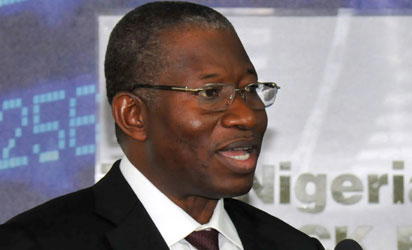
President Goodluck Jonathan speaks during his visit to the Nigerian Stock Exchange (NSE) in Lagos, on March 12, 2015. President Jonathan visited the Nigerian Stock Exchange (NSE) on March 12, and launched a new online mobile platform, X-Gen, designed to increase local investment. The platform is targetted at increasing the number of local investors in the country and to enable about 30 millions domestic investors have access to the market. AFP PHOTO
As Jonathan urges Buhari to boost railway system
By Henry Umoru, Favour Nnabugwu & Funmi Olasupo
ABUJA — The Federal Government, yesterday, directed the Bureau of Public Enterprises, BPE, to commence the privatisation of the Nigerian Railway Corporation, NRC, and other railway facilities across the country.
The National Council on Privatisation, NCP, gave the directive to the BPE and the Nigeria Infrastructure Advisory Facility, NIAF, after its council meeting in Abuja.
Director-General of the BPE, Mr. Benjamin Dikki, said the decision to reform the railways was borne out of the government’s desire to avoid the collapse and eventual shut down of the railways, generally regarded as a loss making but socially and economically important to the nation.
According to him, “the funding challenges facing the future of rail in Nigeria seem dependent on the efficiency and professionalism which the private sector can bring to improve on railway operations.
“The railway reform, restructuring and privatization programme are specifically aimed at achieving the provisional framework for private sector-led growth through expanded domestic and foreign investment; improve NRC’s ability to provide adequate, safe, reliable and efficient rail services; and reduce NRC dependence on the FGN budget by introducing private sector investment in the sector.”
NIAF has committed to funding the consultancy for the development of the roadmap and framework for the concession of the rail tracks of the NRC.
Jonathan urges Buhari to boost railway system

INSPECTION: President Goodluck Jonathan and FCT Minister, Senator Bala Mohammed (far right) during the inspection of Abuja Railway Station project at IDU, Abuja, yesterday. Photo: Abayomi Adeshida.
Meanwhile, President Goodluck Jonathan, yesterday, urged the incoming Buhari administration to continue to boost the railway system as the cheapest and most effective mode of mass transit in the country.
The President said this when he inspected the ongoing construction of the National Railway Terminal at Idu and the Abuja light rail transit system.
Jonathan said he was happy with the progress of work done on the projects and called on the state governors to also build light rails in their state capitals.
He said: “We cannot do mass transit using taxis, small cars and small buses, even the luxury buses.
“It will be too expensive until our rail system works. That is why we are emphasizing on inter-city rail and intra-city light rail systems and of course this government is leaving on May 29 but the incoming government will definitely continue.
“This is a noble project that will benefit Nigerians, especially residents of the FCT. I am quite appreciative of the level of completion; the China Engineering and Construction Company, CCECC, has been doing very well. I am quite impressed; I have been wanting to come and inspect this project for a very long time but it has been so challenging in terms of my commitments.
“I think this period I really need to do so that when I am having conversation with the incoming President; I know exactly what to tell him.
“I have seen it myself. I have seen the level of completion and of course we know the usefulness of this project to us in terms of easing the movement of people in the federal capital territory.
“I have to congratulate Nigerians for this project”
President Jonathan said the projects were dear to the Federal Government, adding that it was the target of his administration to link up all states of the federation.
He, however, said the state governments were being encouraged to construct intra-rail systems in the major capitals to ease transportation.
Disclaimer
Comments expressed here do not reflect the opinions of Vanguard newspapers or any employee thereof.