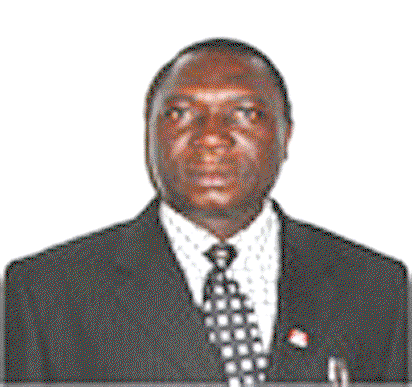
Emeka Adimmadu
By Tare Youdeowei
After over five years of research into the ailing Nigerian economy, why nations that were at par with Nigeria are now ahead and how Nigeria’s economy affects Africa’s economy in the big picture, Emeka Adimmadu, a doctor of Banking and Finance and Senior Lecturer of Federal University of Technology Owerri, Imo State, has come up with recommendations in his article;
Nigeria; Africa’s Pathway to Regional Greatness, that would not only make Nigeria the largest economy but would also place Africa as the leading world economy. Honing on a booming economy reflecting on the lives of the populace and not a handful of elites, the Academic, former Accountant General of Imo State and Justice of Peace makes his findings known.
Excerpts…
Economic misconception

Emeka Adimmadu
Going by the verdict of the Renaissance Capital, RENCAP, and using an adjusted base year to calculate Nigeria’s current year’s GDP, Nigeria’s adjusted net GDP would stand at 405 billion dollars that of South Africa would trail behind at 370 billion US dollars.
Other encouraging highlights of the RENCAP African report with respect to Nigeria’s macro economy include the following; a positive debt budget and current account ratios, as well as a general improvement in Nigeria’s overall financial markets’ aggregates.
Currently, the net market capitalization of Nigeria’s capital market stands at over 77 trillion US dollars with a robust and solid banking sub sector. Beyond the façade of these encouraging hypothetical economic indicators is a nauseating paradox of a sort; abject poverty in the midst of plenty.
The implication of the apparent misconception arising from Nigeria’s GDP re-basing is the possibility to relax and assume that perhaps Nigeria’s economic woes are over.
The herculean task confronting the government is to translate this rising economic profile into discernible improvement in the living standards of Nigerians and which would later translate into favourable regional ratings. Nigeria has yet to evolve as Africa’s regional leader and this cannot be achieved by acclamation of a period based quantitative nominal GDP growth but through a substantial reduction in the gruesome level of poverty staring in the nation’s face and narrowing the gaping disparity between the minority rich elites and the large population of the poor.
Widespread growth
The first urgent task would be to review the conditions and status of existing economic and social infrastructure with a view to raising their standards to an acceptable minimum level in tandem with global benchmark.
A steady flow of foreign investment is a sure guaranty of growth sustainability especially in a situation characterized by huge domestic savings- investment gap, the main feature of Africa nation’s financial intermediation. Presently, this gap is slightly narrowed in Nigeria due to creative nurturing of the financial system through both fiscal and monetary policy derivatives. With financial soundness and complementary fiscal objective, stream of foreign direct investment can be guaranteed. The level of Foreign Direct Investment indicates corresponding level of foreign confidence in the domestic economy’s potentials for sustainable growth and stability.
In a similar way, a reasonable rise in consumer income and sustained increase in consumer spending behaviour will in the long run boost domestic service sectors, including finance, telecoms and retail trade, the mainstay of Nigeria and indeed Africa’s macro economy.
The duty of African governments would be to ensure a steady rise in consumer income through policy incentives, the attainment of near full employment and price level stability. These can be achieved through appropriate fiscal and monetary policy response to both global and domestic economic changes. Any economic boom or expansion, real or imagined, but not translated into measurable qualitative derivatives that improve society’s well being would be misleading and incongruous with standard global platform”
In any contemporary economy with redundant labour force, inadequate infrastructure and oversized public sector, with huge savings-investment gap, overtime would manifest clear signs of distress and failure. In my view and contrary to Adam Smith’s Wealth of a Nation, the study of the poverty of a nation is more important than the study of the wealth of a nation because poverty anywhere is a menace and constitutes a threat to wealth anywhere and every time.
Oil dependence
Nigeria’s future economic growth continues to be driven by a single managed commodity; the petroleum and its derivatives which are subject to increasing vulnerability to the volatile external commodity markets. As the world systematically transit into green economy, there is a growing pressure to abandon gas or petroleum powered automobiles, with the introduction of the new era electric automobiles. That will further exacerbate domestic economic crises on nations that derive financial resources for development merely from oil.
Nigeria’s implied potential economic growth is not entirely supported by adequate economic institutions such as huge private sector investment or domestic demand and output parity or equilibrium, but is rather anchored on some illusive and uncoordinated infrastructural investments from the Asian Tigers; China and India, on ambiguous terms and conditions that add little or nothing to local value.
In addition, the envisaged much hyped Nigeria’s economic growth is still skewed in favour of a relatively small group of very powerful political elites and their cronies. The trickle down of the envisaged Nigeria’s economic growth to the ordinary Nigerian is still marred by an array of massive resource leakages and corruption. Inadequate power supply and clean drinking water, degradation of the environment, decay of existing public infrastructure, poor national housing scheme and now complicated by severe food scarcity and hunger, may diminish Nigeria’s chances of championing the course of Africa’s economic resurgence as a pioneer in global economic mainstream.
Disclaimer
Comments expressed here do not reflect the opinions of Vanguard newspapers or any employee thereof.