By CHIOMA GABRIEL
The gubernatorial candidate of the All Progressives Congress, APC, in Taraba state Aisha Jumai Alhassan would have made history in the last gubernatorial election in the state as the first woman to scale the hurdles of electioneering campaign and break the jinx that has befuddled Nigerian women over the years from emerging successful at the polls as governors.
Mama Taraba as she was fondly called almost made it but then, the near-success syndrome that has been the lot of many Nigerian women in politics cut short her joy. Before the elemental forces played tricks on her, expectations were high that she would emerge successful considering the bent of results being reeled out by the Independent Electoral Commission, INEC.
But suddenly, the elements beat a retreat that first led to the results of the election being declared inconclusive and then, a re-run that finally dashed her hopes as she finally lost the race to the People’s Democratic Party’s candidate, Darius Dickson Ishaku.
Ab initio, Aisha Al-Hassan was coming up strong in the race and was almost thought to have won before the table turned. At a point during collation of votes, Al-Hassan had polled 262, 381 votes from all 16 local government areas in the state and was leading and overtook her main challenger, Darius Ishaku of the Peoples Democratic Party.

Alhassan
Nigerian women would have recorded a rare feat in elective politics had she succeeded in emerging the first elected female governor in Nigeria.
Al-Hassan, a lawyer had defected from the PDP and joined the opposition party after she was elected senator for the Taraba North constituency in 2011. She was the Taraba State Attorney General and Commissioner for Justice as well as the Chief Registrar of the High Court of the Federal Capital Territory.
She had polled a large number of votes from the Gasol local government area as vote counting entered its second day in Taraba, allowing her to surpass the PDP’s candidate. But as the final results from all 16 local government areas in the state trickled in, Ishaku regained the lead by nearly 64,000 votes and hopes of making history sunk. The re-run turned out worse for her. But Alhassan has rejected the result and headed for the elections petitions tribunal.
Addressing a press conference in Jalingo shortly after the announcement of the results, Alhassan described the entire elections process as a “daylight robbery” and said the party would challenge the results in the elections petitions tribunal.
“The combined governorship elections in Taraba were characterised by violence, massive rigging, ballot snatching and abuse of the card readers in substantial parts of the state by the PDP and their allies,” she said. She contended that results ascribed to Wukari, Donga, Takum, Sardauna, Zing, Yorro, Kurmi and some parts of Ussa, Karim-Lamido, Bali, Ardo-Kola and Lau local government areas were not acceptable as they did not reflect the true results of the election in Taraba.
She alleged all the complaints on the irregularities and abuse of the election guidelines were promptly reported to INEC, but that no action was taken.
Who knows, the elections petitions tribunal could turn things around for her.
Peculiar traits
Over the years, Nigerian women have continued to record very poor performances in elective political offices. This is largely due to the sentimental attachment on feminine gender. Although they have been playing crucial role in political life of the country, this has not yielded results in terms of their performances when it comes to elective offices.
Although women are currently participating more actively in politics than ever before, they are besieged with challenges of which discrimination is more rife.
The psyche of the Nigerian man is often predominated by a chauvinistic disposition that decision making is exclusively for the menfolk while women are to be instructed on what to do. The preoccupation that women play the number two role at homes is playing itself out in their political life.
With her 36 states, the Federal Capital Territory and 774 local government areas, Nigeria is believed to have over 800 women who enjoy positions of eminence as ‘first among equals’. Although there is no constitutional provision for the office of the first lady, Nigeria has paraded several First Ladies and many amongst them played roles that made them so prominent. For instance, at Nigeria’s independence, Mrs. Flora Azikiwe was known as Nigeria’s First Lady and she frequently attended state functions with her husband. After her, there were a few First Ladies that became prominent despite the relative short time they spent in the State house. One of them was Victoria Aguiyi-Ironsi whose stay was short but she was very visible. She was succeeded by Victoria Gowon who stayed in the State House for eight years but her presence was equally felt in several public appearances.
When democracy returned in 1999, Stella Obasanjo, the First Lady of Nigeria’s former President Olusegun Obasanjo transformed the public view of her “office”. She actually became prominent before she became the First Lady, when she started several activism campaigns for release of her husband who was imprisoned in 1995 for allegedly taking part in a coup to overthrow the government. Her activities spurred females to be strong and independent, and as such gathered wide support. She once commented that even though her husband had made a commitment to improving living conditions in Nigeria, “things will continue to deteriorate in the country unless more women are allowed to participate in governance.”
In the years of Ibrahim Badamasi Babangida as Nigeria President, there was a turning point in the history of women struggle in Nigeria, when Maryam Babangida institutionalized the office of the first lady in 1987. She became the first working First Lady and launched the “Better Life for Rural Women” programme. Ever since, other women have followed suit.

Okonjo-Iweala: Begs for time
Currently, Ngozi Okonjo Iweala is holding sway as Coordinating Minister and Minister of Finance. Mrs. Oby Ezekwesili also laid a land mark in the history of Nigeria politics. The late Prof. Dora Akunyili, the NAFDAC boss and former Information Minister left her footprints in the sand of time, performing credibly and leading the fight against adulterated pharmaceutical drugs. There have been myriads of women in politics even presently that have done very well and are still performing excellently well.
But in elective positions, women have not performed well in compliance with the efforts they put in electioneering campaigns.
In her view over the poor performance of women in elective offices, Dr. Abiola Akiyode-Afolabi, an activist has made a case for a systemic approach to elective positions.
According to her, “There is a need for us to have a common agenda as women, and behind this agenda there is also the need to have the will to move beyond mere discussion. Look at the national conference for example; there were 92 women out of the entire 492 delegates and women are supposed to comprise over half of Nigeria’s population!
“We have had round-table discussions, open discussions, and I think it is high time we engaged in a more systematic way to be better represented in governance. We need to engage political parties and government because even the National Gender Policy declared 35% affirmative action”.
Poor history
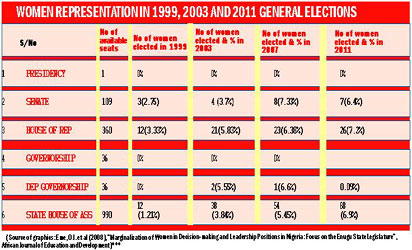
In the past general elections in Nigeria, female candidates consistently performed badly. In 2011 for instance, only 32 women were elected to the national assembly out of 469 members, which is barely 8% representation. Out of the 109 Senators who emerged winners at the 2011 polls, only 7 (6.4%) were women.
The successful candidates were Nkechi J. Nwaogu, Mrs. Helen U. Esuene, Nenadi Usman and Aisha Jummai, all of PDP. Others include Christiana N.O. Anyanwu , Joy Emordi both of APGA and lastly, Chief (Mrs) Oluremi Tinubu.
The casualties of the 2011 national assembly elections included Senator Iyabo Obasanjo-Bello, Senator Daisy Danjuma and Kema Chikwe. The decrease in the percentage of female candidates that won at the polls is disturbing given the increase in the number of women who contested and the figure dropped significantly when compared to the performance of

Senator Gbemi Saraki
women in previous elections.
In the 2007 general elections, 9 (8.25%) female candidates won the senatorial seats. They were Gbemisola Saraki-Fowora (Kwara State), Christiana Anyanwu (Imo State), Zainab Kure(Niger State), Grace Bent (Adamawa State), Joy Emodi (Anambra State), Eme Ufot Ekaete (Akwa Ibom State), Patricia Akwashiki (Nasarawa State), Iyabo Obasanjo-Bello (Ogun State) and Nkechi Justina Nwaogu (Abia State).
In the 2003 elections, there were 4 (3.67%) female senators. Out of the 360 available seats in the Federal House of Representatives, women won only 19 (5.27%).
From records, few women emerged members of House of Assembly across the polity and members of the National Assembly. In states like Adamawa, Cross River, Ebonyi, Jigawa, Kano, Katsina, Oyo, Sokoto, Yobe, and Zamfara, no woman was elected as member of the State House of Assembly.
In states where women were elected as members, they were very few.
Important gains
The 2011 election in Nigeria saw some important gains in women’s political participation. President Goodluck Jonathan appointed 33% of cabinet positions to women (up from 10% in the last government), including the ministerial portfolios of finance and education. This is in keeping with Nigeria’s commitments to gender equality, encapsulated in the National Gender Policy , which sets the benchmark for women’s seats in Parliament at 35% – 5% higher than the international standard.
From 1999-2007 there were marginal but steady increases in political participation of women through election or appointment. Yet in 2011 women gained no more seats than at the 2007 election (and they lost many at the Federal level). This was a huge disappointment given that in each past election, there has been approximately a 2% increase in numbers of women elected . In the 2011 elections, after the political primaries, women candidates constituted just over 9% of the total number of candidates contesting the polls.
No doubt, the nature of Nigerian politics also discourages women’s participation. Political meetings are often held late at night on an ad hoc basis, making attendance difficult for women, who face greater personal risk in travelling alone at night and often have to arrange for assistance to care for families. Women who do attend such meetings have, according to numerous anonymised sources, been labelled as women of easy virtues. More generally, politics is considered to be a ‘dangerous’ pursuit in Nigeria and female politicians are frequently considered of dubious moral character, given their desire to be involved in this profession.
In the just-concluded 2015 general elections, only 14 women emerged members of the House of Representatives-elect according to data provided in INEC website. The exact number of female senators are 7 and those that emerged winners included Binta Masi Garba, Uche Ekwunife, Stella Oduah, Rose Oko, Fatimat Raji-Rasaki, Oluremi Tinubu and Monsurat Sunmonu. The results of some elections held across states in Nigeria have been inconclusive.
Looking back, Oby Nwankwo, thinks a time has come for quota system to be applied in the scheme of things.

N10.6trn controversy: Oby Ezekwesili
“In the 29 states where governorship elections held in 2011, the representation of women seeking the office of governor and deputy governor stood at 87 (22.9 percent) out of the 380 candidates running for the positions. That pathetic percentage was made up of candidates from less known political parties, amounting to no significant increase in women’s representation.
“In the contest for Senatorial seats, 122 women out of 747 candidates, representing 16 percent, were cleared by INEC to run. However, only eight of them eventually won elections to the upper chamber. That makes it 101 men against eight women in the Senate.
“In the lower chamber of parliament, the situation was not any better as 267 women, out of a total of 1,774 candidates, ran for seats at the House of Representatives. This is just 15 percent. For the womenfolk, this is heartbreaking as the 2011 elections robbed them of the many gains of 2007.
“Nigeria must adopt quota system if the affirmative action must be implemented. The Justice Uwais report recommended a proportional representation but that was unfortunately ignored. In Cross River State however, twinning system is being proposed to ensure that if, for example, the governorship candidate is a male, the deputy is a female. That way, more women will come on board.
It’s sad to hear that out of 360 seats at the lower house in the National Assembly, we have only 24 women! Out of a Senate House of 109, we also have only four women! This is in spite of the 2006 National Gender Policy raising the affirmative action to 35% which we still do not have!”

Bucknor-Akerele
Indeed, It has not been smooth for the Nigerian women in terms of representation in top public offices. At present, in the Senate, none of the principal officers is a woman, and only eight of the 109 Senators are women.
The House of Representatives has only one female principal officer. However, only 24 (7 per cent) of the 362 members are women.
The figures of women in Nigerian politics are in contrast with the situation in countries such as Rwanda, where women make up 61 of 106 parliamentarians (58 per cent), and Senegal where women occupy 65 of the 150 parliamentary seats (43 per cent).
In Nigeria’s 36 states, there is no female governor, and the country does not appear ready to have a woman as president.
All of these realities exist despite the National Gender Policy’s promise to support women to occupy 35 per cent of elective positions in Nigeria.
Remi Sonaiya, KOWA’s presidential candidate, at the twitter conference said, “Women should begin to seek elective positions more; not just appointments. With each woman that rises beyond those limitations, many more get encouraged.”
Amy Oyekunle, the Executive Director of the Kudirat Initiative for Democracy (KIND), said that for women to remain relevant in parties, there is need to “advocate for greater representation at the party levels, support women through actively identifying, training and building capacity to lead, contest, and advocate for issues, and also create affirmative action like quotas to enable them contest”
In the beginning…
Before the early 21st century, the role and status of women in Nigeria have continuously evolved. In the precolonial period, women played a major role in social and economic activities. Division of labour was along gender lines, and women controlled such occupations as food processing, mat weaving, pottery making, and cooking. Moreover, land was communally owned, and women had access to it through their husbands or parents. Although a man was the head of the household in a patrilineal system, older women had control of the labour of younger family members.
Outside the home, women were seen but not heard. In the public, power was generally dominated by men, but titles were given to women in specific areas. Yoruba and Hausa legends describe periods when women were either the actual kings or heroines. Such women as Moremi of Ile-Ife and Amina of Zaria are notable legendary figures, as are the powerful queens in the Ondo and Daura histories.
Formal education has been the most powerful agency of change for the modern woman, from which a large number of elite women have emerged. Intelligent, educated, and confident, the modern woman can be found in all leading occupations; they now challenge many aspects of patriarchy and are gradually organizing to ensure that the political arena expands sufficiently to accommodate them.
Enter the modern woman
The transformation undergone by the Nigerian woman over the years as a result of education became manifest in democratic regimes. Since 1999, Nigerian women have been active in

Orelope-Adefulire
politics.
Their participation in the ongoing Fourth Republic has produced prominent women like Dr Okonjo Iweala, who currently serves as Minister of Finance and Coordinating minister for the Nigerian economy).
Women have even run for top political offices, for instance, the case of Sarah Jibril and Prof. Oluremi Sonaiya of Kowa party who contested for the office of President with Goodluck Jonathan in 2011 and 2015 respectively; and Hon. Mulikat and who strongly vied for the seat of Speaker House of Representative.
As it were, women are said to constitute over 60% of the Nigerian electorate. The 2006 census puts Nigerian women at about half the population of the entire country.
But despite this numerical advantage and the massive participation in voting, less than 20% of political offices are held by women.
But despite the difficulties faced by women in politics, they have continued with their political ambition, contributing enormously to the political and national development in their own way.
Before independence, a couple of women political activists such as, Mrs. Margaret Ekpo, Mrs. Janet Mokelu and Ms. Young were members of the Eastern House of Assembly. The late Mrs. Funmilayo Ransome-Kuti, though not a full-fledged politician, was a very strong force to reckon with in the politics of the Western Region. And Hajia Gambo Sawaba waged a fierce battle for the political and cultural emancipation of women in the North.
As democracy matures, there has been an increase in the number of male governorship candidates that had women as their deputies. Political parties in Lagos State often choose women to contest as deputy governors. In 1999, only Lagos State had an elected female
Deputy Governor in the person of Mrs Kofoworola Akerele-Bucknor although she
was later removed and replaced by Femi Pedro, a man, as a result of party intrigues.
In 2003, the number of deputy female governors increased to 2 (5.5%), in 2007 it increased to 6 (16.6%). The 2011 general elections produced only a female deputy governor in the person of Mrs Adejoke Orelope Adefulire of Lagos State who contested under the platform of Action Congress of Nigeria(ACN).
Some of the female candidates contested against male political heavy weights. A case in point is Plateau State where Paullen Tallen (Labour Party) once contested against political heavyweights such as Joshua Dariye who was governor from 1999-2006.
Senator Gbemisola Saraki-Fowora (ACPN) who contested for the governor’s seat in Kwara State had ethical and religious issues to contend with in addition to contesting against the PDP’s candidate which also pitched her against her brother who was the incumbent governor of the State.
Quite a number of women in past dispensations won their parties’ primary ticket for the National Assembly and the various States’ Houses of Assembly. In Lagos State, all the female candidates from ACN won at the polls in the election into the National Assembly and the State House of Assembly. Women contested for only 7(17.5%) seats out of the 40 seats at the Lagos State House of Assembly. Adamawa State which had 23 women vying for political offices managed to produce only three female winners, they include Hajiya Aishatu, Mrs Wale Fwa and Mrs Wilbina Jackson.
Financial challenge
Perhaps , the greatest challenge women face in getting elected in Nigeria relates to financial constraints. The costs of running an electoral campaign are high – even more so in the context of Nigeria where politics is highly monetised. Aside from paying for the campaign itself and the materials and coverage that go along with this, many candidates also dispense ‘patronage’, in the form of cash handouts, to voters. Women are at a disadvantage in this regard as they consistently earn less than their male counterparts and are usually not in charge of household finances, limiting their ability to make independent decisions. While many candidates receive donations from patrons, there are few patrons willing to risk their money on female candidates, given the low likelihood of them being elected. As a result, women’s campaigning is frequently smaller-scale, with less coverage than that of men. This helps to explain the lower success rate of women at the Federal, as opposed to State level. But as Nigerian Senator Patricia Akwashiki says, ‘how can 9 women senators or less represent 54 million women in Nigeria?’
In every ramification, the Nigerian woman has come a long way despite her dismal performance in the field of politics. There is no doubt that women have some potentials and rights to contribute meaningfully to the development of their country. The Nigerian government should therefore, work towards achieving gender equality in democratic governance, increase

Frontline female politician, Sarah Jubril
women participation and access to politics.
Dr. Joe Okei-Odumakin thinks internal democracy is very necessary in political parties as efforts to get more women in elective positions have not yielded very good results.
“There is no internal democracy in the political parties and this has continued to prevent women from having equal political opportunity. Though the present administration of President Goodluck Jonathan has tried to improve on appointive positions for women, it is yet to meet the 35% affirmative action. This was why women delegates at the national conference identified the urgent need for gender mainstreaming and full implementation of the 35% affirmative action. There are, however, efforts going on right now at different levels, engaging political platforms and demanding that political spaces be opened up for the inclusion of more
Disclaimer
Comments expressed here do not reflect the opinions of Vanguard newspapers or any employee thereof.