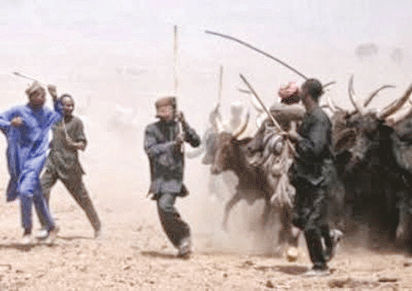
Herdsmen
There is no love lost between farmers and herdsmen in many parts of the country. For quite some time now, the media have been inundated with reports of conflict after conflict between farmers and herdsmen in different parts of the country and at the end of the day, several innocent lives are lost, farms and cattle destroyed. Farmers in Benue State, the food basket of the nation, are worst hit, causing many to believe that if nothing is done urgently to stem the tide, widespread hunger may be staring Nigeria in the face. In this report, Vanguard Features, VF, takes a look at the recent attacks in Oyo, Benue and Enugu states and the best way forward.
By Ebele Orakpo
Recent attacks:
On February 14 when most people the world over, were celebrating St. Valentine’s day of true love, residents of Okaka town in Itesiwaju Local Government Area of Oyo State were experiencing the opposite as hundreds of hectares of farmland were destroyed by cattle.
Speaking with VF, one of the affected farmers, Mr. Nwachinemere Emeka, CEO of Livingstone Mega Industries Limited, Iseyin, Oyo State said: “Several farmlands belonging to individual farmers, corporate organisations and farmers associations were grazed. The proportion of the destruction left in the wake of the grazing was more than had been witnessed in a long time. Over four hectares of cassava farm belonging to Livingstone Mega Industries Limited, were grazed by cattle. Adjoining farms owned by Nigerian Cassava Growers Association and some indigenes of the area, were also grazed. About 200 hectares of cassava on the whole, were destroyed.”
Self-defence:
Fearing that they too may lose their farms in the same way as others, they decided to take action. Said Emeka: “Some local farmers sprayed DDT (Dichloro-diphenyl-trichloroethane) on their farms in the aftermath of this sad event and 45 cattle died of poisoning. This created acrimony between the villagers and herdsmen who had vowed to retaliate, a situation that has plunged everyone into a state of fear. This perhaps was heightened by the sad incident within the same period where herdsmen killed a farmer in his farm in neighbouring Iseyin town.

Herdsmen… as death merchants
“There are fears of a Fulani raid, and the indigenes are battle-ready. If these things are not addressed speedily, we might have another Benue on our hands; only worse. This is because this reign of destruction and the consequent disaffection it brews is not restricted to Okaka, it will spill over to Oke-Ogun area of Oyo State and the entire South-West.
Iseyin was in a state of confusion because a farmer, who had walked into some Fulanis grazing his farm and challenged them, was murdered in the heat of an argument. Another farmer allegedly witnessed this dastardly act.
According to Mr. Emeka, the situation made the indigenes to mobilise and arm themselves, with local hunters and vigilantes leading the way. They barred Fulanis from both the mosque and the Kara meat market and passed a vote of no confidence on the conflict resolution instruments of the state – the Police and their local chiefs, citing bribery to derail justice. They would rather seek justice from organisations like O’dua Peoples Congress, OPC.”
Emeka noted that when his farm was grazed in 2013 and he reported to the Police, nothing was done.
Meanwhile, the Olokaka of Okaka has continued to meet with his chiefs, the security agencies and to dialogue with his people in order to avert another crisis. One of the members of the council of chiefs who spoke on condition of anonymity lamented that despite all the peace meetings they had held at the local government level, no solution appeared to be near. “Now, the situation is so dire for some of the affected farmers who not only do not have food to eat in the interim, but worst of all, do not have seedlings for this year’s farming season, all because of the wanton destruction of their farms.”
Government not helping matters
Also speaking, the Secretary, All Farmers Association of Nigeria and President, Nigeria Cassava Growers Association, in Okaka, Chief Ajibike who lost 10 hectares to herdsmen, said the alternative to anarchy was for the Federal Government to quickly create grazing reserves where the herdsmen can be confined. He lamented that despite signposts put to give notice to herdsmen that farms are nearby, they still graze the farms with impunity, saying that one of the reasons was that the cattle are usually left in the hands of little boys.
However, Emeka regretted the lack of will by government to implement propositions for a grazing reserve. He wondered if government was waiting for the eruption of violence in Okaka before they realise that something needs to be done. “Such reactionary measures have never done anyone any good. Also, the inability of farmers to get justice when their source of livelihood is destroyed is an invitation for anarchy,” he stated.
The victims:
Those who lost their farms to herdsmen include:
*Nigerian Cassava Growers Association (97 hectares of cassava, estimated at about N20m.)
*Alhaji Yakubu and Chief Ajibike – 50 hectares and 10 hectares, respectively.
*Mr. Ogunleye, a Lagos-based corporate farmer – 100 hectares.
*Livingstone Mega Industries Limited – 14 hectares cassava farm.
Chief Karimo Oyetoro, a victim, described how he lost N300,000 worth of yam seedlings he had taken to his intended farm the previous day. According to him, he had carefully laid out his yam seedlings at his farm and covered it as he had always done in the past. The next day, to his chagrin, they were all gone.
Mr Liade Ogundokun who lost 80 hectares of cassava, noted that if the situation isn’t resolved, the farmers would be forced to take the law into their own hands and expel the herdsmen. This sentiment is shared by most of the victims. Alhaji Yakubu, another farmer said: “If this issue is not resolved, the only alternative is to send them away. Else, I would have no option than to move away from Okaka because of attempts to assassinate me because I have been so vocal concerning the incursions into our farms.”
So far, an estimated N40 million has been lost to cattle grazing and this has left farmers in a precarious situation.
Way forward:
When contacted, Professor Charles Reith, Vice-President, Academic Affairs and Director of Sustainability, American University of Nigeria, Yola, said although he is not working on the issue of diffusing conflicts between farmers and grazers, for the moment, he is much more interested in increasing knowledge in the general way rather that just in response to the clashes. “This is one more area where we could solve the problem with greater knowledge, with a greater understanding of how to farm more effectively and how to manage the cattle, not only to avoid conflicts such as we have seen but to actually produce more food by making the land to produce to its natural capacity.”
New grazing method:
There is a method of grazing cattle that was developed in Zimbabwe called Management Intense Grazing. This involves a really wise use of land where the cattle are kept in discrete areas and are managed with solar wires in a way that they would never go into the farms. They are like little electric wires with the solar panel; so if a cow bumps up against it, the cow gets a little shock and learns to recognise that wire and stay within the bounds. So if a Fulani shepherd can learn how to lift his stick, walk a hundred feet and put it down so the cattle will be confined in the paddock until they have eaten everything, even the unpalatable weeds.
Plus they will have churned up the soil and fertilized and dampened it with their droppings. This will be the perfect environment for the roots of the desirable grasses to re-sprout. However, it is important by the time they re-sprout, the cattle need to have been ushered into a new paddock so the grass will have plenty of time to reestablish. Months later, the cattle will be reintroduced to that paddock, where they will find plenty to eat and will repeat the same cycle.”
Unsustainable land use:
Reith thinks that sustainable farming and grazing methods will not only help preserve lives and farms but also the environment. “A lot of people think desertification is caused by global warming; global warming makes it worse but it is unsustainable land use like cutting off the wood for fuel and farming in a not very sustainable way, not rebuilding the soil you farm and grazing every last bit of grass.
“That is part of the education that these communities should receive. I noticed that farming in Nigeria is very spread out. They don’t get much food from a given area of land, so the farmers unnecessarily spread out using where people traditionally grazed; and the grazers spread their cattle over much more land than necessary, grazing on the land that the farmers need; it is no wonder there is conflict. All of this conflict is as a result of lack of basic knowledge on how to responsibly manage cattle over grazing areas or farm effectively using the allocated lands with greater productivity. Here in Yola, it’s just like you see in other places. The herdsmen graze pretty much anywhere they want, including right in the middle of town. They move their herds and take them to whatever food is available.
“I am working with Fulani villagers to help them understand better farming techniques and better management of the environment. I am very interested in increasing the agricultural productivity in the area so that we begin to support the thousands of Internally Displaced Persons, IDPs. Besides providing immediate aid which AUN is very good at doing, we are also starting to think about how to farm more effectively and therefore provide a larger food base. I suspect a long time adjustment in population if many of the IDPs decide not to go home,” he said.
Use of jatropha:
“At AUN, we are raising awareness in improved farming techniques and also in the use of jatropha, a plant that is ideal for separating farms from grazing fields. Jatropha is a plant that produces bio-fuel, berries and oil and at the same time, repellent to cattle. So you can plant lines of jatropha between where the cattle graze and the farm. The cattle will come up to the jatropha but not cross it to go into the farmland. You use the jatropha to make oil, soap, to cook and the wood for cooking,” said Reith.
The Hammer mill:
In an earlier interview with Vanguard Features, the Director-General, National Board for Technology Incubation, Dr. Mohammed Jibrin said the hammer mill, a crop residue crushing machine was fabricated at the Technology Incubation Centre, Kano to help stem the conflicts between farmers and grazers occasioned by the nomadic method of cattle rearing and also help farmers get the most out of the crops.
He said: “The hammer mill is a crop residue crushing machine. Crop residues are raw materials that can be used by the industry for production of ceiling boards, doors, windows and particle boards. They could also serve as feed for animals. But because crop residues cannot be processed in this part of the country, they are being wasted as animals cannot even consume 30 per cent of it. For that reason, the machine was fabricated. Farmers having realised the value, are buying the machine and it has made most cattle rearers stay in one place since the feed can be made available to the cattle in one place.
“Also this will settle the issue of cattle destroying farmlands and farmers clashing with herdsmen. Cattle should not be left to scavenge if they are required to produce good quantity of meat or milk,” he said. “One interesting thing is that as a result of this machine, hundreds of jobs have been created,” he added.
Disclaimer
Comments expressed here do not reflect the opinions of Vanguard newspapers or any employee thereof.