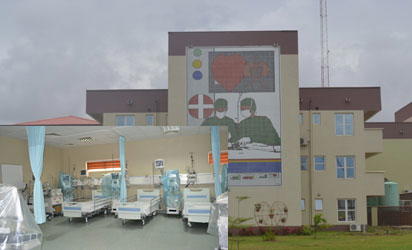
One of the theatres at the new Lagos State Cardiac and Renal Centre.
By Chioma Obinna
IN 2012, the World Health Organisation, WHO, reported that Non Communicable Diseases, NCDs, notably Cardiovascular Diseases have attained epidemic proportions particularly in developing countries like Nigeria.
The report came at a period when Lagos state had attained megacity status and was experiencing the difficulties of handling rising cases of renal and cardiac diseases. Cases of patients requiring financial assistance for treatment and/or transplant surgery abroad had to be coped with as well.

One of the theatres at the new Lagos State Cardiac and Renal Centre.
Even today, many Nigerians who go abroad for surgery return either worse off with mismanaged cases or lose their lives in the attempt. Others are faced with challenges of post treatment such as access to drugs. This has been the scenario for years.
But light appears to be at the end of the tunnel for Nigerians seeking such specialised care for cardiac and renal problems as a permanent solution to diagnosis, management and surgery of these conditions is on the horizon.
Lagos residents and by extension all Nigerians, can now benefit from a new, world class Cardiac and Renal Centre just opening at the Gbagada General Hospital.
The N5 billion Centre, first of its kind in Nigeria, will manage cases of CVD and Chronic Kidney Disease, CKD. A dangerous outcome of CKD is end-stage renal disease and its prevalence is increasing world-wide due to changes in demographics of the population, differences in disease burden among racial groups, and under recognition of earlier stages of CKD and risk factors. CKD increases the risk of other CVDs The WHO had estimated that by 2015, about 20 million people would die from CVD, representing 30 percent of total world death.
The health body also estimated that by 2030, there would be a great shift from infectious diseases to NCD, with NCD accounting for more than 75 percent of deaths worldwide.
In Lagos State secondary and tertiary health facilities, 22,785 cases of hypertension were managed in 2012 and 23,203 in 2013.
The state-of-the-art centre billed to be officially opened tomorrow would render out-patient services, diagnostic services, admission for all cardiac conditions requiring hospital stay, among other routine and specialised services.
Under renal care, the Centre will also render a complete retinue of diagnostic services from ultrasound to haemo-dialysis for acute and chronic kidney diseases, renal surgery.
“’This is the first of its kind and the beginning of solving cardiac problems in the country,” said State Commissioner for Health, Dr Jide Idris. Nigerians will now have access to affordable open heart surgery and kidney transplant locally among other treatments.
Idris, in a chat with Good Health Weekly said: “In recent times, there has been an epidemiologic shift in the disease pattern with an increase in Non-Communicable and Mental Health disease burden seen across the state especially hypertension, diabetes mellitus, cancers and Road Traffic Accidents. State Hospital statistics also show an increase in end-stage renal disease.”
The 67-bed facility has on the ground floor as Renal Centre with four specialist renal clinics, four specialist cardiac clinics, resting and stress test electrocardiography (ECG) rooms, echocardiography laboratory, exercise room, cardiac rehabilitation room, and telemedicine conference room amongst others.
A, five-bed Intensive Care Unit, 64 slice CT scan, catheterisation laboratory and 2-bed recovery room complement the package.
Further, Idris disclosed that 10 percent of the services at the centre every month will be free of charge. “As at this point in time, LASUTH has about 60 patients who need open heart surgery but cannot afford it. These children may be the initial beneficiaries of the 10 percent services.”
He said the idea of the facility being situated within the premises of the Gbagada General Hospital was to reduce the spate of medical trips abroad as well as build local capacity especially for ailments that should be treated locally but where expertise and facilities are not available to manage them.
Idris observed that the State government through the Ministry of Health considered it appropriate and timely to have a befitting cardiac and renal Centre due to the increasing number of patients presenting with end stage renal failure and coronary heart diseases .
The lack of a purpose built renal specialist centre, the periodic nature of the cardiac and renal missions which has limited the number of beneficiaries and the need to conserve the financial resources currently being expended in the management of patients with renal and cardiac diseases in foreign countries are other reasons for building the facility.
“A copulation of these factors prompted the need for us to build facilities locally, find a way of staffing them locally to provide the needed services to treat people of these ailments, reduce the money we are spending to sponsor people abroad, and more importantly to build local capacity.
“Setting up of the facility will help bring back home Nigerian medical specialists. It is as a way of ‘brain gain’ to defeat the ‘brain drain’ phenomenon.”
The building project started in 2008 when the award was made to Messrs Deaux Project Limited which also equipped it, It will be managed privately through a five year operation and management concession by a suitably qualified competent consortium of medical professionals renewable for another five years subject to satisfactory performance and mutual agreement of the parties wherein the proponent will provide all the health care services; clinical and non-clinical and total facilities management required for the value-engineering Renal and Cardiac Centre.
On donor organs, Idris said the drive for donors must be patient specific. “We will address that in the centre because donor issues are patient specific because all the organs must march. All these things must match to ensure patient compatibility.”
He said indigent patients fall into the 10 percent free services each month and excesses will be borne by the state government through the state’s insurance scheme.
“Hopefully there is a bill pending in the House that will address things like this. It has passed first and second readings and public hearing. And it is the final reading that is left. Once they pass it into law, the issue of affordability will be addressed properly.
Speaking, the Chief Executive of Renescor Health, the Concessionaire, Dr Ladi Awosika said the Centre is a good beginning to solving the problems in question, however regretted that about 10 more facilities are required to finally address cardiac and renal problems.
“The Centre has the capacity, in the next six months carry out three open heart surgeries in a week, four interventions in a week. With the catherisation lab which only two Nigerians can perform the services.
“Dialysis is going to be scaled up; probably we will be doing 60 a day in the next few weeks. It is not just about the cost but a lot of people are dying without getting any intervention. We will now have to face the long term sustainability of care which can only be addressed when the health insurance bill is in place. There is no country in the world that it works without the heath insurance scheme. It is expensive to run dialysis three times a week even at the cheapest cost of N20, 000 per session and N60, 000 per week. Not many people can do that for a week and whenever you are on chronic dialysis you have to end up with renal transplant. That comes with it challenges too. It is very expensive.
Disclaimer
Comments expressed here do not reflect the opinions of Vanguard newspapers or any employee thereof.