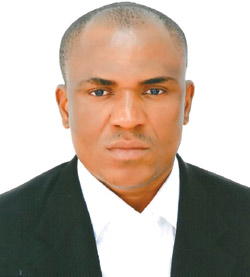
Festus Mbisiogu
By Victor Gotevbe, Vera Anyagafu & Prisca Sam-Duru
President of Good Governance Initiatives , Mr. Festus Mbisiogu, in this interview speaks on issues of national significance.
What is your position on the state of the nation?
My position in respect of the political situation at present is clear. I want to state that Nigerians should be given the chance to vote according to their choice during the general elections. They should not be intimidated into voting the wrong person, thereby mortgaging the future of the country. Whichever party that finally wins should ensure that the country is provided with steady power supply, good roads and all necessary infrastructures.

Festus Mbisiogu
If all these are put in place, we would have resolved over 90 per cent of our challenges and everyone is happy
During the 2011 electioneering campaign, President Goodluck Jonathan promised fixing the power sector if elected, on the strength of that what is your assessment of the power sector?
My constant advocacy for steady power supply in the country is based on the fact that every country needs constant power supply to enable a progressive economy. I have always urged the Nigerian government to do more on power supply. It is important for the government to understand that the availability of steady power supply is one thing that made a country like China the second largest economy in the world.
In Nigeria, almost every home and office generate power from generating plants, and from the statistics made available to me, Nigeria has about 2,400 manufacturing industries, out of which 800 have already stopped production because of unsteady power supply and high cost of maintaining power generating plants.
It is sad to know that all profits made during sales of manufactured goods are eaten up by fuelling and maintenance of the generating plants. With this on ground, the rate of unemployment surges and it also discourages Diaspora Nigerians, who are eager to erect industries in the country.
The Igbo are most creative, hardworking and if provided with steady power supply, Nigeria will overtake China. My wish is that President Goodluck Jonathan focuses more on power to solve this dampening power situation.
You emerged the Igbo person of the year. Can you tell us about it?
The award given to me as the Igbo person of the year 2014, will definitely spur me to do more for my people and the good people of Nigeria. I did not know that people are seeing what God is doing through me and when Igboamaka called to say I am going to be awarded the award , I was marvelled. About eight years ago when I moved some of my businesses to Dubai from China, I discovered that Nigerians, especially Igbo constitute over 80 per cent of Africans in China, yet the presence of the Nigerian government was lacking.
Many, if not all Nigerians in the Guangzhou province of China, travel through a distance to receive consular services. I felt the pain and was prompted to do something about the situation.
I painstakingly reached out to the Nigerian authorities through the media and today a consulate has been situated in Guangzhou, thereby putting an end to the dangers of travelling to Beijing for consular assistance.
Many Nigerians are in Chinese prisons, do you have an idea why this is so?
It is difficult to say. But I think there are lots of misconceptions here. The sad thing is that their families or government do not know about it. Sometimes it appears difficult for the Nigerian Ambassador and in some cases the non-provision of persons’ itinerary to the embassy upon arrival, contributes to improper information concerning such persons. In other words, it is imperative for persons to declare their itinerary and personal information once they are in any foreign soil. However, Guangzhou was rated as a place where Africans, mostly Nigerians take part in criminal activities. On a second thought, I discovered that the problem was more of the fact that every black is considered a Nigerian and this is not good for our image. With the assistance of other well-meaning Nigerians in diaspora, I was able slow reduce the rate of these accusations.
Disclaimer
Comments expressed here do not reflect the opinions of Vanguard newspapers or any employee thereof.