By Emeka Ugwu-Oju
Being text of a statement at a world press conference organised by concerned Nigerian Professionals and Entrepreneurs Forum for the 2015 general elections in Lagos
PREAMBLE: We have the honour to welcome you to this press conference, which we have called in furtherance of our continued genuine intervention in national affairs but particularly in the yet-to-be-held 2015 general elections in Nigeria. Only in January this year, we called a similar world press conference in Abuja to address certain critical national issues with regard to the 2015 general elections earlier scheduled to hold on February 14, 2015 but postponed to March 28 and April 11.
As before, we believe we owe it as a patriotic duty to our fatherland, Nigeria, to intervene in the goings-on during the political campaigns and assist with distilling the critical issues that matter most to the electorate and redirect the two major presidential candidates to toe the path of issue-based discussions and debates rather than focus on diatribes, mudsling, and invectives that have so far dominated the campaigns at the expense of clarifying issues for the hapless voters.
Introduction: It is pertinent to reiterate that, the Concerned Nigerian Professionals and Entrepreneurs Forum on the 2015 Presidential Election is a group of Nigerian professionals and entrepreneurs in diverse fields totally concerned about a successful and violence-free election that must advance the interest of the teeming population of Nigerians especially as the relevant issues are concerned.

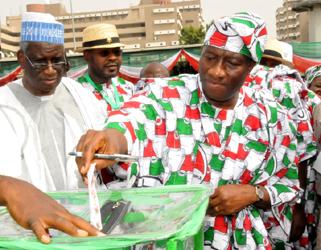
Large turnout of voters in Surulere, Lagos last Saturday.Insert Suleiman Abba, IGP. File Photo
Violence free election
We need to reiterate that we are a non-partisan group. However, we see ourselves not only as a civil society group but also as a critical stakeholder group with an interest in and a right to intervene in matters that concern the life, well being and development of our fatherland, Nigeria. In that wise, we have a stake in the rescheduled March 2015 elections. And the stakes remain very high indeed.
As a way of futhering our mission, we have planned seven town-hall meetings in the six geopolitical zones and a national town-hall meeting in Abuja.
The zonal town hall meetings will hold simultaneously on March 15, 2015 at various locations whilst the national town hall meeting will hold on March 19, 20, 2015. Representatives of the two major political parties, the People’s Democratic Party (PDP) and the All Progressives Congress (APC) and other stakeholders are expected at the zonal town hall meetings whilst the two major presidential candidates of the two major political parties, President Goodluck Ebele Jonathan and Major-General Muhammadu Buhari (retd) are expected at the national town hall meeting.
At both the zonal town hall meetings and the national town hall meeting, critical issues will be distilled first from the manifestoes of the two political parties and from the proceedings of the zonal town hall meetings (contributions from stakeholders) and later presented to the larger Nigerian public. The presidential candidates will address those issues at the national town hall meeting either together or separately. However, we are discussing with the campaign organisations of the two political parties on the details and format, whether it is going to take a debate format or the two candidates will appear separately.
The issues: The following issues have been distilled as the critical issues that matter most to the electorate and we shall make bold to address them point by point. We believe that the campaigns of the two major political parties and their presidential candidates have not sufficiently addressed the issues to guide or enable the electorate to make the right choices.
Therefore, our intervention is crucial at this juncture as a means to redirect the electioneering campaigns to focus on the relevant issues. It is amazing that the campaigns have centred on personal attacks without improving even with the best of exhortations from different concerned groups. We have been in the vanguard of advocating for issue-based campaigns and we will continue to drum up this because it is the best way to go.
The fundamental change in the dynamics of the global oil market (guaranteed average low oil price for the foreseeable future ) and the negative implication for a mono product economy: It is necessary that we remind the political parties and their candidates that the shift in the dynamics of the global oil market resulting in the volatility in the foreign exchange market and consequent down-turn in the economy will be here with us for some time to come.
Comprehensive report
We would like the candidates to address how they intend to tackle this issue.
Restructuring/creation of a fair, just and equitable federation: We have had a national conference which, over a period of five months, deliberated on various sticky issues that bother on the Nigerian question. The conference came up with a comprehensive report, including a set of distilled issues that form the basis for a brand new constitution. What remains to be done is the implementation of the conference recommendations. How the candidates intend to implement the report or whether they will muster the political will to implement the report is important to the electorate.
Reduction in cost of governance at the federal, state and local government level: Recently, there was a mini conference online amongst our members focusing on the cost of governance and the consensus reached was the urgent need for drastic reduction in the cost of governnace to free up resources for capital investment reqiured to provide enabling enviroment for faster economic growth.
For example, the idea of a part-time legislature was proposed and It was even suggested that, not only should there be a part-time legislature but that our Federal representatives should make use of their states’ liaison offices whilst they are in Abuja as a concrete means of reducing the cost of governance. How the presidential candidates will address this issue and other issues is important for the electorate.
Transiting from an oil income sharing to a wealth creating economy: The situation as of today is that there are little or no incentives to professionals and entrepreneurs for wealth creation. What has happened is that there is almost absolute dependence on revenues from oil and gas which account for about 90% of the country’s revenue and these revenues are controlled by the government, which also allocates or shares same.
This is what accounts for the struggle to get into government by Nigerians because it is in government that people can attain sudden and unmerited wealth. Even professionals and entrepreneurs scramble for the largesse from government. So, how the candidates intend to stem this trend is also important for the electorate. Climate change: Perhaps, it is not obvious to many Nigerians that there is a nexus between insurgency in the North East and climate change. There is a school of thought that climate change is responsible for the lack of incentive to agriculture in the North East where land has turned arid and has discouraged young people from engaging in farming.
Ready targets
These young people have become idle and therefore ready targets as recruits into the rank of insurgents. It is important that the candidates proffer solution to this issue.
Security of lives and property: Many Nigerians may have forgotten that there was a time the South South and South East geopolitical zones were ravaged by kidnappings and abductions that almost ruined the economy of both zones. This was the equivalent of what we call insurgency today in the North East. Kidnapping has not been tamed totally given the recent experience of the kidnapping of an octogenarian foreign missionary in Kogi Sate.
Unemployment: The issue of unemployment of youths in particular is a tinder box waiting to explode. With all the best efforts so far to tame this monster, the question of unemployment remains a critical issue that requires a drastic solution, which has remained more of a mirage.
Corruption: There is no doubt that corruption is endemic in Nigeria.
It remains to be seen what holistic action that can be taken to tackle this cankerworm. It will be interesting to get the presidential candidates to proffer lasting solutions to this malaise.
Food, water & housing: The basic needs of Nigerians, including food, water and housing have not been adequately addressed Education: The question of quality and affordable education for the teeming masses of Nigerians has dragged on for as long as one can recall. There is lean investment in education aside making publicly-funded education qualitative and affordable. Many young Nigerians are yearning for university education but cannot get places.
Skills acquisition
Even with the entry by private universities not much has changed. At the primary and secondary levels, the story is not different. So, how will this trend change post-May 2015. All said, what is needed is education that focuses on skills acquisition; entrepreneurial education where the individual can employ himself or herself and even provide employment for others. The way education will not seen as a meal ticket or licence to white collar job.
Conclusion: From the foregoing, it is clear that there are enormous issues that bother the electorate, which require very clear and unequivocal discussion by the campaigns of the two major political parties that are presenting the two main presidential candidates, President Goodluck Jonathan and General Muhammadu Buhari (rtd). These issues will be further distilled at the zonal town hall meetings and subsequently addressed by the presidential candidates at the national town hall meeting.
On the question of the 2015 general elections, all we need to say is that, on no account should any Nigerian who is registered and willing to vote be disenfranchised because of inabilty to collect a PVC,whether card readers are deployed for the elections or not. It is instructive, however, that if the elections had held as originally scheduled, on February 14, 2014, it would have been a disaster going by the recent experience with the test-run of the card readers.
Disclaimer
Comments expressed here do not reflect the opinions of Vanguard newspapers or any employee thereof.