By Ebele Orakpo
Unemployment has been linked to youth restiveness and insurgency in various parts of the world, especially in developing nations. Unfortunately, illiteracy cannot be divorced from unemployment and Nigeria, allegedly having the highest number of out-of-school children in the world, currently put at 10.5 million, no thanks to exponential growth in her population, it becomes pertinent to find solutions to this time bomb.
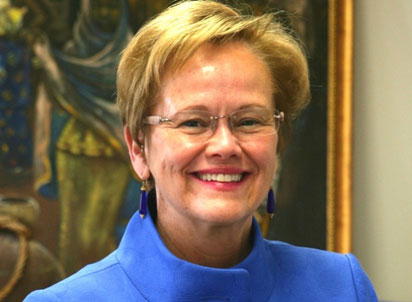
In this chat with journalists in Lagos recently, Prof. Margee Ensign, president of the American University of Nigeria (AUN) said the best way out is technology, noting that it has been tried in Yola, and it is yielding results.
Excerpts:
 “Nigeria’s population is doubling every 23-24 years and the country is expected to be the third largest in the world by 2045. So how are we going to educate all those people? We believe technology is a big part of the solution,” Ensign said. The UN had said that Nigeria needs about 400,000 new teachers this year, to be able to achieve universal primary education.
With the current state of things, this is almost impossible, but with the use of tablets and smart phones, Ensign believes it can be achieved.
Education responsible for peace in the midst of insurgency:
To ensure peace in their city, Ensign recounted how AUN formed a partnership with religious and community leaders in Adamawa, the Adamawa Peace Initiative (API) in pursuit of peace and reconciliation.
She said: “Three years ago when fuel subsidies were removed and the country was in a difficult moment in terms of peace and security, the then chairman of AUN Board, Ahmed Joda and I, reached out to all Christian, Muslim, community and business leaders in Yola to see if we can surround our vulnerable youths because we believed that if we didn’t take care of these youth with no access to education, no employment and who may have lost their parents, we all could be in trouble.
“It is a simple formula but now, people around the world, from Syria to those dealing with ISIS, are asking how we have handled these vulnerable youths.”The API members are mostly community leaders who know members of the community and those that need help. So they identified those vulnerable youths and AUN rolled out some programs for them, including the Peace through Education program. The AUN-API education component has three programs: primary school – literacy and math; secondary school- science, technology, engineering and math, (STEM) and a principals and teacher training institute.
ICT training program:
“Among the vulnerable youths identified, some are in our ICT training program -boys, girls, men and women who hadn’t had access to much education. People have asked me the point of teaching people without much education to use the computer and smart phone. Here is the point: In our first graduation, we had an elderly man amongst them and I said to him, ‘Sir, what will you be doing with your new training? Without hesitating, he said: ‘I am going to MIT’s web site to get a free education.’
“So this is a huge solution to education in Nigeria. The best graduating student in the computer science faculty pre-test and post-test is a 13-year-old with very little formal education and our faculty said he tested off the charts. He is now in a free CISCO certification course. This might seem small but we have to begin thinking about solutions to world class education in Nigeria. “If you are going to be the third largest country in the world and be among the world powers, education is very important.
Right now, we are in most of the primary schools in Yola. They have access to Samsung tablets loaded with free books. This semester, our students are writing apps in Hausa and Fulfulde because you learn better in your mother tongue.
High illiteracy:
The illiteracy rate in Adamawa State is 77 per cent, so how can they make decisions or earn an income? We really believe illiteracy is a big part of the challenge we see. Every AUN student is involved i n one of these projects and they love it. Our students write books for primary schools and we print them. We just started a new program two weeks ago where we have 200 more vulnerable youth. We put Christian and Moslem youths in what we call the Unity team and they are playing football, volleyball etc and learning about peace and conflict resolution.
Chibok girls:
We have 21 girls who escaped the Chibok attack with us. They not only inspire us but remind me of why I am here because I have seen the changes in them. They were kidnapped while they were taking their national exams but I don’t think I will shock you if I tell you that most of them were not prepared, very few spoke English so we have really intense programs.
I have nine faculty for 21 students and they are making the most amazing progress I have ever seen. So when you do it right, even these young women who are totally traumatised are turning into amazing students.
We have tried to make technology available to young people here. We hope to roll out this program throughout the region, and I don’t see why other Nigerian universities can’t do the same elsewhere. We don’t say go out and look at the problems and come and be pessimistic, go out and teach these kids how to read so they can have a better life, you are a computer scientist, write those apps in Hausa so they can learn how to read. Teach the community, from 13 to 83 years.
Disclaimer
Comments expressed here do not reflect the opinions of Vanguard newspapers or any employee thereof.