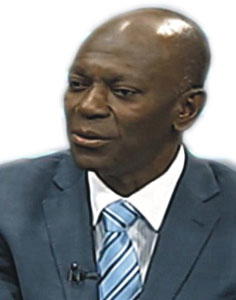
The Executive Secretary, Major Oil Marketers Association of Nigeria, MOMAN, Mr. Obafemi Olawore, last week intimated journalists about efforts between government and oil marketers to avert fuel supply shortages. Clara Nwachukwu was there. Excerpts:
 Preamble
You will recall that last year the government through the Minister of Finance paid us about N345b, which were mainly for 2013 and part of 2014.
However, we still have some outstanding of 2014 and some early part of this year the total of invoices saved is about N164billion on subsidy and on foreign exchange and interest combined the total is around N100billion now.
However the good news is that the Minister met us yesterday (last week Monday) and she actually promised, and gave us schedule of payment between now and the end of March, which to a very large extent was agreeable to our principals.
This means that we believe the Minister and we will only have cause not to do so if at the end of March nothing happens. We believe her and so the product situation that was actually going to go down will have to pick up.
This means that we need to assure ourselves that even if we notice any tightness anywhere, for the sake of yesterday’s meeting it is a temporally tightness and therefore there will be product.
So today, we are not going to be using the word scarcity at all, that shouldn’t be the word for today’s discussion at all. But in all we are going to play our own part.
Q & A
The last time we were here, you said marketers had made a request for an increase in margin, and that the minister had set up committee on the issue. What is happening in this regard?
The committee has not concluded its work. Remember for a committee to do a very thorough job, they need to do a lot of collating of data and there are a lot of things to consider even though we are hard hit, we still believe that we need to do a very comprehensive job. So the committee is working, and we hope that pretty soon, we will be able to conclude our job and submit to the authority that set up the committee.
If I’m not mistaken, you did also say that government will reimburse the marketers for the difference in the shortfall between the old pump price to original pump price and the new one. Is this different factored into the outstanding amount you just quoted to us?
No.
Honestly I don’t have the figures for that and what it is, is that you know when the price was dropped, we already had stock, which means that what we would have sold at N97 and we are told to sell at N87/litre. There was going to be some loss but the government has taken that one up, and I believe that PPPRA has not concluded the job because I don’t have any update on that, but what is gratifying is that we would be reimbursed.
Looking at diesel, if you check the PPPRA pricing template, they recommended N114/litre, but marketers are selling at between N140 and N145, why so much gap despite the fall in crude oil price?
The unfortunate situation we find ourselves in, was and is that as the crude price was dropping, as the international price of diesel was dropping, we devalued the naira.
But for PMS, let me tell you something interesting here, before devaluation the exchange rate for bringing in product was N171.36 to $1 and at that price the landing price was N90.67/litre.
There was a time the exchange rate went to N188 and N188 was for interbank rate, N171 was the Central Bank rate which they gave us. But when it went to N188 the landing cost of PMS, for example, rose from that N90.67 to N98.36. And as at today, when the exchange rate has come to N199 you know that there is no window again, all windows have been closed.
When R-DAS and all the DAS were removed the landing cost rose to N103.45, so you see that the main factor here is the exchange rate. If it moves to N215 the landing cost of PMS will move to N110.84.
Once the exchange rate starts moving especially the way it moved by N10, N20 or N30, it will swallow all the advantages we would have derived from the fall in international oil prices. If we had retained the exchange rate at N171 the story would have been different.
I am sure that if you looked at PPPRA website of yesterday and applying N199, you won’t get them recommending N110. Though I have not checked but we can check before we leave here today. The exchange rate plays a very important part in the whole calculation.
What stops you from collaborating on domestic refining project so that all these costs associated with fuel importation will be drastically reduced and Nigerians will continue to feel your impact in a more positive way?
With due respect to those experts they have completely forgotten that there is one vital step that needs to be taken and that step is that you don’t cap any product and expect a business man to go in there. Once you put it at N97 then what they are saying is that “no matter your production cost N97 is sacrosanct, don’t go beyond it because if you do, you are in trouble.”
For diesel, when the exchange rate was N171.36, the landing cost for diesel was N89.77. When the rate went to N188 to $1 the landing cost went to N96.86. At N199, the landing cost is about N100.
Note that with this landing cost you have not added other charges like distributive margins, you have not added transportation both local and international, there are some costs, taxes we bear on the road when we are going. So, if you add all this to it, there is no way you can sell the product at what PPPRA has indicated on the template.
Even if the market is deregulated the PPPRA will also continue to recommend price, if there is an outstanding and actual subsidy is sustained, it simply means that government is also going to offset the differential
Again, what I believe is that you are the expert here and what you are neglecting to do is, the fact that you are assuming that the money that would have been paid as reimbursement comes to us, is not our money but a cost that we have incurred by borrowing money from the banks and the money is taken upfront by the banks.
When we get the SDN from the government, we collect and give to the banks. They deduct their money before anything else. That is why we are crying if there is any delay.
This is because the banks have the money they gave us and if you delayed they will collect their interest.So you can take whatever days to collect their money they will be collecting there interest, they are calculating immediately government pays you, you indicate to the bank, and the SDN goes to that bank and the bank takes the money, and most of the time we don’t have any change left at all.
So, it isn’t that we are collecting the money, and the money is kept by us, but it is money borrowed from the banks to do business at a loss of N97. And then you are reimbursed and that reimbursement is paid through you to the banks and the banks collect their own upfront, so you do not have anything left for you to do that kind of business.
But the setup is not that easy and not a straight forward thing; you need some conducive conditions to be able to go into it. Basically, the bottom line is there must be that deliberate catch and in this case is complete deregulation.
Once you deregulate, these refineries will be popping up. So we need the National Assembly to pass the Petroleum Industry Bill, PIB, we believe the PIB will go a long way in pushing this. And if you want to do a PIB that is faultless before it is passed, then we are thinking that we are not human beings, why do you have the word amendment?
In the America constitution they have amendment, they have had so many amendments, so it is better to pass it and as we go ahead, if there is any need to amend, we’ll do the amendment that will provide a fertile ground for investors to go into refineries.
Will the schedule of the payment cover all the debt?
Hopefully! That is why I said earlier we are happy and therefore believe the minister, and we want to believe her and we want to believe that she stays with the schedule.
So the threats from the banks are they as a result of these debts?
Yes. Most companies have reached their limit so they can’t get any support from banks.
If it’s so bad, why are you still in business when you are faced with these looming challenges?
Economics tells me that the moment you are able to cover your fixed cost it is better to remain in business. Ultimately, what is the lasting policy to ensure a permanent solution to these challenges?
The solutions are for a complete deregulation not partial deregulation but complete deregulation. I also need to add that deregulation should not be that you can do anything you like. There must be a framework of deregulation.
That is why I prefer what the NCC is doing in the telecom industry. Instead of what our own regulators are doing. Deregulation should be empowered, and should be bold; it should be able to call people to order. There must be a framework or platform for this to work.
I don’t know if they actually got the money back or not. There was a time I read that NCC fined the telecommunication operators some huge amount of money for breaching some rules, and that should be it.
There should be complete deregulation then the regulators should be empowered to carry out their functions. In which case, it would be devoid of government interference, let this people do their work very well, because when you have this interference, we would have a situation where if marketer ‘A’ is sanctioned by a regulator then he would now go to the government and then it is reversed. No. It should be such that the applied sanctions, they stand by that and let the company at fault, comply and pay the price for it.
Because there will always be fall in price, or rise in price you know what happens anytime you have a solution, be prepared for the problem that is coming up. But if you relax, and you do not forget the fact that you just came out of one serious problem and then you forget that something happened, the problem will come up again.
Finally, I want to let you know that we are ready to go into refining but the first thing is complete deregulation.There are some strong argument that suggest at this point we might have full deregulation on stream, like what happened in 2013, if you allow sentiments to always come into play in business transaction there will always be a problem.
One day, I said to myself that if PIB is becoming a very difficult thing to crack, while don’t we take the downstream. So let us take the downstream, and do whatever the PIB is suggesting at the downstream and we move ahead.
It may not look tidy, but must it stay forever because some people disagree. At some point, we must move ahead, a decision must be taken, those that are not happy are at that particular point, let them go ahead come along and then state their grievances. Let the authorities look at their grievances as we move ahead and move on.
You previously said you were being owed N250billion, how come the additional N14billion?
The amount is not static and the figures cannot be static. If nothing is done and we meet again next month, it would have increased. But if something is done about it and we meet next month it will decrease, and that is what we are saying.
…Is it because of the exchange rate?
Apart from the exchange rate, we have not submitted for February. In fact, for January not everybody has submitted. If people who have not submitted for January do so this week, and you come to me next week, the figure will move from N264 billion plus X.
Against the backdrop of this, the emphasis is not actually on what they owe us alone. What was written by the media indicated that it could lead to scarcity. My own appeal is that we should not create a situation where the public will now be reading the figure to give them the impression that there could be scarcity and induce panic.
I am appealing that government has met with us and given us a timetable of payment, which we agreed and therefore we are going to bring in products.
The 2015 budget proposal for subsidy, and from what you are owed, it appears we are going to overshoot the budget even in this first quarter. What is the outlook and is this realistic?
Let me say that, when I read the figure I was surprised. As at the time the budget came in, they owed close to N250billion, which means there is nothing for this year. If there were owing 250billion for last year and they now budgeted for N250billion this year, it means they only made provision for last year, and the assumption is they were not going to provide subsidy for this year. That is my assumption.
We want you to give us an estimate of what the stock level is in order for scarcity not to loom?
The stock was getting low, but because of the meeting we had yesterday, this has started picking up again. All we want is that let each party keep to its agreement.
You don’t seem confident with the agreement?
I am confident.
What are you saying about the new foreign exchange regime because at the end of the day it is going to key into all? Did you table it before the minister, if so, what did she say?
The minister and the governor of CBN are talking in the issue of foreign exchange. This is part of the whole thing that gives us confidence that we should continue to bring in products.
But is the N87/litre sustainable?
The answer is no, it is not sustainable. The higher the exchange rate, the higher the subsidy, which means the more unsustainable the N87 becomes. At N97 we were paying subsidy and at N87 we are paying also. Both figures are not realistic and they could be sustainable in as much as you have the money to pay the subsidy that arises from them, otherwise we would go back to complete deregulation.
Remember that at the time the government came down to N87, if they had not come down and left it at N97, we would have been paying back to government, because as at that time there was an over-recovery. But because they dropped it by N10, we immediately went back to subsidy regime. For me, they would have stayed there, but government always tries to satisfy the masses.
There are speculations that government would not pay the bank interest charges, what is your take on this?
Government is going to pay.
The reason is this, when the statement was made, we did an advertorial and we said government cannot say they won’t pay because if we had an agreement of payment of 45 days and you don’t pay me within that stipulated agreement time frame, and the banks are charging me interest, it is not my fault. We have the PSF guideline and we have an agreement we signed for 45days, so government will pay.
Disclaimer
Comments expressed here do not reflect the opinions of Vanguard newspapers or any employee thereof.