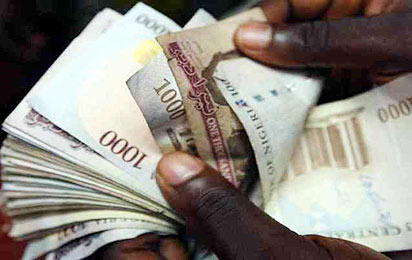
Naira
By Babajide Komolafe
Lending rates in the interbank money market rose sharply to 48 percent yesterday following intense scarcity of funds.

According to data by FMDQ, lending rate for Overnight borrowing rose to 48.42 percent at the close of business yesterday from 23.75 percent on Tuesday. Similarly, lending rate for Secured borrowing rose to 45.83 percent from 22 percent.
The sharp increase in lending rates, according to Kunle Ezun, a currency analyst, was due to lower market liquidity. “Despite the opening balances of N81.6 billion on Tuesday, the funding requirements arising from inter- bank obligations and transactions weighed on market performance”, he said.
Meanwhile the nation’s external reserve on Tuesday fell to $31.68 billion, its lowest level in more than three years.
According to data published by the Central Bank of Nigeria (CBN), the external reserve fell by $489 million from $32.17 billion on February 20th to $31.68 billion on Tuesday, representing 1.5 percent decrease.
The external reserve has fallen by 10.9 percent this year, falling from $34.47 billion as at the end of 2014 to $31.68 billion.
Investigation however revealed that the continued decline of the reserve is driven by increased dollar sale by the CBN in the interbank foreign exchange market, in a bid to keep the interbank foreign exchange rate from the crossing the N200 per dollar mark.
On Wednesday February 18th the CBN closed the of the official foreign exchange market by the CBN on February 18th, citing the need to preserve the nation’s external reserve.
In a statement issued by Ibrahim Muazu, Director Corporate Communication, the CBN stated, “In recent times, however, with the sharp decline in global oil prices and the resultant fall in the country’s foreign exchange earnings, the Bank has observed a widening margin between the rates in the interbank and the rDAS window, thus engendering undesirable practices including round-tripping, speculative demand, rent-seeking, spurious demand, and inefficient use of scarce foreign exchange resources by economic agents.
“This has continued to put pressure on the nation’s foreign exchange reserves with no visible economic benefits to the productive sector of the economy and the general public.
In view of the foregoing, it has become imperative that appropriate actions be taken to avert the emergence of a multiple exchange rate regime and preserve the country’s foreign exchange reserves. “Consequently, we wish to inform all authorized dealers and the general public that, with effect from the date of this press release, the rDAS/wDAS foreign exchange window at the CBN is hereby closed. Henceforth, all demand for foreign exchange should be channelled to the interbank foreign exchange market.
“For the avoidance of doubt, all authorized dealers and the general public should note that the CBN will continue to intervene in the interbank foreign exchange market to meet genuine/legitimate demands.”
Disclaimer
Comments expressed here do not reflect the opinions of Vanguard newspapers or any employee thereof.