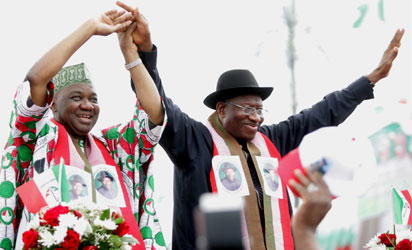
Nigerian President Goodluck Jonathan (R) and Nigerian Vice President Namadi Sambo greet supporters at a ceremony in Abuja on November 11, 2014. Nigeria’s President Goodluck Jonathan on November 11 declared his bid for re-election, vowing to finally defeat Boko Haram whose rise in strength during his first term has threatened the country’s sovereignty. The 56-year-old made the announcement to tens of thousands of supporters in the red, white and green of his ruling Peoples Democratic Party (PDP), at a carefully orchestrated ceremony including patriotic music, dancing, prayers and speeches. AFP PHOTO
By Ikechukwu Nnochiri
ABUJA – Justice Ahmed Mohammed of the Federal High Court sitting in Abuja, Tuesday, referred the suit seeking legal clarification on the actual number of years President Goodluck Jonathan and his Vice, Namadi Sambo have spent in office so far, to the Court of Appeal.
In his ruling, Justice Mohammed relied on the provision of section 295(2) of the 1999 constitution and transferred the matter to enable the appellate court to give interpretations to sections 135 and 137 of the constitution as they relate to tenure of the office of the President.
Justice Mohammed noted that the questions that were posed before the court for determination vis-a-vis the reliefs sought by the plaintiffs, were the same in content and fact with another suit earlier referred to the Court of Appeal for judicial interpretation of the same sections of the constitution.
He stressed that no court had pronounced on the issue before now, hence the need to allow a higher court to intervene.
None of the parties opposed Justice Mohammed’s decision to shift the matter to the appellate court for determination.
It will be recalled that three plaintiffs, Mase Daphine Acho, Sadeeq Umar Sarki (both lawyers) and Murtala Abubakar had gone before the court to challenge the eligibility of President Jonathan to stay in office for another 4 years.
They argued that another four-year term for the President and the Vice-President, Sambo, would amount to a breach of sections 135(2 (a) and 137(1)(b) of the 1999 Constitution.

Nigerian President Goodluck Jonathan (R) and Nigerian Vice President Namadi Sambo greet supporters at a ceremony in Abuja . AFP PHOTO
The plaintiffs specifically prayed the court to declare that having taken the oath of office twice, Jonathan and Sambo have already exhausted the limit allowed by the 1999 Constitution.
They contended that the President and Vice President had held office for two terms recognized by the 1999 Constitution to wit: (i) the first term was held to conclude the un-expired term of the late President, Umaru Musa Yar’Adua between May 6,2010 to May 29, 2011;
(ii) the second term is still being served from May 29, 2011 to May 29, 2015.
The plaintiffs asked the court to declare that Jonathan and Sambo do not have the capacity to serve as President and vice president respectively for another term of four years after the completion of their current terms in office in view of the combined effect of the provisions of sections 135(2) (a) and 137(b) of the constitution.
They want a declaration that the first oath of office subscribed to by Jonathan on May 6, 2010, being the oath of office administered to him to occupy the office of president for the purpose of completion of the un-expired term of office of the late President Yar’Adua must be taken into cognizance in computing the number of years that he has served and can serve as president, in determining the effect of the combined provisions of sections 135(2) (a) and 137(1)(b) of the constitution.
The plaintiffs want an order of court restraining INEC from recognizing Jonathan and Sambo as presidential and vice presidential candidates of the PDP or any other political party for the 2015 presidential elections.
They urged the court to go ahead and determine if someone who was firstly elected as a Vice President, and subsequently took an oath for the office of the Presidency following the demise of the original occupant of the position, spent the remaining two years of such administration, can still claim to have the right to two separate tenures of 4 years provided for in the constitution.
Arguing through their lawyer, Mr. James Ocholli, SAN, the trio contended that since the constitution made provision for a maximum tenure of 4 years each, allowing Jonathan to contest the forthcoming presidential election would amount to allowing him to spend a maximum of 10 years in office contrary to the provisions of the Constitution of the Federal Republic of Nigerian.
“The One term of 4 years cannot be subdivided. Under section 1(2) of the constitution, there cannot be a president for Nigeria by appointment Such presidency can only emanate in accordance with the provisions of the constitution.
“I therefore submit that a Vice President who does not want to have the fraction of a tenure, has an option to decline being sworn in as a President after the demise of the President.
“He ought to have stepped out for the Senate President, after which a fresh election would have been conducted for him to formally take over”, they insisted.
While urging the court to take cognizance of sections 135, 137, 142(1) (2) , Ocholli, argued that “conversely, where a Vice President took benefit of section 142, (1) (2), and completed the tenure for which he is on a joint ticket. It cannot lie in his mouth any longer as is being contended herein, to say that the 2 years he enjoyed by virtue of constitutional provision be discounted so that he will have a 10 year tenure of separate four years and additional two years.
“My Lord, this is because the concept of tenure elongation which has been condemned by the Supreme Court, would have been rubbished by this ingenious argument”, he added.
Meantime, both President Jonathan, his Vice, Sambo and the Peoples Democratic Party, PDP, who were cited as defendants in the matter had earlier sought its dismissal for lack of merit.
Jonathan through his counsel, Mr Kenechukwu Nomeh, in a counter affidavit dated October 24, said he has the legal right to contest Presidency come March 28.
”We submit that the 1st defendant assumed the office of the President sometimes in 2010, by virtue of section 146(1) of the constitution.
“The answer to the plaintiff’s originating summons can be found in the combined reading of section 137(1) (b) and section 318 (1).
“In line with section 137(1) (b) of the constitution, for the 1st defendant not to be qualified to stand for election to the office of the President in the forthcoming 2015 general elections, he must have been elected to such office at any two previous elections.
“By the affidavit evidence submitted before this court, the parties are in agreement that the 1st defendant has been elected to such office, as president only once at the previous election.
“Under Section 142(1), the 1st defendant was only deemed to have been elected as Vice President in 2007 when he was elected along with the late President Umaru Musa Yar’adua.
“It is therefore not a correct statement of the law to say that an elected President cannot be in office beyond 8 years, that is not correct my Lord.
“We respectfully submit that the constitution itself made provision with regard to scenarios where the President can actually stay beyond eight years if the President is doing a second term”, Jonathan’s lawyer argued.
The PDP through its National Legal Adviser, Mr. Victor Kwon, equally challenged the competence of the suit.
Disclaimer
Comments expressed here do not reflect the opinions of Vanguard newspapers or any employee thereof.