By NKIRUKA NNOROM
Two weeks ago, the Chief Executive Officer of the Nigerian Stock Exchange, NSE, Oscar Onyema briefed journalists on the achievement of the Exchange in the out-gone year and some of the strategies the management has put in place to ensure a robust market in 2015. NKIRUKA NNOROM was there and captured it for Vanguard.
How successful has the market making programme been?
Market making programme recorded modest result in 2014. We will provide you with detailed analysis on that in terms of participation rate and the liquidity they were able to inject into the market. We expect that they should be able to do more, especially if we are able to get appropriate financing arrangement and securities lending becomes fully operational.
What is the contribution of other floors of the Nigeria Stock Exchange, NSE, to the volume of trading recorded?

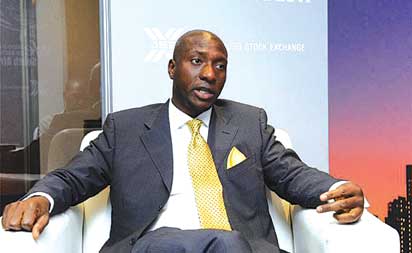
Oscar-Onyema,-CEO,-NSE
The other floors outside of Lagos floor contributed only two percent to the trading volume. Considering that we have 14 floors, the amount of trading that is occurring on the other floors has not been quite impressive and most of that two percent is actually from Abuja. So, we will make changes to optimize the use of the other branches.
Having postponed the deadline for compliance to the minimum operating standard by stockbroking firms, can you give us the new timeline set by the Exchange?
Just to be very clear, we did not postpone the deadline for meeting our minimum standard; it was the SEC that moved the deadline for recapitalization to September. We did not move our minimum standard, so it still remains the end of 2014.
What we released was an implementation timeline. So, as you know, we are expecting that dealing members will begin to turn in their financial statements and their reports to the Exchange by the end of March. So, we cannot go on until we receive those reports and then we will then schedule an inspection visit. We will go and inspect them to be sure that they actually have what they claimed.
And then, when we’ve completed our inspections, that is when we will begin to talk about remedial actions and enforcement and all of that will take us till December 2015. That does not mean that somebody that has not meet the standard should then relax, the timeline remains.
Will the NSE claim that it protects investors with the level of delisting going on. Also, post delisting, is there is anything the NSE is doing to ensure that retail investors are protected.
In the life of any exchange around the world, the reality is that you are going to have listings and delistings on annual basis. Companies will list for various reasons, but you will also have delistings either those that do not meet your standard any more or those that have committed regulatory breaches or those that voluntarily want to delist because it is not in their business interest anymore to continue to remain listed.
We did not put it as something on our list of to dos because we believe that we have robust rules around the protection of retail investors around listings and delisting and we intend to continue to enforce it. The items we put on the list are new initiatives we are working on or we will start working this year, but all of them are things we intend to deliver this year.
How much awareness programme is the Exchange considering to increase participation of domestic retail investors considering the Road Shows it is embarking on to other countries?
In my speech, I did say that we will focus on increasing local domestic investment and outreach to local investors. We have fine tuned a plan and it is going to be very targeted. So, you will not see necessarily having big events in the name of targeting domestic investors. It is going to be targeted and it is gong to be really focused on having very significant impact. Yes, we will be hosting an event in Zurich, Switzerland on January 19th, and it is part of event we agreed with the Nigerian ambassador in Switzerland to host on our way to Davos for the World Economic Forum.
So, we will be talking to Nigerians in diaspora – people that actually requested that we talk to them on opportunities that exist in the Nigerian capital market. So, we will go there and make case for them to invest some of their money in Nigerian capital market. As you know, Nigerians in diaspora account for the biggest inbound remittances into the country and there is no way we will not get a portion of that into the capital market.
What does the Revised Fee structure you spoke about mean and does it entail reduction in fees?
It is not necessarily going to be a reduction in fees. I should explained that one of the things we delivered in 2014 was the transaction cost analysis, which we worked with the Securities and Exchange Commission, SEC, Central Securities Clearing System, CSCS, and broker dealer community to provide using an external consultant. The analysis showed certain things; first one is that our pricing is not competitive compared to other similar markets, to markets in emerging markets or those of developed markets.
For both implicit and explicit cost of trading, we also looked at the listing fees things like. You should know that because of the structure of the way pricing happens in the Nigerian market, the NSE cannot just make unilateral decision on even our own fees because our fees account for the 10 percent of the cost of daily trade.
So, if you want to get impact, then you have to engage everybody that is involved in daily trade, so that we can first of all optimize the fee structure to encourage liquidity in the system, to encourage people to put more money in the market and to encourage tighter spreads in the bid aspect. So, those are the kind of changes we want to make in fee structure that will facilitate a higher quality market. If in the process of doing that we cut fees, that is all well and good.
Disclaimer
Comments expressed here do not reflect the opinions of Vanguard newspapers or any employee thereof.