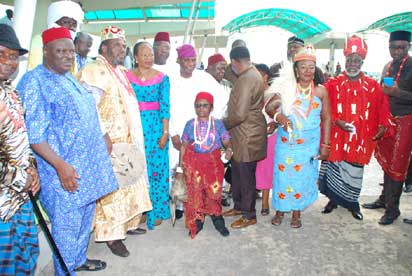
L-R- DG of CBAAC Sir Ferdinand Anikwe, Pete Edochie and other Nollywood stars cultural festival in Yenagoa
ByJAPHET ALAKAM & CHRIS ONUOHA
Culture is born out of an aggregation of people who come together for the sole purpose of finding meaning to their lives. Culture as an important ethnic identity, consists of language, ideas, beliefs, customs, taboos, codes, institutions, tools, techniques, work of art, rituals, ceremonies and symbols.
When the various issues that are embodied in culture are put together it could led to development of the society. But, there are ways of life that may negate development and values especially when such a culture fails to adapt to changing challenges. It is for this reason that development can only take place when culture is ready for it. Culture then must be seen as a dynamic mechanism that adjust and adapt to external and internal conditions of existence to satisfy human, biological and social needs, so it can be said that development is midwived by culture.

L-R- DG of CBAAC Sir Ferdinand Anikwe, Pete Edochie and other Nollywood stars cultural festival in Yenagoa
Based on the above, how can culture be utilized to drive and transform African economy and social wellbeing of the people? This was basis of the discourse last month, when the Center for Black and African Arts and Civilization (CBAAC) in collaboration with Bayelsa State Government and University of Port Harcourt hosted the International Cultural Festival and Colloquium in Yenagoa. Papers from various academic dons with critical issues bordering on cultural renege and negation were presented at the discourse.
Prof. Sule Bello Suleiman, Chairman, African Research and Development Agency, Kano State, who was the Keynote speaker brought to limelight, how Africa with its endowed human, material and ecological resources lags behind in the global developmental reckoning. While attributing some of the problems to the lack of proper focus on values of culture by government, he said that insecurity and disunity among ethnic entities impedes the process too. Furthermore, as he extols the laudable impact made by the entertainment industry which has internationalized the continent’s culture through films and music, it is worthy of note that culture through this sector, has in no small measure moved both the economy, culture and social life of the African people to a height in the global market aside oil.
It is a known fact that African Nollywood is ranking third in world film making industry trailing behind Hollywood (USA) and Bollywood (India), with our Star actors listing in Oscar Award and other world Movie Awards, while Music has gripped a hold on international scene including the prestigious World Grammy Award nominations. This diaspora reach through our cultural endowment is fully packaged with our traditional attributes and cultural heritage.
The Director General of CBAAC, Sir. Ferdinand Anikwe, on his part, opined that culture presents itself as both the foundation and the root of human development, whether as individuals or groups; but noted that “it is saddening that we are neglecting our own culture to our peril.”
He made reference to seeming wave of cultural glories, realized from the African entertainment sector which have impacted immensely to the world civilization. “African actors and musicians have placed the continent strategically in the world map through the showcase of our language, lifestyle, costume and fabrics including our indigenous foods in their home videos and music videos.” Anikwe then called on African States to evolve both policies and programmes for the internationalization of her culture through art, music science and technology, education, tourism and diplomacy by revamping the spirit of the various cultures.
Speaking on the Culture as a ‘Viable Mechanism for Evolving Authentic African Identity’ Adediran Adekunle Amos of the Social Studies Department, School of Arts and Social Sciences, Federal College of Education, Osiele, Abeokuta, said that Cultural identity can be expressed through certain styles of clothing or other aesthetic makers from different ethnic group. These identities identify Africans from other people, thereby making them more unique wherever they find themselves. That is why Africans in diaspora are more identifiable with their traditional and cultural make ups.
On the contrary according to him, certain ways of life may negate development and values especially when such a culture fails to adapt to changing challenges and development can only take place when culture is ready for that change. “Every development irrespective of its dimension is culturally conditioned and it must be used as a framework or platform for development in Africa. The relationship between culture and development is symbiotic; just as culture provides the milieu for development; developmental changes serve to constantly prompt the culture to its responsibilities towards the individual or group.” He added.
Dr. Anthony Onwuma of CBAAC in his views argued that you cannot drive the economic development of a nation outside of their culture. He added that when you look at the Asian Tiger’s success story today, it is because huge attention to their culture came into play which supposedly was the bedrock of the financial empire they built today.
Dr Aminata S. Kiello of the Socio-Anthropologue S/C Fonds de Solidarité Africain B. P. 382 NIAMEY, NIGER, while presenting a paper titled “Popular Culture and Development”,using the descriptive diagram of the Fulani tribe to give an insight of the challenges certain culture have on the development policy in the continent.
“Development brings more or less easy lifestyles, but everyone should better assess the impact of its power and success, the corollary of which is: overwork, stress, psychosomatic illness, throwing out of common life and dehumanization, suicide, etc. The Occident, winner of history and thus Leader of the vanquished, is forced today to re-learn the “living together”, easily practiced by any Fulani of Bitinkodji.”
Looking at it from the views of Dr. Abu Edet of the of History and International Studies, University of Calabar, in his presentation titled “Ancient Treasures of Nigeria: As Instrument for National Development Growth and Promotion of External Relations”, centered on the discoveries, preservation and curatorship of the ancient treasures in museum collections, harped on the need to sensitize everyone, to the fact that the reconstruction of the past is only possible when their heritage is carefully protected and patiently studied in a scientific manner. “If Nigeria is to keep its integrity in the cultural sector of preservation of the nation’s cultural property, it has to, at all cost; train all professionals in the preservation of Nigeria’s heritage. This is in view of the indispensible role of museum professionals as catalyst in museum development matrix.”
Disclaimer
Comments expressed here do not reflect the opinions of Vanguard newspapers or any employee thereof.