By Victor Ahiuma-Young
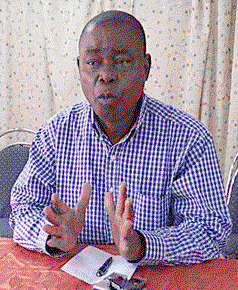
NIGERIA Labour Congress, NLC’s new General Secretary, Dr. Peter Oso-Eson, was in Lagos where he had an interactive meeting with a cross section of journalists. In this piece, Labour Vanguard brings to its readers, what the new scribe says is his mandate among others.
 What is your agenda in NLC?
The agenda that I have arose from the terms of reference which the National Executive Council, NEC, of the NLC gave to me on my appointment. The NEC gave me mandate to reposition, reorganize and revitalize the secretariat to play its proper role in NLC.
These were included in my letter of appointment and that therefore sets for me the frame work for my agenda. My agenda,first and foremost is to focus on the secretariat.
Because you know the secretariat is the engine room of the congress because it is the executing organ of the congress. Decisions taken by organs are translated into action by the secretariat and so, for me, it is to look at the secretariat and identify what I see as problems and how to overcome those problems.
One is that we want a secretariat that will work in unity because part of the problem we noticed that has bedeviled the functioning of the secretariat over the years is that there was lack of cohesion, there was lack of unity of purpose in the secretariat.
Partly because of either the way things were done by the leadership of secretariat or by the way departments were not allowed or empowered to function effectively.
If there is a department charged with a specific responsibility and today you find that some function of that department has been performed without even the knowledge of the department or the head of the department. Those things undermine the way you work effectively.
Part of my goal is to ensure that we have a structured secretariat where departments are allowed and empowered to perform their functions under the leadership of the general secretary and the collective decisions that are taken by meetings of the heads of the departments. Also, apart from just the administration and executing decisions that are taken, the secretariat of the NLC is the anchor point and the engagement point with the industrial unions.
We need and we hope to be able to relate to the leaderships of industrial unions in such a way that when they have problems and they want our intervention or assistance that we are there and we work with them effectively.
Another challenge to me is the relationship between the secretariat and our state councils. We have our state councils but whatever they do is regarded that the NLC did it. So, the image of the NLC is affected majorly by the way our state councils functions. We need to be able to work with our state council in a way that projects a positive image of congress.
I don’t want to go into details but I do know that in some cases, there are problems, some of them intermingled with politics. We are hoping that we will find a way to work together to find a way to improve on those things.
The second is seeking to revitalize the labour movement and I take that very seriously.
When we see for instance, problems in the students movement, because of the very positive role the students movements had played in the labour movement over the years.
We want to reach out in advisory and other capacities to try to see if we can bring ideas and ideology back to the functioning of a contestation within the movement. In the same way, within the labour movement itself that we want to try and bring back some logic of ideology driven work in the unions so that we do not have unions that completely lack a working class consciousness.
We know that the labour movement is not made up of socialist ideology only or people with socialist meaning, but we need to at least, be conscious of the fundamental role of the working class consciousness in defining the things that we do. So, through education programmes, we have always had education programmes but we need to relook at the content of our education programmes to see over the years where we lost the ideological touch that is then weakening this working class consciousness.
So, for me if within my tenure I am able to achieve even 50 percent of these two broad platforms I will be happy that we started something, that’s for the first part of the question.
How does NLC see the austerity measures announced by the Federal Government recently?
We are convinced that the starting point for austerity should be a cut-back in the cost of governance. We’ve always argued that the cost of governance was excessive, there was a lot of waste and that government can efficiently function with a much leaner expenditure pattern.
There are those who interpreted that to mean that in order to have a leaner expenditure pattern, it is to shed either institutions or to shed workers. We disagree with that position.
Our position is that with the employment position in the public sector today, most of the costs that are running and weighing heavily down on the finances of government, have nothing to do with the remuneration of the workers.
It is to do with the bloated prerequisites attached to the management people who are paid under the political officers’ scheme; both in the ministries – like Permanent Secretaries, for instance, come under that, Directors Generals and that ; and of course, the National Assembly, itself. There is a lot of waste going on. So, this period of austerity, should avail us the opportunity to revisit and streamline the cost of governance.
That is the starting point.
Two, the government has come through the Minister of Finance, to say that one aspect of the austerity is that they are going to raise taxes on what they call luxury goods. We agree in principles with this. Because -you see, the extremely skewed distribution of income in our country in which less that 10 per cent of the population controls more 70 per cent of the total income and wealth. Most of those very rich people are not paying tax. Therefore, there must be a scheme to ensure that we get them to pay adequate taxes.
But in determining those that are luxury goods, we need to be careful to actually determine what are those are goods that are consumed by the rich; and goods in this category; you find that you go to our tour airports, the private jets’ congestion in most our airports today, indicates a country that is wantonly rich even in the midst of the poverty we are talking about.
In fact, the joke among the rich today is, “how many jets do you have?” If we tax for instance, the acquisition of private jets exorbitantly, that will be something that is welcome.
In the same way, there are other frivolous ways of consumption. There are bottles of celebrity wines; champagnes and all that in which to buy one bottle, two minimum worker’s salary need to be combined even to buy a bottle. Those who consume such commodities, they should be taxed and taxed heavily. So, we need to define correctly what the luxury goods are and we agree with that.
How will congress react should government decide to retrench Nigerian workers as part of the austerity measure?
When it comes to retrenchment, we have taken the position all along, that we will resist any retrenchment and if government were to try to put the burden of this adjustment on the workers, the Congress in unity with its counterpart, the TUC, will stand ready for whatever is required in order to prevent that from happening.
Let me also that in terms of the impact on the workers, the areas that worries us very seriously is that crude prices are falling. In other countries, what that is immediately translating to, is that the price of petroleum products and pump head is coming down. In the United States, in the last one month, the price of a gallon of petrol, has come down from $3 to$2, in response to this price adjustment.
In our country, we are not allowed to enjoy that benefit. What government is doing is that in order to shore up its naira revenue, it has gone to devalue excessively, the naira; $13 devaluation in one day, and then a continuous process of depreciation.
What that does, is that, because we import petroleum products largely, the gains from the falling price of crude which ought to translate to us consumers, is prevented by that devaluation; because, by devaluing the cost of the head price , it might even increase and we say that that is wrong and with the benefits of the falling price of crude, must be translated to Nigerians, and that , therefore, going forward, we want a situation in which the pump of petrol and other petroleum products should actually be adjusted downwards.
What is congress position on the socio-economic and political situations in the country?
I think is a very genuine one but you know it’s like asking me to deal with the whole burden of this country but we recently have become very worried. The socio political problem in our country today frightens u maybe I should use this because we have never rarely given this to the press that it worried us so much recently that we decided that apart from the issues in the press that we needed to address a formal letter on the situation in the country to the president of the nation and we did.
We’ve not released that letter to the press. We will take decisions forward whether to base the type of response that we get. But we thought that there are now very weighty issues. Number one the security situation in our country in which we find a band of insurgence able to take territory and we look at our military they area unable to cope with the situation.
For a military that we used to project as the pride of Africa in the various missions that we go to, we are at a loss as to what is the problem and we think that there is need for some of this matters to be addressed in that same vein, we are worried that the country is at war but the body language of our political leaders does not suggest it, we’re going around as if we are not at war.
The civil war, the Nigerian biafran war we knew what was the body language, we knew what the national position of that war was and we have this war going on but we are going on as if nothing is happening. In the face of all this we are finding wanton and arbitrary exercise of power.
The invasion of the national assembly for instance we made our poison public on it but all this events happening in our nation frighten us that we are getting into a situation that may actually undermine the survival that I, you and all of us fought for decades to reclaim and therefore we are extremely want that is need to change the way we are dealing with this issue very quickly to ensure that we do not endanger our nation and this were doing like I said in two ways, one on specific issues you hear of us when we issue statement but on some particularly on security issues because we have also been concern that security issues are not things that should be politicized.
So when we see political parties trying to score political capital on the security matter, we condemn them no matter which parties they are and so we think that there is need for some avenue we can deal with the security matter that will not be put in the political realm and that is why we have had to write the letter I mentioned to Mr president on his leadership in relation to this issue of security and some of the things happening in our country and we hope that Mr president will take that letter seriously and depending on the type of response we get we will re-evaluate whether we will have to release and make public that letter. So broadly these are consensus and we will try to deal with them.
Few years ago a study group in USA predicted that the Nigeria state would disintegrate in the 2015 and today indices of a failed state stare us in the face; collapsed infrastructure, inefficient health care system, insecurity and so on. What is your take?
The study of a US Think tank study is what we are all quoting and continue to quote that Nigeria will disintegrate by the year 2015. I am confident as Nigerian and the labour congress is confident as a per national organization that that prediction will fall flat on his face.
Nigeria will not disintegrate in 2015. Yes we have this challenges we however are confident that Nigerians will rise to the challenge and deal with this challenges. Nigerians have faced challenges in the past probably more severe than that we did not disintegrate. I believe that this country has so much uniting it.
If we disintegrated today, my daughter who may be married to somebody from the north, where will she go? Benson himself who may have taken a wife from my village where will they go? The youths of this country have created a magnitude of socio network and nexus that will not be so easily dissolvable.
There are the business class these people we are talking of who are smiling for the bank never mind when it help them to promote where it comes from in order to maximize the profit either from political investment or from business investment they will tell you they are from here but when they have played that game of knocking the heads of the common from the different groups against themselves, you see them in the night and in the evenings enjoying their benefits and celebrating without recourse to tribe, religion or any other thing.
The various elements that cement us we have grown them in the fifty something years of post independence existence that it is not going to be that easy to dissolve. So in a simple answer to your question believe that the prediction will not come true. We of course face this challenges we will over come them but what we need to agitate for is that we do not need to take decades to overcome them, we can overcome them in the short run if the right political leadership is provided.
Disclaimer
Comments expressed here do not reflect the opinions of Vanguard newspapers or any employee thereof.