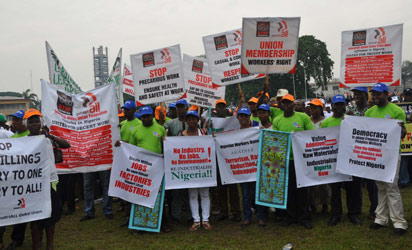
Cross section of Nigerian workers, during the 2014 Workers day commemoration, THEME: Building Enduring Peace and Unity, Panacea for Sustainable National Development, at Onikan, Stadium, Lagos Island. Photo: Bunmi Azeez
By Victor Ahiuma-Young
Inclusive and Sustainable Industrial Development: Africa Agro Industry for Food Security, was the theme of a one-day round-table organized in Abuja by affiliates of IndustriALL Global Union Federation, Nigeria Labour Congress, NLC, Trade Union Congress of Nigeria, TUC, and Federation of Informal Workers’ Organizations of Nigeria, FIWON,with support of the Friedrich Ebert Stiftung, FES, to mark Africa Industrialization Day 2014.

The round-table acknowledged a few positive developments in the economy especially in the agricultural sector with increased local production particularly in the agricultural and cement sectors, the Kano State government and its massive investments in Small and Medium Enterprises, SMEs, reported to have generated over 300,000 jobs as well as the Osun State Government which has established a local garments factory to produce school uniforms as well as an educational electronic tablets assembly plant came up for special mention.
It also appreciated progress in the automotive sub-sector which has witnessed the establishment of 32 automobile and automobile parts assembly plants since commencement of implementation of the National Automotive Policy.
The roundtable equally acknowledged the Federal Government’s recently launched National Industrialization Policy, saying it is a commendable attempt to articulate a roadmap for Nigeria’s industrial development, but doubted faithful implementation of the Policy.
While participants lauded interventionist role of the N00 billion cotton textile and garment fund helping stem decline in the sector, they called for recapitalization of the Bank of Industry, BoI, for the provision of affordable capital for local manufacturers, especially small and medium scale producers which have enormous growth and employment generation potentials.
They lamented that many other sectors of the economy continue to record poor performance even as the share of manufacturing in the GDP remains a worrying six per cent, notwithstanding the recent rebasing of the GDP which makes Nigeria nominally the biggest economy in Africa with a GDP of US$ 510 billion, and with impressive annual GDP average growth rate of 7.4 per cent in the last decade. Growth has not been inclusive, broad-based and transformational.
The roundtable lauded successful launch of the Nigeria Industrial Revolution Plan, NIRP, by the Federal Government, noting however that policy making processes and implementation could benefit from the involvement of critical stakeholders, particularly organized labour.
According to the roundtable, the “biggest problem facing rapid industrialization in the country over the past decade has been inadequate infrastructure in general and lack of power supply in particular. Power generation has remained 4,000 megawatts on the average, about the same figure recorded for 2013, one full year after completion of the privatization of the electricity generation and distribution infrastructure in the country. This is a figure which translates to less than 30 watts per capita when average for developed economies is 2,000 watts per capita and therefore grossly inadequate for home and industrial needs. In fact, over 60 per cent of the population are completely excluded from electricity supply.
“In spite of the challenge of global competition the manufacturing industry as a whole generates around 72 per cent of its own energy needs at great cost. But operating with generators greatly increases the cost of manufacturing goods, making it difficult for Nigerian goods to compete with cheaper imports. The problems dovetail into the informal economy with agonizing reports by informal sector operators losing their livelihoods as a result of high cost of generating energy through electric generators.
“The Federal Government must develop and follow an industrial policy that is supportive of local production through deliberate strategies of promoting competitive production through aggressive infrastructural support and a mix of well thought-out macroeconomic framework that rewards value addition and employment generation. The need to address the unrelenting spectre of violence of extremist religious and criminal gangs especially in the Northern parts of the country was also highlighted.
The communiqué by the participants called on government at all levels to “take the lead in patronage of made in Nigeria products, firm up regulatory controls on smuggling and dumping of sub-standard goods, revisit failed privatization bids especially in the iron and steel sub sectors, stop indiscriminate granting of import waivers, ensure that the Free Trade Zones really promote industrial development and fair labour practices as well as demonstrate strong leadership through proactive enforcement of laws and policies that support local production and industrialization.
Failure of privatisation
“This is a huge gap between the electricity needs estimated to be about 25,000 megawatts currently and current electricity generation of 4,000 megawatts. That this gap will be further widened with increasing demand for electricity that is estimated to double in 2025.”
The roundtable participants decried multiple unresolved issues around transparency of the privatization process, declining power supply and failure to invest massively in the areas of generation, transmission and distribution infrastructures by the new electricity companies and government.
According to them, “the performance profile of previously privatized public enterprises in Nigeria has not given people hope with recorded dismal outcomes in terms of asset stripping and outright plant closures as is the case with NITEL and Ajaokuta Steel Mills.
They called on “government to recognize that electricity generation is strategic development needs that cannot be left wholesale to the vagaries of the market and urged government relook at the enabling laws to provide for community ownership and state ownership in critical areas of rural and peri urban needs. This will help address the problem of prohibitive cost of electricity supply in rural, peri-urban and poor urban neighbourhoods.”
Disclaimer
Comments expressed here do not reflect the opinions of Vanguard newspapers or any employee thereof.