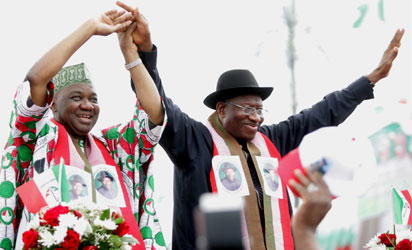
Nigerian President Goodluck Jonathan (R) and Nigerian Vice President Namadi Sambo greet supporters at a ceremony in Abuja on November 11, 2014. Nigeria’s President Goodluck Jonathan on November 11 declared his bid for re-election, vowing to finally defeat Boko Haram whose rise in strength during his first term has threatened the country’s sovereignty. The 56-year-old made the announcement to tens of thousands of supporters in the red, white and green of his ruling Peoples Democratic Party (PDP), at a carefully orchestrated ceremony including patriotic music, dancing, prayers and speeches. AFP PHOTO
By Douglas Anele
The people who drafted the constitution apparently did not envisage that a Vice-President who takes over after a President had died in office and who subsequently gets elected on his own merit might wish to contest for a second term.
Otherwise, they would have inserted a provision that either limits such a person to only one term of four years in addition to the period he or she held office to complete the unexpired term of the predecessor, or made it explicit that serving out the remaining term of the last occupant does not prevent the successor from going for two terms of office. Hence, since the 1999 constitution does not explicitly exclude someone in Goodluck Jonathan’s situation from seeking re-election, it would be sheer waste of time and effort for the opposition to go to court on this matter.

Nigerian President Goodluck Jonathan greets supporters at a ceremony in Abuja on November 11, 2014. AFP PHOTO
Having argued in the preceding paragraphs that based on the 1999 constitution President Jonathan can still contest the upcoming presidential elections, it is appropriate at this point to consider whether he deserves to be re-elected or not. This issue can only be properly decided after an objective assessment of his performance in the last five years. The fundamental duty of any government is provision of adequate security for everyone living in the country.
In this all-important aspect of governance, Jonathan’s government has performed below average. This is because armed robbery, kidnapping and brutalisation of ordinary citizens by soldiers and police personnel have increased dramatically since 2010. But the greatest security challenge to President Jonathan and the security agencies now is the Boko Haram phenomenon. A lot has been said and written on the hideous atrocities of the Islamic fundamentalist sect. However, the increasing audacity of Boko Haram in unleashing violence and anguish on Nigerians, epitomised in the kidnap of hundreds of female secondary students at Chibok about two hundred and thirty days ago, is a ringing indictment of Nigeria’s security forces.
Of course, decay in the security apparatuses of government began even before independence in October 1, 1960. Nevertheless, in recent years the situation seems to have grown worse. Aside from corruption, inadequate funding, nepotism, and preference of mediocrity over merit in recruitment and promotion, there is high-level sabotage of federal government’s efforts to defeat Boko Haram by few disgruntled members of the Northern establishment to frustrate Jonathan’s administration.
Unfortunately, at the beginning President Jonathan, like former President Olusegun Obasanjo, underrated the security threat posed by Boko Haram, which explains the sluggish and haphazard response of government to it. Presently the problem has worsened considerably. Without equivocation, therefore, we can say that on the issue of security, the President’s performance is not encouraging.
The next criterion is the economy – has our economy improved since Goodluck Jonathan became President? It would take several large textbooks to answer that question adequately. But certain indicators seem to suggest that the economy has not been moving in the right direction since 2010 despite its rebasing by government, which appears to project a robust economy bigger than that of South Africa. One, Nigeria still relies heavily on export of crude oil, a trend that began in the 1970s, which makes the country vulnerable to the vagaries of crude oil prices in the international market. Inspite of President Jonathan’s modest achievements in agriculture and exploration of the economic potentials of solid minerals, the non-petroleum sectors of Nigeria’s economy remain underdeveloped and rudimentary.
The manufacturing sector, stymied by decades of epileptic electricity and shambolic policy formulation and implementation, is not expanding as it should for the actualisation of growth targets set by the federal government to meet the millennium development goals. The problem of erratic power supply nationwide remains a sore point against Mr. President. While some experts claim that recent reforms by government in the power sector are steps in the right direction, since Jonathan became President Nigeria has never generated up to six thousand megawatts of electricity, whereas the country needs at least about twenty thousand megawatts to meet her energy needs.
In the transport sector, there is some improvement in federal airports and road infrastructure; yet the southeast still has the worst network of federal roads in Nigeria inspite of the promise by Jonathan to address the problem if he were elected in 2011, a situation that has almost crippled the movement of people and goods within the zone. Nigeria’s railway system is still chronically outdated, and the waterways are underutilised. Under President Goodluck Jonathan, the economy as a whole has been tottering: for most ordinary Nigerians the suffering continues. In my view, the President and his economic team have not managed our economy with the appropriate degree of discipline and bold creative imagination that can make a positive difference in the lives of Nigerians.
The President has not done enough to discourage official corruption in the country – indeed his actions sometimes seem to downplay its significance as the deepest single cause of our underdevelopment. Many Nigerians strongly believe that corruption is thriving under Jonathan’s presidency, and that Mr. President himself does not project an image of a leader who really wants to end the culture of financial imprudence and rascality in governance.
As a corollary, President Jonathan is wedded to the obnoxious practice of running a bloated government. At a time when Nigeria needs to invest her financial resources wisely, maximising every kobo that accrues to the federation account, the President maintains an oversized cabinet that, collectively, does not add commensurate value to the system. As a paradigm example of a wasteful leader, he went on a pilgrimage to Jerusalem with a retinue of aides to pray and seek divine intervention for the country’s mounting problems. If Nigeria had a National Assembly that takes it job seriously, it would demand to know how much was spent on that wasteful and ridiculous jamboree. But Nigerians know it would be much easier for an elephant to pass through the eye of a needle than for members of the National Assembly to insist on accountability from the President, because our democracy is Animal Farm democracy.
Limitations of space prevent us from using other criteria to assess the President’s suitability for re-election next year. But from our brief analysis thus far, the most reasonable conclusion is that, based on performance, the President should not be re-elected. Without a doubt, his administration has recorded some modest achievements; yet they are not enough to secure him a second term of office. Now the question is, does the main opposition party offer a better alternative? My candid answer is – No. The most viable candidate of the APC, Muhammadu Buhari, had lost the presidential elections three times and, as I argued sometime ago, contradictions surrounding his fourth attempt vitiate his electability. Even with all the money at his disposal, Atiku Abubakar just does not have enough charisma and political capital to neutralise the incumbency factor on the side of Jonathan.
Concluded
Disclaimer
Comments expressed here do not reflect the opinions of Vanguard newspapers or any employee thereof.