By CHRIS OCHAYI
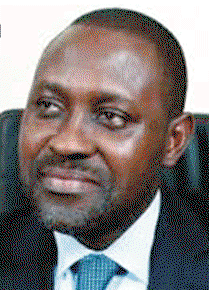
The Managing Director of Oando Gas and Power, Mr. Bolaji Osusanya, recently emerged President of the Nigeria Gas Association, NGA, at the just concluded NGA West Africa Gas Strategy conference held in Abuja.
 In this interview with Sweetcrude, he called for integration of processes for gas development. Excerpt:
The NGA West Africa gas conference has just ended, as a major participant, what are the issues discussed?
The issues discussed will provide a veritable platform for interfacing with government and other stakeholders on gas related matters, and also creating a platform for networking.
There are four tenets of our association, so I think the first thing I will do is to further entrench that. But in line with that, there are some key initiatives that we would like the Council to look at in the next two years. One of it would be how to broaden the participation base in the association.
So far, we have limited it to practitioners and the more integrated we see our market be, the more it is clear to us that we need broaden the membership of the association. We need not only look at gas practitioners but also look at people who are in one way or another connected in the value chain. So that mobilisation of a broad spectrum membership would be a key initiative.
The second initiative would be our connectedness. We have been passive members of the International Gas Union. We have also been passive members of other regional associations that have evolved, the Africa Gas Association.
We will certainly try and look at them and there is even more push from the conference to be at the fore of creating a West African or a regional gas association. We can then have an integrated strategy and learn from ourselves given that different people in the region are doing different things.
On the African scale, you must know that apart from the Algerian and Egyptian market, there are new comers to the gas base. There are also Mozambique, Tanzania, South Africa, so I think there is clarity as to why we should encourage that connectedness with such associations.
The third initiative would be actually creating value for members. It is getting more expensive to belong to voluntary association.
We are under great pressure to show value. So people come to our meetings because of what they derive and the only way we can do that is to make sure there are dividends for their participation. And what do I mean by dividends.
They must be richer in terms of their knowledge base; they must be better in terms of networking; and they must be better in terms of ability to support their opportunities whether it is by lobbying, by connecting them to studies.
We must be seen to be adding value in one way or another so that we can sustain their membership. So those are the three keys over and beyond the tenets that we already have.
There was much focus on West Africa during your conference. Specifically what are the challenges that you have identified and what solutions have you proffered?
The conference has proffered several solutions on the regional side of the business. We had very interesting conversation in the morning that centred on the idleness of the existing infrastructure, the discovery in other states and the need to create flexibility within that infrastructure.
I think today we learnt interestingly that we are now even to begin to consider revising flows on the West African Gas Pipelines. So today, we have gas in the region and we have an infrastructure that is flexible enough to take that gas to markets that need them.
Today, we even heard that there is a plan to expand and extend the infrastructure beyond the three countries that it covers. So there are things to do, to build the pipeline and extend it from Tokoradi in Ghana further west. Or to take it further north to Burkina Faso, something we never contemplated before.
So I am pleased that the change that happened in the last few years is beginning to gain momentum and sooner than later the whole region would be covered. I worry for our country because I don’t think we have put the agenda on the fast track that it deserves.
But I guess that is something that we would like to do as an association to fast track the good steps that are already being taken to get us quickly to close the gap and pro-act the future because we already have a clear scenario of what that future is.
It is a future that demands about 7trillion cubic feet, tcf, of gas from us domestically and several other volumes for the region. So we know what that future is. So I think the issue now is how to get ourselves going knowing that there are no short-cuts in our industry.
Looking at the Nigerian market, power generation has dropped to 3,100 megawatts, MW, and the 4,000MW capacity is not sustainable due to gas shortages. As the NGA President, which is a major stakeholder in the gas market, how can Nigeria overcome this problem of gas shortage?
I don’t even think we need to say anything new from what we have said before. And I think we have the assurance and if you go by what the Group Executive Director, GED, Gas and Power, Nigerian National Petroleum Corporation, NNPC, Dr. David Ige said, we already have the assurance that in a short term that those power plants that are stranded would be supplied.
The lesson is the need to be integrated in our developments. Those power plants have no business being built without gas being provided in the first place. So I believe the lesson is that we will be more integrated.
Having said that, we have to focus on the future. We know what the power short fall is; we know how much more we need to provide for.
We know that gas is the future and that gas will be relevant fuel in the energy race going forward. So the future is now, we have to start planning how to accelerate that development to meet what we already forecast.
That is why I am saying as President, NGA will really mobilise members and other stakeholders to start to do what they need to do today. And we will do it in an integrated manner this time.
If you are incentivising price, sensitise everybody. If you are putting in a new regulation, put a new regulation that at least considers everybody and in that way we all move along.
As a key player in the industry, even if we are able to produce enough gas for domestic use, do you think that Nigeria has the infrastructure to transmit the product to various destinations of need?
The shortage is clear and the challenges are well documented. The straight answer to your question is, no. We don’t have enough infrastructure today to carry the gas to the markets they are needed. Like I said to you, there is no point having molecules that you cannot transport.
Just as there is no point having infrastructure without molecules. So it has to be an integrated development and different people must play their role in different parts. I work for a company that is good on the processing and transport side of things. But we are not going to move an inch if we don’t see the molecules.
And I know that the molecules providers too will not move an inch if they don’t know that we have a plan to put in place the infrastructure. What we have to do as an industry and as practitioners is to start to further integrate. W
e have a unique opportunity because today in our group, we have an E & P site. So we can connect the dots from our E & P reserves and resources, all the way to the market.
We need, as an association, to be encouraged more to do that and where people are not that integrated, we need to find the formulae for them to work in that integrated nature.
So there is really no need why the marginal field people and the mid-stream companies like ourselves should not have a common forum to talk and create business opportunities that we can see full chain.
So that is it. I must say there are things we can as practitioners influence in our respective organisations.
But the best we can do as an association is to create the platform for that discussion to happen. You know we have members in different parts and sometimes the aspirations of members are not exactly the same.
We have IOC members, independent members, mid-stream members, downstream, we have LPG’s members. So don’t always imagine that our aspirations are the same but we create a platform where people can at least discuss and express themselves.
Disclaimer
Comments expressed here do not reflect the opinions of Vanguard newspapers or any employee thereof.