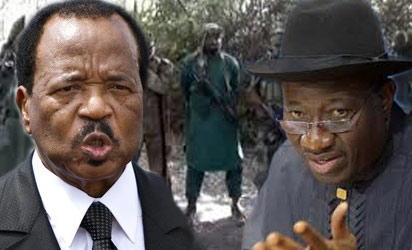
President Goodluck Jonathan and President Paul Biya, Cameroon
By Favour Nnabugwu
The existence of militant groups is not a new phenomenon in Africa but their increasing presence and violence has become a growing concern for countries in the continent. As a result of religious fundamentalism, tribal and ethnic tension, continued regional and political instability, and the extremist ideologies of groups to establish new states and reform old ones, Africa offers fertile ground for extremism.
This year alone, scores of people lost their lives in attacks orchestrated by terrorist groups in various regions of the continent. The main groups are Boko Haram in Nigeria, al-Shabab in Somalia and al-Qaeda in the Islamic Maghreb (AQIM), based in Algeria.

President Goodluck Jonathan and the ‘ghosts’ Boko Haram
Boko Haram, which means “Western education is sinful”, is an Islamic jihadist organisation based in Nigeria, Niger and Cameroon. Founded in 2001, the group is fighting to reform West Africa into an Islamic region ruled by Sharia law. It operates in a cell-like structure and is popular for its use of motorbikes. Their leader, Abubakar Shekau, who was said to been been killed but claimed he is still alive, has been deemed a global security threat by the United States.
Boko Haram is a diffuse, grassroots based radical insurgency that has waged a bloody campaign against the Nigerian state since 2010. It operates across northern Nigeria. It also traverses the porous borders into Niger, Cameroon, and even into Benin and Niger.
Five African countries, Nigeria, Cameroun, Chad, Niger and Republic of Benin, came together last week to fight terrorism together. They are determined to tackle terrorism in one of the countries all together using the pay off, ‘one for all, all for one’.
They, therefore, formed a Multinational Joint Task Force, MNJTF, to combat the activities of Boko Haram in any of the countries and agreed to send their troops to begin counter-terrorism operations against the group along their national borders on November 1, 2014 while they have concluded to establish MNJTF in Baga, a town in Kukawa Local Government Area of Borno State by November 20.
Nigeria’s Foreign Affairs Minister, Ambassador Aminu Wali, noted with deep regrets the continuous atrocities of the insurgent group in the sub-region.
Wali said the ministers agreed on the need to put in place an appropriate legal framework for military operations against insurgents in the sub-region, in view of Resolution 1556 (2004) of the United Nations Security Council which considered terrorism as the greatest threat to international peace and security.
The minister, who addressed journalists after the meeting, expressed the determination to coordinate the MNJTF in the Lake Chad Basin and commended the pledges by the LCBC member-states and Benin Republic to deploy contingents along their common borders.
According to him, the LCBC states deliberated on the draft common resolution to the United Nations Security Council and the African Union. He added that they adopted the resolution and agreed to forward it to the Heads of State and Government of the LCBC member-states and Benin Republic.
“The ministers committed to the implementation of the decisions of the heads of state and government on the establishment of the MNJTF Headquarters by November 20, 2014. The ministers committed to the deployment of the pledged contingents by the LCBC member-states and Benin Republic within their national borders by 1st November, 2014,” he stated.
Wali stated that the meeting requested Niger Republic to introduce the draft resolution to the Peace and Security Council of the AU, while the Republic of Chad, and Nigeria would introduce the resolution to the UNSC.
“The ministers further directed their Permanent Representatives in New York and their Ambassadors in Addis Ababa to hold consultations with a view to ensuring the adoption of the resolution by the UNSC and AU, respectively,” he said.
The phenomenon of Boko Haram’s insurgency is complex, intriguing and not understood by many. And within the interstices of Boko Haram activities lay the criminal and political dimension of its character, activities and operations.
The world over, terrorists do society no good. They are harbinger of pains, sorrow, destruction and death. Destruction, arson and kidnappings are increasingly becoming permanent features of terrorists in Nigeria.
In view of the cacophony of divergent figures of the dead and the plethora of criticisms, the military has lately made it sufficiently clear that Baga is open to local and international assessment. The MNJTF has shown readiness to provide security cover for individuals and groups willing to visit the area.
Nigeria’s President Goodluck Jonathan welcomed the support provided by regional leaders in the efforts to combat Boko Haram.
“I believe that if we cooperate more and monitor our borders closely, the movement of criminals and terrorists as well as small arms and ammunition across our shared borders will also be drastically reduced,”Jonathan said.
The visiting ministers were accompanied to the Presidential Villa by Wali and the Chief of the Defence Staff, Air Chief Marshal Alex Badeh.
The President said that with their collective experience and professionalism, he expected the visiting ministers and their Nigerian counterpart to come up with an effective action plan for the successful implementation of the decisions reached by the leaders of Nigeria, Chad, Niger, Cameroon and Benin Republic.
His words: “This is the way to go because terrorism is something that requires cooperation and solidarity and collective action. This again is consistent with the outcome of the meeting in Niamey, which is a meeting Nigeria and its neighbors taking an assessment of the security situation and seeking to define a common strategy in the fight against terrorism within the region”.
The Lake Chad Basin Commission Heads of State and Government as well as the representatives of the Republic of Benin, also penultimate Tuesday, in Niamey, Niger Republic resolved to fight in synergy against Boko Haram wherever it rears its ugly head among the member states in the region.
On the outcome of the deployment of the MNJTF, Executive Secretary, Lake Chad Basin Commission, Engr. Sanusi Imran Abdullahi, said MUJTF “is to give us a tool for the fight against all forms of terrorism in the Lake Chad Basin and in the member countries or at least in the member countries that have signed this declaration at the extra ordinary summit.
“We are going to join security forces on military hard wares and the troops will work together on the borders of Nigeria, Chad, Cameroon and Niger, under a special task force unit”.
Disclaimer
Comments expressed here do not reflect the opinions of Vanguard newspapers or any employee thereof.