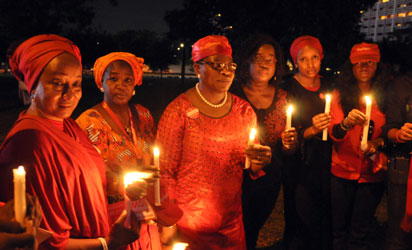
File: Campaigners for the release of abducted Chibok Schoolgirls hold candle lights representing the number of the missing girls on October 12, 2014 during a vigil in Abuja to mark six-month anniversay of the kidnap by the Boko Haram Islamists at Chibok town, northeastern Nigeria. Civil societies and campaigners for the release of abducted Chibok schoolgirls will on Tuesday, October 14 mark six-months since 276 girls were abducted by the Boko Haram sect from their school, Government Secondary School, Chibok in northeastern Nigeria. AFP PHOTO
BY LAJU ARENYEKA
Before the tragic kidnap of the Chibok girls and her consequent unrelenting campaign to ‘Bring back our girls’, Dr. Oby Ezekwesili was already a household name in Nigeria and abroad.
One of the many controversial scenarios that come to the minds of many, especially as concerns the education sector, was her proposal to transfer the management of unity schools to private hands during her time as education minister in 2006.
This reform, misunderstood by many, did not see the light of the day during her 10-month stint as minister. But Ezekwesili believes it could have changed the system for good. Just like the return of the Chibok girls would inspire parents and

N10.6trn controversy: Oby Ezekwesili
children in North-East Nigeria to believe in education again. In an interview with Saturday School Life, SSL, Ezekwesili speaks on these and more.
The abduction of the Chibok girls has greatly affected girl-child education in the North-East. What do you think can be done to avoid such a tragedy in the future, and build the trust of the people in that region to send their children back to school?
A number of parents whose children are of school age say they are afraid that what happened to these children may happen to their own children.
These Chibok parents were willing to release there girls to acquire education and see what happened to them. But when the Chibok girls have been missing for more than six months and nothing tangible has been done to recover them, it gives a very bad signal. It is important that we should bring back our Chibok girls because it would send the strongest signal to everybody that you don’t have to make a choice between safety and acquiring an education.
The number one thing is to get these girls back. It will send a good signal that human life means so much to us. It tells every girl child in Nigeria that if you go school, you can be protected. And that if something happens to you, there is a government that will get you back home.
Also, in terms of the location of schools, we need to ensure that the schools in those areas are situated in such a way that safety is top priority. We need to ensure that such targets like school environments have safety measures to protect the girl child and the boys in school and as well as their teachers. We should not make that very terrible mistake of asking people to choose between being educated or being safe and alive.
What is your take on the education sector today?
The state of the education sector is still below my expectations. The challenges that were there which we tried to resolve with the multiple initiatives and reforms that were carried on over about ten months that I was minister have still not been implemented.
I mean it was almost eight years ago that I was minister and at that time, we declared a crisis situation in education, so imagine what the situation is today. Nigerian students’ performance in the West Africa Senior School Certificate Examinations, WASSCE, gets worse every year.
We must improve everything that has to do with access to relevant and quality education because then the individual who is so given the capability to function in a modern economy would not just wait for the structural change of the economy in other for job opportunities to arrive, they would become the creators of the jobs themselves.
Before, during and after your time as minister, there have been attempts to bring in new policies. The challenge has however, been with the implementation of these policies. What can be done to ensure proper policy implementation in the sector?
One of the things I have learnt in terms of policy implementation is to ensure that the reforms are communicated in a way that would enable as many people to begin to see the benefits of that reform on all sides.
When you embark on a reform, some people think there are going to be losers and as a result, they will resist that reform.
When we tried to do the reform of the unity schools in this country, many people who did not understand that that reform was intended to make unity schools quality schools kicked against it. At the time I came in, officers in the Ministry of education were just keeping aside and perhaps selling admission to unity schools to people who could afford it.
We were trying to break-loose from that bureaucracy and bring in non-profit earning partners like the old boys and girls associations, and other non-governmental organisations to have the autonomy to manage these schools with public money but tied to performance. If that had been implemented, we would have gone back to the days of merit where the child of the rich and poor could get access to quality education even if they do not have connections.
Most of the resources for unity schools were being badly managed, and they weren’t getting to the schools appropriately. If you are not spending education budgets effectively what you are going to get is rat holes in form of schools. When people don’t fully understand a reform, they kick against it.
But if you have enough time on your hands to convey the message, then people would become champions of the reform.
You are constantly berated on social media for your efforts in the campaign to see the kidnapped Chibok girls returned safely home. What keeps you in the struggle?
If it been thirty-five years ago when I was just about getting out of secondary school that such a thing happened to me, where would I be? And I just look at it and I say that only God knows what these girls are going through.
That is why they need a voice, whether the people speaking out for them are ten or one million; the more the better for them. We must stand and insist that these girls are brought back, safe and alive.
We do not know who these girls are going to be. They could be the ones that would solve our problems as a nation. So why should we give up on them.
The voices of these girls have been taken; therefore we must become a voice for them. And we will be a voice. It comes at a price.
I have been pelted with insults, I’ve been maligned, but it doesn’t matter, because nothing any of us is going through can be compared to the plight of those girls.
Disclaimer
Comments expressed here do not reflect the opinions of Vanguard newspapers or any employee thereof.