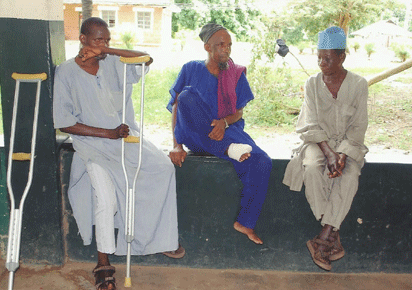
*Men suffering from leprosy… early detection can help
*Solitary life inside leprosanium
By Wole Mosadomi
They felt isolated and almost forgotten by the society. They were stigmatized and shunned by most people including close relatives. Many people thought that having anything to do with them was an abomination. However, the thinking is changing because the disease is curable especially if it is detected early enough.

Women… a life of neglect
Many people still call the victims lepers but those infected are frowning at the tag. Their submission is that since those who are infected with other serious and deadly diseases like HIV/AIDS, tuberculosis, cancer, malaria and others are not called by those names, their case should not be different.
They now want to be referred to as “’ persons affected by leprosy’, instead of lepers. The last Eid-el-Kabir was a testimony to the complete neglect and isolation of the people affected by leprosy.
Their colony, at the outskirts of Minna, the Niger State capital, cannot easily be located. No sign board to link a visitor to the leprosanium. The area is covered by thick forest; the road leading to the referral centre is almost not motorable especially when there is a downpour while the buildings harboring the patients are dilapidated and the environment unkempt.
When our correspondent visited them at their colony the Saturday preceding Sallah, while Minna and environs were bubbling, the victims at the centre were completely caught off from the joy of the moment. That had always been their sad experience in the past years during various festivities. In the male ward, it was virtually an empty building with only five patients while the female ward had only three patients.
It was gathered that two of the male patients literarily discharged themselves to celebrate the Sallah with members of their families after the prayers and to join other celebrants enjoy the festivity. In an interview with our correspondent, the male and female patients in the leprosanium said they had no alternative than to take their fate since they had no alternative of getting cure or better attention elsewhere.
One of them, who is perhaps the longest staying patient at the centre, Lawal Umar, said he had been on admission at the centre for about 25 years receiving treatment. Married with one wife and blessed with three children (one male and two females), Umar said, though he is receiving drugs free of charge, one major problem being faced is lack of funds for the upkeep of his family. Speaking in Hausa, Umar said he was a farmer before he got infected with leprosy.
According to him he could not go back to farming because of old age and because he had lost some of his fingers to the dreaded disease. Another patient, Muhammed Shuaibu, 58, said he had spent three months in the centre. He said his family including a wife and four children were resident in Katsina, adding that by the time he was brought to the centre, he was almost paralyzed because of the severity of the disease.
“I thank Allah that with the treatment I have received so far and with the assistance of the crutches given to me, I can now walk gradually and feeling better more than before,” he said in Hausa language.
He also solicited for assistance from individuals, corporate organizations and even government.

*An empty ward at the leprosanium
Another patient, Alhaji Audi Umaru, who was referred to the centre from Babanrami village, Niger State, said he was a specialist in cow rearing before he was knocked down by leprosy virus.
Married with two wives and blessed with nine children, he said since he got to the centre a month ago, he had started feeling better.
His major problem besides being a leprosy patient is that he is diabetic and needs to be placed on special diet for total cure.
One of the female patients, Hadiza Saleh, also, in an interview, said she had been on admission for the past three months.
She said at the time she was rushed to the centre, she was paralyzed as a result of the deadly virus which had eaten deep into her nerves.
Hadiza, beaming with smiles while picking her steps to demonstrate her improvement, commended the Leprosy Mission of Nigeria (TLM) for the supply of back slam sandals to facilitate her movement.
The patient said, though the inmates were not with members of their families to celebrate the Eid-el-Kabir, they were thankful to Allah that some Christian bodies and a former head of state, General Abdulsalami Abubakar, made their day with special meals and gifts brought to them for the Sallah.
For several years now, TLM had played significant roles in waging war against leprosy.
While the mission has been meeting its own statutory role of 70%, government has at its own level failed woefully to meet up with its own 30% contribution thereby making the situation worse.
National Director of TLM, Dr. Udo Sunday Odihiri, in an interview, said leprosy cases, instead of being on decline, has been on the increase in Nigeria, pointing out that 3,805 new cases were recorded across the country due to the neglect of those affected by the disease by government.
He said the statistics captured in 2012 showed 3,805 new cases recorded by the mission Nigeria out of which 332 were children while 26 were from Niger State.
Odihiri said all steps taken to seek the face of government at all levels to combat leprosy had not yielded much results.
“It is possible for government to get rid of leprosy in the country provided government at all levels give adequate attention to it as given to other diseases”, the TLM boss said.
According to him, besides the neglect by government, stigmatization of the people affected, even after being completely healed, has led to the reluctance of victims to come out until when their cases have become hopeless.

*Men suffering from leprosy… early detection can help
The TLM boss gave cheering news to those infected that treatment is free across the country and that leprosy is curable provided it is detected early.
He therefore called on those affected to seize the opportunity to come out early to be treated.
Meanwhile, the mission at a training workshop for journalists on reducing leprosy related stigma and discrimination called on participants to be mindful of the use of language while reporting on leprosy cases.
According to Odihiri, inappropriate language use can damage the credibility, undermine ones argument or alienate the audience.
“The language that people use reflects what they think and can influence how they deal with situations. When we speak or write, we can cause offence if we use the wrong words and so, we need to think about the language and terms that we use”, he stated.
Disclaimer
Comments expressed here do not reflect the opinions of Vanguard newspapers or any employee thereof.