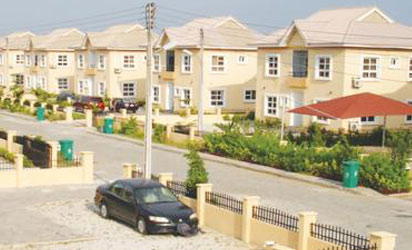
A Housing Estates in Lagos
By YINKA KOLAWOLE
Globally, there is a strong consensus that housing development is important for stimulating economic growth and job creation in any economy.
Indeed, housing construction is one of the most used indices for gauging the economic situation in most developed countries. As a matter of fact, housing construction indices, such as the Case-Schiller index, are some of the most common measures used by analysts to gauge economic trends in OECD countries and in the US.
Available data has however shown that most African countries do not see and treat the housing sector as engine of economic growth. For example, looking at the size of mortgage finance as a share of GDP of various countries, in the UK, mortgage finance to GDP ratio is about 80 percent and 77 percent in the US. For Hong Kong, this ratio is 50percent, across Europe the average is about 50 percent, and for Malaysia it is 32 percent. For many African countries, the ratio is low: 2 percent for Botswana, 2 percent for Ghana, and only 0.5 percent for Nigeria. South Africa is the outlier with mortgage finance at 31 percent of GDP.
At a recent World Bank forum, Dr. Ngozi Okonjo-Iweala, Minister of Finance & Coordinating Minister of the Economy, spoke about three crucial roles that the housing sector can play in national development. According to her, the sector can serve as an important contributor to economic growth; support job creation and economic inclusion; and provide social benefit by contributing to community and nation building.
“Although a non- tradable sector, the housing sector has a tremendous multiplier effect on the broader economy. We know that housing contributes to GDP through two main channels, namely: private residential investments such as, construction of new homes; and also via the consumption spending on housing services. For example, in the USA, private residential investments contribute about 5 percent of GDP, while housing services contribute another 13 percent of GDP, summing up to a total housing sector contribution of 18 percent of GDP. There are also secondary economic impacts of the housing sector. Housing wealth/assets can often be used as collateral to stimulate additional private consumption and investments.
“The housing sector can support job creation and economic inclusion. The job creation potential for the housing sector is enormous. In India, each new housing unit generates 1.5 direct and 8 indirect jobs. In South Africa, each housing unit creates 5.62 direct jobs and 2.5 indirect jobs.
The sector can help promote economic inclusion by creating jobs for craftsmen and artisans such as masons, plumbers, welders, electricians, painters and so on. Also, the housing sector provides social benefits by contributing to community- and nation-building. Home-ownership often gives citizens a true stake in their communities.
After owning a home, many citizens tend naturally to be concerned about the provision of public goods in their communities – from schools, to clinics, to security. These are intangible social benefits which a strong housing sector can help to generate,” she stated.
Nigeria has an estimated housing demand of 17 million units, with an additional 2 million units needed every year. Labour impact assessment studies in countries with similar demographics and economies as Nigeria, estimate that at least 5.62 direct jobs can be generated with every new home, and 2.48 indirect jobs in housing related expenditure.
This translates to about 8 jobs generated with every new house constructed. This means that the housing sector is capable of generating 16 million jobs – direct and indirect – every year. So far, our country is yet to realise this potential. Therefore, addressing the housing deficit will have a game-changing impact on our society and our communities.
Disclaimer
Comments expressed here do not reflect the opinions of Vanguard newspapers or any employee thereof.