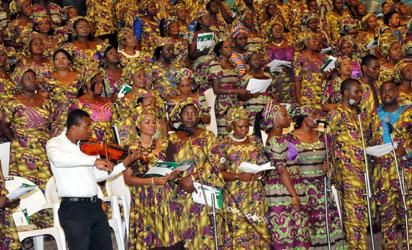
File photo: Church choir
* How EVD nearly aborted Redeemed Church Convention
By Sam Eyoboka
WIKIPEDIA, the online encyclopedia, states that the separation of church and state is a metaphorical description for the distance in the relationship between organized religion and the nation-state. It added that the term may “refer to creating a secular state, with or without explicit reference to such separation, or to changing an existing relationship of church involvement in a state (disestablishment)”. It goes on, “Although the concept of separation has been adopted in a number of countries, there are varying degrees of separation depending on the applicable legal structures and prevalent views toward the proper relationship between religion and politics.”
 Continuing, Wikipedia explains that while a country’s policy may be to have a definite distinction in church and state, there may be an “arm’s length distance” relationship in which the two entities interact as independent organizations. A similar but typically stricter principle of laïcité has been applied in France and Turkey, while some socially secularized countries such as Denmark and the United Kingdom have maintained constitutional recognition of an official state religion”.
It adds, “The concept parallels various other international social and political ideas, including secularism, disestablishment, religious liberty, and religious pluralism. Whitman (2009) observes that in many European countries, the state has, over the centuries, taken over the social roles of the church, leading to a generally secularized public sphere. The degree of separation varies from total separation mandated by a constitution, as in India and Singapore; to an official religion with total prohibition of the practice of any other religion, as in the Maldives”.
Last Monday evening, a crowd of over half million individuals, drawn from different parts of the globe, were stunned when General Overseer of the Redeemed Christian Church of God, RCCG, Pastor Enoch Adejare Adeboye, announced that attempts were made by two states in Nigeria to stop the just concluded 62nd annual convention of the church. Adeboye has Ph.D in applied mathematics and, for several years, was a lecturer at the University of Lagos and the University of Ilorin. In its January 2009 edition, Newsweek, one of the two most prestigious and leading news magazines in the world, named him one of Top 50 Global Elite (one of the 50 most powerful individuals in the world).
The General Overseer had earlier announced the ban of delegates from Ebola-affected West African nations, such as Liberia, Sierra Leone and Guinea, from attending the church’s just concluded convention at the RCCG Redemption Camp along Lagos-Ibadan Expressway. Adeboye, while speaking at the convention, expressed regret over the decision to bar members of the church in the affected nations, but prayed that God would soon arrest the situation. The development came two days after a Nigerian female doctor tested positive to the Ebola virus. A nurse, who also tested positive to the virus, was confirmed dead by the Lagos Health Ministry.
Officials of the federal and Lagos State governments met with the RCCG leader to adopt precautionary measures by not allowing people from the infected countries to come to the church’s convention, which usually attracts thousands of participants. Adeboye also told pastors at the church’s ministers’ conference, which preceded the convention, that all those who fasted for 100 days at the beginning of the year, should have no fear of Ebola as the disease would not get to them. He warned his pastors to avoid laying hands on anybody they suspected had full blown Ebola as they might contract the disease.
Addressing House Fellowship leaders and workers in the church among thousands of foreign delegates from cross the globe, except people from Ebola-prone nations, Adeboye said: “Two state governments tried to stop this convention because they were afraid of the outbreak of Ebola Virus Disease, EVD. But we assured them that we are always very clean. Please, do not prove me wrong. There will be no outbreak here”. He then began to roll out the do’s and don’ts in the camp about basic hygiene and general environmental responsibilities, threatening that any province that fails the daily sanitation test would be shown the way back home.
The G.O. charged his members and others in attendance to embrace the habit of cleanliness, praying that EVD would not get to the country full blown and also at the convention ground.
That planned stoppage of the scheduled spiritual event immediately sparked off a debate with some Nigerians throwing their weight behind the two state governments, agreeing with the campaign in different electronic media the following morning “that Lagos, Ogun and the federal governments should prevail on the leadership of the Redeemed Christian Church of God to postpone or cancel their convention following the outbreak of Ebola”.
“It will be dangerous to allow the convention to go on,” the argument continued.
Driven by the concern for fellow country men and women, callers advanced several reasons, some genuine and others borne out of parochial and mundane sentiments. A caller said, “Imagine one or two victims in that convention, we will be in serious trouble. And knowing Nigerians, somebody who has contracted Ebola may go there to pray for a miracle. Bet you, it may happen.”
Disturbed by the development, we approached the church’s head of Department of Health, Pastor Adeyemi, who immediately assured our crew that the church was on top of the situation as it is collaborating with Lagos State government, the United Nations Children’s Fund, UNICEF, Federal Ministry of Health, the Nigerian Centre for Disease Control, Ebola Rapid Response Team, Incidence Management Centre on the dreaded virus that had claimed about 1,000 lives in West Africa.
The assurance notwithstanding, Nigerians continued the debate, with some insisting that the two states, headed by Muslim governors, overshot their mandate by seeking to stop a scheduled spiritual event, wondering if they would have demanded the stoppage of the recent Eid-el-Fitr, the first day of the Islamic month of Shawwal—marking the end of Ramadan.
Several Nigerians used the occasion to vent their anger, warning government and politician against dabbling into religious issues because of its tendency to create caustic division in the society and dividing the nation along sectarian lines. They further urged government to focus attention on governance and stop hypocritical dabbling into religion, because “since the creation of Nigeria, it has been in the consciousness of an average Nigerian that his allegiance should first and foremost be pledged to Nigeria, not his ethnicity or religion affiliation”.
“Regrettably,” Olamide Bakare argued, “the reverse has consistently and increasingly been the case: tribal loyalty and religion association is virtually intrinsically imbedded in almost an average Nigeria citizen’s psyche”.
“We treat and relate with one another on regional-based citizenship relationship, not as citizens of Nigeria.”
A cleric, who did not want his name in print, wondered why the two state governments, which had hugely benefited from similar spiritual programmes, could not have assisted the church by making scanners available at the RCCG convention. “Other states in the country and other parts of the globe will gladly play host to such events considering the huge sums of money spent before, during and after such programmes. If each of those who participated in the seven-day event spent N5,000 on accommodation, feeding and sundry items, by the time you multiply that by the huge number of people who attended, you would coming close to some nation’s GDP,” he stated.
Continuing on the economic theory, another respondent was of the opinion that before RCCG moved into the site, and opened the place for other ministries to converge on that stretch of land, the neighbourhood was a den of criminals. Besides, the church had uplifted the living standard of the area and the economy of Ogun State, arguing that the worshippers who throng the place every month for Holy Ghost Service eat and buy fuel while some lodge in hotels.
And a huge number of unemployed youths, instead of going into crime, take advantage of such massive turnout of people to eke a living for themselves and their families by selling their wares at the camp. Many of the respondents who crave anonymity were unanimous in asking the two governments to act as their counterparts in the civilized world by providing safety nets for such massive gatherings by rallying round the organizers through preventive measures instead of trying to truncate them.
Pastor Edmund asked said, “What would they want Daddy G.O. to tell foreign delegates that had arrived the country? ‘You know the government people say we should cancel the convention. So, gentlemen you should go back home. God bless you?’ Is that what they would have wanted the man of God to say?”
“In other climes, government would provide scanning machines all around the camp and immediately procure sanitizers for the use of participants, rather than make such ridiculous proposals at a time the nation needs spiritual cleansing,” a female assistant pastor argued, noting that any serious politician would see the potential economic advantage of such programmes and proffer well thought out solutions to any health hazard.
“Will Friday and Sunday worships, where crowds of people gather to worship their Maker now cease because of Ebola Virus Disease? Close the nation’s borders, if you are determined to stop Ebola, a disease that was first discovered in 1976 in Africa and we have to wait for an American experimental drug for treating the often deadly Ebola virus,” a participant lamented.
The biomedical collaboration between US and Canadian researchers involves a drug that is manufactured in tobacco leaves and is hard to produce on a large scale. “In responding to the request received this weekend from a west-African nation, the available supply of ZMapp is exhausted,” said a statement on the Mapp Bio website.
Ebola first appeared in 1976 in two simultaneous outbreaks, in Nzara, Sudan, and in Yambuku, Democratic Republic of Congo. The latter was in a village situated near the Ebola River, from which the disease takes its name.
Ebola virus disease (EVD), formerly known as Ebola haemorrhagic fever, is a severe, often fatal illness in humans. EVD outbreaks have a case fatality rate of up to 90%. EVD outbreaks occur primarily in remote villages in Central and West Africa, near tropical rainforests. The virus is transmitted to people from wild animals and spreads in the human population through human-to-human transmission. Fruit bats of the Pteropodidae family are considered to be the natural host of the Ebola virus. Severely ill patients require intensive supportive care. No licensed specific treatment or vaccine is available for use in people or animals.
Disclaimer
Comments expressed here do not reflect the opinions of Vanguard newspapers or any employee thereof.