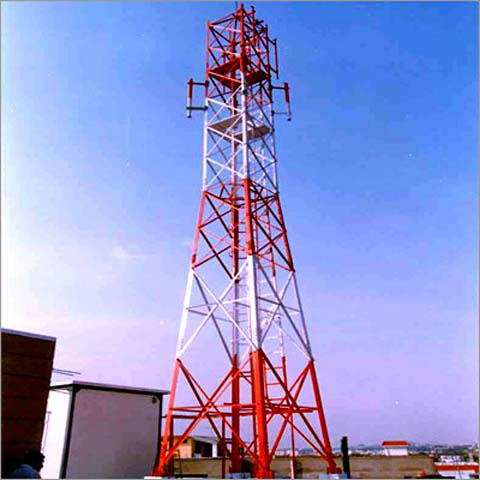
Telecom mast
By Prince Osuagwu
Considering the continued devaluing telecom services in the country, the solution readily available on the lips of many Nigerians would be for operators to make more investments, especially in optimising and upgrading their facilities.

*Telecom mast
However, industry experts are not looking at the situation as an open and close case of throwing in more money. Some believe that certain level of transparency and support must come from government to guarantee the operators that such investments would not end in futility.
Among those who think that it would be difficult for operators to make more investments without a more conducive environment than obtainable at the moment included a Deputy Manager, Financial Advisory & Investment Banking at a Lagos based Financial Derivatives Company,Mr Dubem Arah.
Arah’s points seem tenable but it is also left for the Nigerian people to evaluate.
Drop in ARPU
Ordinarily, the fundamental shift in the industry from a voice dominated environment to a data dominated environment is a threat to the viability of most operators.
As at December 2012, the national monthly Average Revenue per User (ARPU) was N912 (~$6), an 87.5% decrease from its 2003 level of N6,384 (~$48). The Nigerian people need to appreciate the fact that justification for additional capital investment becomes a harder sell for the management of telecom operators due to the lower ARPU.
The operators’ cost structure is equally unfavorable and a major drawback in the quest to increase capital expenditure in the country. A key component of telecoms infrastructure is the Base Transceiver Station (BTS), which essentially connects mobile phones to the network.
About 15% of all BTS in the country are connected to the power-grid, which leaves operators dependent on fuel-powered sites. Fuel costs associated to operating BTS in the country account for about 60% of operators’ network costs. To put it in perspective, network costs in Nigeria are about two to three times more expensive than in other African markets due to fuel costs. It is estimated that Nigerian operators spend about N10bn a year to power their base stations.
Vandalism of telecom facilities
Apart from the financial difficulties, the current state of security for telecom infrastructure is not encouraging for any potential investor.
Every savvy rational investor considers the safety of its assets when making an investment decision. Unbeknownst to most Nigerians, vandalism of telecoms infrastructure is a major problem. About 2% to 3% of Nigeria’s BTS are shut down at any point in time due to vandalism, resulting in a loss of about $50m to $100m every year.
Vandalism on Telecom infrastructure occasionally occurs in error during excavation, but for the most part is perpetrated through acts of sabotage and theft of equipment. In 2013, the Nigerian Communications Commission (NCC) noted that it had recorded about 1200 fibre cuts in just a few months.
These acts of vandalism are common in rural areas of the country, which are characterized by high poverty and unemployment rates. The low standard of living and lack of opportunity leads youth to revert to such actions to extort telecom operators.
The actions of vandals create significant expenses for operators in terms of repair and replacement costs, lost revenue, and also “appeasement” fees
From a decision-making standpoint, rolling out more equipment in an environment where the assets are not protected presents a significant risk.
Delays in investment are also encouraged by market uncertainty due to the current antagonistic environment between operators, regulators and government.
Investors in the Nigerian economy are not new to theses uncertainties, in the petroleum sector about $100bn worth of investments is being delayed due to the delayed passage of Petroleum Industry Bill (PIB) according to the international oil companies (IOCs). Such uncertainty in the telecoms sector can have a knock-on effect for the consumer.
The US in the early mid 1970s was a perfect example of what market uncertainty can do. According to Jerry Hausman, a professor of Economics at Massachusetts Institute of Technology (MIT), regulatory issues delayed the introduction of cellular telephones in the United States for 7 to 10 years. The delay purportedly cost consumers about $31- $50bn (1994 dollars) each year.
In recent times, telecom operators have been attacked by regulators or government through fines and unregulated tax charges.
This does not provide the incentivizing platform needed for investors to commit more funds to capital expenditure. The story of the telecoms sector will mirror that of the Nigerian petroleum industry if a proper regulatory and fiscal structure is not designed and enforced by relevant stakeholders.
Solutions for costs, Security & Uncertainty
Evaluating the dynamics of the telecoms environment, it is clear that there is still a strong need for increased capital investment in the industry.
The publicized customer satisfaction levels with telecom operators serve as enough evidence for the need for improved services. However, until a solution is provided for the operators to deal with issues surrounding its operating costs, security, and uncertainty, Nigeria may not achieve the telecoms investment per capita observed in some of the emerging economies such as South Africa and Brazil.
The ICT industry is critical to support the economic growth needed to maintain Nigeria’s status as the largest African economy. Hence, all stakeholders should participate in providing a conducive environment for the required capital investment to improve the telecom industry’s quality of service.
A key win would be in the area of power supply. Unfortunately, the benefits of the electricity reforms of the Goodluck Jonathan administration are not realizable in the short term. However, it is important for the government to show its commitment to the blueprint of achieving significant growth in the generation and distribution of electricity across the country.
True commitment and observed improvements in the power sector should serve as stimulus for increased investments in the Nigerian economy. The envisaged cost savings should be reallocated to improvement and deployment of infrastructure for more efficient service delivery to the customers.
Critical National Infrastructure
Protection of telecommunication infrastructure in the country, especially in remote areas, is a paramount need for operators. There have been recent talks of the potential passage of a bill by lawmakers, which seeks to give telecommunication infrastructure the status and legal protection of Critical National Infrastructure as well as other critical infrastructure such as power.
The bill is a step in the right direction; however a delay in the passage will endanger the $25bn investment in the ICT industry as well as future investments will be endangered for the foreseeable future. It is also important to acknowledge that passage of the bill is not sufficient; awareness and enforcement are the true determinants of the effectiveness of the bill.
A comprehensive plan is needed to communicate to Nigerian residents the need to protect all critical infrastructures and the penalty for violating the law in the country.
Lastly, a well-defined and legally backed fiscal and regulatory framework is needed to eliminate uncertainty about the telecom companies’ operations and potential investment. There is need for a uniform tax and levy framework across the nation which has a legal backing. This would protect the operators from exploitative charges as well as the creation of unbudgeted new levies/taxes. Ultimately, a properly designed tax and levy framework will increase the positive perception of due process in the industry. Consequently, investor confidence in the environment will be improved which will in turn increase the probability of more capital investment in the industry.
Roles govt should play
It is fair to say that telecom operators are generally evaluated by consumers without consideration of the rough operating and financial environment. However, if the government and all other stakeholders can play their roles to provide a more suitable environment, then it will become crucial that each operator provides world class and cutting edge service. High expectations of a telecom investment per capita at par with countries such as South Africa will be the norm. As Edward Teller said, “The Science of Today is the Technology of Tomorrow”. The delayed action to improve the effectiveness of the industry will only lead to a lag in the technological and economic development quest for Nigeria. We have attained the status of the largest economy in Africa; ICT should be supported to play its role in making us an economic power on the global front.
Disclaimer
Comments expressed here do not reflect the opinions of Vanguard newspapers or any employee thereof.