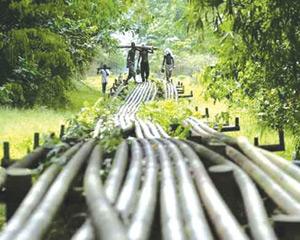
Gas pipeline
The protection of oil, gas and refined product pipelines against sabotage, illegal tapping, militants and terrorist actions, combined with the detection of leaks and in-line equipment failure, is a high priority in all countries, but has been notoriously difficult to achieve.
Oil and gas installations are critical infrastructure of high importance and value. If a pipeline is damaged, significant revenues will be lost, harm may be caused to the environment, and the leakage could be a potential danger to the local population. More importantly, a terrorist attack on an unprotected pipeline could have catastrophic consequences.
This article describes how the latest developments in pipeline monitoring and security technology meet the challenges of today’s demanding environment. New sensing solutions provide greater visibility into the pipeline network and buy operators additional time before an event occurs, allowing for repairs, evacuations or a security response to reduce potential damage or losses.
A Vulnerable Network of Strategic Assets
It has never been more important to ensure the safety and reliability of production and distribution assets for the oil and gas industry. In a fragile economy, threats to pipeline infrastructure can have a significant effect on both industries and communities, whether they are intentional disruptions or inadvertent damage caused by excavation equipment, land movement or pipeline leaks.
For pipeline operators, the three main types of third-party damage are theft, terrorism and construction work. Pipeline tampering and pilferage are common problems in developing countries. Pipelines are also an easy “soft target” for terrorist and militant organizations whose declared aim is to cripple our economy.
A typical transportation and distribution system for natural gas or liquid hydrocarbons can extend hundreds of miles and comprise thousands of sensors, valves, pumps and controllers. In the United States, the national pipeline system is an extensive mode of transportation with unique infrastructure security characteristics and requirements. Virtually all the critical pipeline infrastructure is owned or operated by private entities.
There are:
*161,189 miles of hazardous liquid pipelines
*309,503 miles of natural gas transmission pipelines
*1.9 million miles of natural gas distribution pipelines
According to the U.S. Department of Transportation’s Office of Pipeline Safety (OPS), the majority of pipeline incidents are caused by “damage by outside force.” Property damages alone for more than 300,000 miles of transmission pipe can cost operators millions of dollars annually.
Limitations Of Existing Technologies
Most petroleum producers recognize the importance of deploying an effective pipeline monitoring and surveillance solution, which includes a round-the-clock vigil on key operational parameters in the distribution network, as well as monitoring leakages, electronic surveillance and physical patrolling of the right-of-way.
In a continuing effort to remove the guesswork from pipeline operations and reduce costs, many techniques have been developed to address risks and maintenance needs in a strategic fashion.
Common pipeline security measures include aerial surveillance, ground patrolling, installation of pipeline warning boards/markers, deployment of security personnel, and conducting awareness campaigns to educate habitants along the pipeline route. Advanced telecommunication systems and leak detection systems are also widely used to improve the monitoring and remote control of pipelines.
However, armed security guards cannot be everywhere at the same time. Closed-circuit television (CCTV) security cameras are effective for surveillance, but are less useful if not incorporated into a complete security system. Plus, their infrastructure costs are not economically viable. Radar is proven as a long-range water and surface-based solution, but again, is not economically viable due to the need for power and network connectivity.
Most conventional pipeline security systems rely upon point-sensing technologies to estimate locations of events. Positioning these systems in the correct and most relevant locations can be a challenge. They can also be affected by a single large and often harmless event blinding the system to specific activities that can affect the process.
Overall, the majority of existing detection technologies only provide notice that a damaging event has occurred, allowing an operator to put into place reactive countermeasures to stop the associated costs from escalating.
Latest Pipeline Monitoring Solution
In recent years, innovative technologies for pipeline surveillance against third-party damage or intrusion have become increasingly available. With advances in miniaturized sensors, standardized data processing and reliable communications, oil and gas companies now have access to robust tools for the monitoring of extended and complex pipeline systems.
One of the most effective solutions for pipeline monitoring involves a technique known as Distributed Acoustic Sensing (DAS), which can convert a fiber optic cable into a listening device. A DAS system is designed to prevent pipeline damage from occurring in the first place by providing advance warning of the events leading up to an incident.
Disclaimer
Comments expressed here do not reflect the opinions of Vanguard newspapers or any employee thereof.