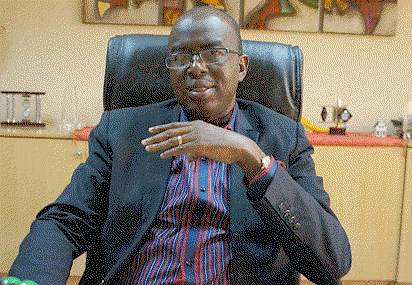
Director-General of Nigeria Employers Consultative Association (NECA), Segun Oshinowo’s delegation was in Geneva, Switzerland for the 103rd International Labour Conference.

He spoke to journalists on a number of issues ranging from organizing the informal sector to job creation potentials in Nigeria and other issues. The story is presented by Labour Vanguard.
THE issue being raised here is how to organize the informal sector. Of what relevance is this to the Nigerian economy and you as employers, how do you see this?
Well, the issue of informal sector is actually key to the promotion of the socio- economic development of Nigeria. As you well know, over 90% of the workforce in Nigeria operates in the informal sector.
If we were to reduce the incidence of poverty in Nigeria it is extremely important that we address our minds to the basic policy option. We have to encourage the transition of enterprises and workers from the informal sector to the formal sector
So, quite unlike past years when ILO focused basically on labour rights or social rights, we have a topic that is linked to the socio-economic development of member states.
NECA is a bit experienced in the area of the informal sector. If I take your NEW project, what are the challenges of organizing the informal sector?
The interesting thing about the promotion of entrepreneurship …. that is actually what made us to move in that direction. We have a thousand and one enterprises that are run by women in the country that requires support.
We are not talking of financial support, but we are talking of how they could embrace the basic process of principle and system that would enable their businesses to be competitive.
It is a very good success story for us because we started with just 10 members, but today nationwide we can boast of about 800 members and we are still touching the issue on the periphery.
The next phase of the evolution will be the introduction of a Micro Finance bank and before the end of the year, the women hope to be introducing their own Micro Finance bank which will, to some extent address the basic issues of their financial challenges.
I must say that those businesses would be able to attract our quest into promoting women entrepreneurship. It would be basically Micro and Small enterprises. Yes, you might want to say that some of them operate in the informal sector.
So, there is still the big challenge of building up institutions or coming up with policies that would promote the formalization of the informal sector.
Remember that in the promotion, or transition of the informal sector to the formal sector there are a whole lot of other things that are linked to it.
The issue of promoting it, the issue of meeting the standards, the issue of transparency of the government is the major challenge because it is easier for you to promote businesses that are semi-formalized, or formalize it to boost the issue of tax collection in the formal sector.
My own basic worry in terms of the disposition of Nigerians in this kind of a topic at the international level is that the composition of our team does not seem to reflect the basic expertise we need that would basically contribute to the debate because this is not a purely social core issue, but there are economic dimensions to it.
I would have expected the Federal Government of Nigeria, in putting together a delegation, to get the Ministry of Finance; here I am talking of someone that is of micro-economic disposition that can easily understand all aspects of the subject.
When we talk about the delegation, it should include persons from the Ministry of Trade and Industry, somebody from National Planning, and so it should not have been a straight jacketed dominance by Ministry of Labour personnel.
In future, we should take note of that point that in constituting our delegation to national programmes, the theme and the topics that would be addressed should inform the composition of our team to be able to give meaningful and qualitative positions to the discussion.
On our own side we do not have a problem because NECA delegation has an economist as part of our own team and the economist has been part of our discussion team on the transition of the informal sector to the formal sector.
From time to time, I do consult with the economist in order to get my perspective and my contribution right on the debate.
Africa has been identified as the global economic power, but with the crisis raging on the continent, especially in Nigeria, how do you see Africa sustaining it?
Based on the issue raised, yes Africa has the potentials but it will depend on a number of factors. Those are the factors we expect our Governments to pay attention to.
First, the imperative for peace is important, because no matter how potentially rich you are, if you cannot guarantee the security and safety of your investment, then your potential amounts to absolutely nothing.
Secondly, infrastructure is key and we have huge deficit of infrastructure in Africa.
Third is the stability of our Government in terms of consistent implementation of our economic and fiscal policy in the countries. These are the factors that must be put into considerations to make the realization of the potentials in the Continent come into reality
Policy objectives
What of the skills — the manpower that we require to make the potentials work?. A good example of Nigeria is the formulation of our auto policy that has wonderful, beautiful policy objectives, but with manpower implication. If you want the car assembly plants to set up factories in Nigeria, where will the skills come from?
Have we addressed the basic institutions that would provide the skills? These and other variables and parameters are what we need to actualize the potentials that we identified. Without them, then our potentials would amount to nothing.
You identified security, manpower and other variables to be the factors that would make the Continent sustain the current Africa’s global economic position. As an employer, how do you think these factors can be addressed from the Continent to maintain her global economic might?
I have had cause to travel by road to some key economic sectors in Nigeria. If we you take our road infrastructure as an example, it is a huge challenge moving products on our roads in Nigeria.
That is one dimension of it and the other dimension is in terms of complimentary system. The question here is that can we count on our roads system, and the answer of course is no. In air connection, you can probably identify about four or five economic hubs.
These are issues in Nigeria when it comes to transportation ,infrastructure and this is key when you want to promote industrial development.
Nigeria, of course is the commercial capital in West Africa, but how can you travel to Ghana by road, and when you do, your experience is what you may not want to think about again.If that is true for individual, you may want to think of what happens, when it comes to business.
I think it is better that we have to get our Government to think of what to do, because the Government has beautiful documents and beyond rhetoric, the real focus should be how well we ready to translate our rhetoric into actions .
I think the solution to this is our basic challenge and beyond this, the issue of stable electricity supply is there because privatization will not guarantee stable electricity supply and you cannot expect the private sector operators giving the enormity of the deficit in the sector to be able to handle the deficit in short time
It is a medium and long term project and Government cannot simply wash its hands off from the power sector because it has been privatized. Government still has a role to play.
Sir, could you please, throw more light on how the issue of social protection that has been keenly discussed in the last few days in the ongoing International Labour Conference (ILC) would affect the Nigeria economy?
The debate on social protection as discussed in the ongoing conference is a chicken and egg story. Yes, social protection is important because to a large extent it would address your pervasive issue of poverty and raise income level of the less privilege .
We have seen it worked in Brazil, but you need the good fiscal space to be able to implement your social protection because it requires resources. Will the Nigerian Government been able to fill the fiscal space that would support social protection?
This is because employers are not prepared to add additional payment beyond their taxation. And that is the question that Nigeria Government can readily answer, because in some presentations of the ILO that I have seen, the condition is that Nigeria and other countries in the West African region can actually afford to support the social protection floor
It is not as if we did not have some semblance of social protection in Nigeria, but we need to harmonize these social protection scheme, integrate them and then back them up with appropriate fiscal support to make sure that it actually gets to the rural areas because the bulk of the population of Nigeria is in the rural arrears
And we cannot talk about social protection within the wage context, but what we are talking about social protection is basically on the wage sector of our population, which actually account for less than 5% of the work force.
The question is that how will it trickle down to the non-wage sector and that equally explains why pension does not really connect with those people because they are not in the wage sector. Pension is only workable within the wage context
Disclaimer
Comments expressed here do not reflect the opinions of Vanguard newspapers or any employee thereof.