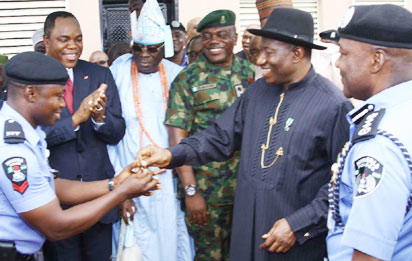
President Jonathan presenting house keys to a beneficiary of of the Goodluck Jonathan Housing Estate, Idimu, Lagosousing Estate giving a salute to guests at the official unveiling of the Estate on Friday July 19, 2013 in Lagos, watching with admiration are Mr. Olatunde Ayeni, Chairman, ASO Savings & Loans- financier of the Goodluck Jonathan Housing Estate, Idimu, Lagos; Oba of Lagos, Rilwan Akiolu, Lieutenant Colonel Ogogbane Adegbe Aide de Camp to Mr. President, Special Guest of Honour Dr Ebele Jonathan, President, Commander in Chief of Armed Forces of Nigeria and Mr. Muhammed Abubakar, Inspector General of Police at the official unveiling of the 200 of the 504 units of 3-Bedroom block of flats. Photo by Lamidi Bamdiele
By Ochereome Nnanna
IN the first part of this article we showed conclusively that regions and states have never been created based on the much-touted concept of “viability”. They were created principally to grant groups self-determination and opportunity to develop at their own pace.
In fact, state creation can be described as the further extension of independence (which Nigeria won from the British colonialists in 1960) to smaller groups.
That is, however, not to say that states cannot be viable. We will treat that later on. Apart from granting self-determination, two other factors account for creation of states. The first is the need for the federal government to fully assert its sovereignty on the territorial extents of the nation when faced with threats of internal implosion. The second was the scramble for the oil wealth of the nation.
On May 24th 1966, Gen. JTU Aguiyi-Ironsi, the first military head of state, issued the Unification Decree in which he dissolved the four Regions and established what he described as four “groups of provinces”, thus abolishing federalism in Nigeria. This proved unpopular even though Ironsi felt it was the right step in the direction of uniting a nation fractured in the aftermath of the failed coup of the Five Majors led by Major Kaduna Nzeogwu.
General Yakubu Gowon who succeeded Ironsi, after briefly restoring the four Regions, decided to create the first group of twelve states in order to weaken the Eastern Region, isolate the main Igbo Biafra protagonists, win the support of other Nigerians and forestall the secession bid. Funny enough, even though Gowon annulled Ironsi’s unitary government, he still adopted the basic principles of unitarism in a “federal” arrangement run by the army. Thus was born the first tendrils of the centralised federalism we are currently saddled with. Between Ironsi and Gowon, the primary objective for tampering with the structure of Nigeria was the same: put the country under the command of a single centre of authority in order to overcome a national crisis.
When Gowon eventually overcame the secession bid, the oil boom, which started gushing out of the soils of the former Eastern Region, triggered a stampede for control of the centre within the military because whoever controlled the centre controlled the oil wealth and political powers of the federation. An informal hierarchy of privileges emerged. The North, which led the war against secession, perched on top of the food chain, followed by its closest Majority ally, the West. The Minorities of the North were third, followed by the Minorities of the South. The Igbos (the former Biafrans) hugged the bottom.
They were excluded from decision making organs of the federal government until 1979 when astute political footwork led to an accord between the Igbos/Southern Minorities and the North which enabled the North to win the presidency in 1979. The return of civilian rule catapulted the Igbo back to number Two in the hierarchy of privilege (politically, at least), thus placing Vice President Alex Ekwueme in a pole position to succeed President Shehu Shagari in the National Party of Nigeria (NPN) zoning arrangement in 1987. But when the military returned in 1984, the Igbos were flushed out of their new position and the Yorubas restored to number Two. It gave the South West the opportunity to challenge for power in 1993, when Chief Moshood Abiola won the presidential election. The second military rule prepared the Yorubas to eventually produce the president of Nigeria in 1999 after the North’s hold on power weakened as a result of their over-manipulation of the political system to perpetuate themselves in power.
As from 1976 when General Murtala Mohammed, who overthrew General Gowon, created 19 states, he upset the balance of the federation in favour of the North, with the West having the second largest share and the Igbos left at the bottom. Also, the Local Government Reforms of 1976 bequeathed the North with the lion’s share of the LGAs, giving the second largest to the Yorubas and the least to the Igbos. In the sharing of the federal constituencies towards 1979, the North also got the largest share, followed by the Yorubas, while the Igbos got a token that kept them at the bottom. There seemed a deliberate and conscious effort by the two “winning” Majorities to artificially reduce the Igbos to a Minority group.
There were two major reasons for this phenomenon. The first and obvious one was that the Igbos, since they led the secession bid, must not only be punished for doing so, but also kept weakened to prevent them from being able to challenge for power. That scheme succeeded, because since the war ended the Igbos could not come close to occupying the presidency. In fact, when the North and West had taken their turns to their heart’s content they went behind the Igbos and gave it to an Ijaw man, their willing partners in the war against Biafra. An irony soon emerged, though. While the North has become the greatest political enemy of the Ijaw for holding on to the presidency which they see as their birthright, the Igbos are now the backbones and bulwark of the “Ijaw presidency”, while the new Yoruba mainstream has gone into a merger with the reactionary wing of the Northern political class, all in a bid to snatch the presidency from the Ijaw come 2015.
The second propelling factor for the creation of states after the war and the belittling of the Igbo was the oil boom. After the war, the oil boom brought tons of easy money into the hands of the ruling coalition of the North and West.
States and local governments became the units to share the oil wealth of Nigeria gushing out of the soils of the defunct Eastern Region. With the Igbos weakened and excluded, it became possible for the war’s winners to gorge themselves on the oil war booty until the youth of the Niger Delta took up arms to fight for their God-given resources.
The agitation for more states today is based on the struggle for more share of the oil wealth. It is a very unfortunate scramble for a resource that is not only perishable but is actually about to perish. The US has almost completely withdrawn its age-long purchase of Nigeria’s oil due to its newfound energy independence, and more oil is being discovered around the world.
As long as we continue to leech upon this single national resource, no state will ever be “viable”. Indeed, states can be viable, even if we create all 55 of them. Only full resource control can make for viable states. Resource control will force leaders to exploit their human and natural resources for the upkeep of their states. It will force states to cut down on the size of government, downgrade the size of recurrent expenditure in their budgets and increase that of capital to create wealth. It will force states to take firm measures against corruption and indolence in the public service.
As we sit back and wait for the oil money every month, the economies of all states are headed for collapse. The people of the Niger Delta must stand firm now on full resource control because the oil wealth is on the verge of finishing. When it does, everybody will abandon the zone to suffer its acid rains, oil spills, sterile soils, fishless rivers, ocean-flooded coastal villages and other humanitarian disasters – alone!
Disclaimer
Comments expressed here do not reflect the opinions of Vanguard newspapers or any employee thereof.