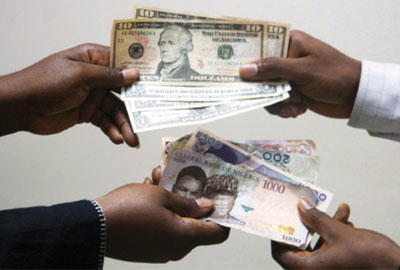
Indeed, Naira devaluation is probably the most potent weapon against the prosperity of Nigerians. Nigeria’s migration from a potential industrial power house with bustling social affluence, to a subdued and stumbling economy clearly began with the adoption of IMF’s Structural Adjustment Programme during Babangida’s regime: the chorus from International Agencies, at that time, was also that falling oil prices with an unserviced debt burden and the consequent restriction of trade credit to Nigeria, were the products of an allegedly overvalued Naira exchange rate.
By Omoh Gabriel, Business Editor
The Central Bank of Nigeria (CBN) last week reduced the volume of weekly foreign exchange sales to Bureaux De Change (BDCs) by 70 per cent to $15,000 per BDC and announced a 250 per cent increase in the capital base for BDCs to N35 million from N10 million.

In addition, the mandatory caution deposit was reviewed upward to N35 million from $20,000 per BDC while the licensing fee was raised to N1, 000,000 from N100, 000. Application fee and annual renewal fee was pegged at N100, 000 and N250, 000 respectively.
The apex bank also banned ownership of multiple BDCs, and said that membership of the Association of Bureaux De Change Operators of Nigeria (ABCON) would no longer be a compulsory licensing requirement.
“All existing BDCs and those currently operating with a Final Approval Letter are required to comply with the requirement on mandatory cautionary deposit by 15 July 2014 while all current applications are expected to comply with these new requirements,” the apex bank said.
Since the announcement of the policy on BDC stakeholders in the sector have raised issues and some out of selfish interest. Many of those who operate these BDCs are within the CBN and government quarters. They are individual who uses surrogates to ripe off the nation.
The genuine BDC operators are few and do their business genuinely. Before the policy was made public some of these vested interests have already gone to work preparing the minds of operators on the line of action to take. In recent years the Nigerian economy has been highly dollarised.
The dollarisation of the economy was decried by Sanusi Lamido Sanusi as Governor of the Central Bank of Nigeria. In Economic parlance, dollarisation of an economy occurs when the inhabitants of a country use foreign currency parallel to or instead of the domestic currency as a store of value, unit of account, and/or medium of exchange within the domestic economy.
Nearly every government functionary, from the presidency to governors, ministers, Bankers, and top business managers, spend dollars in Nigeria unhindered as if it has become a legal tender.
Where are these dollars coming from? Most of them are purchased from Bureau de Change. Bureau de Change is supposedly meant to serve small end users of foreign exchange. But the reverse is the case here in Nigeria. Many serve as a conduit pipe for political office holders to drain the nation through unhindered access to foreign exchange.
In fact even the genuine small business men who go to some of these bureau de change purchase foreign to import goods that are not necessary in the country. How can Nigeria being importing took pick made from bamboo? Yet the nation complains of dwindling foreign reserve.
In Nigeria today, many residents store their value in dollars, liquid assets are moved freely around with the dollar as preferred currency. Those who offer bribe use the dollar. The incidence of the use of dollar in Nigeria has weakened the naira and Nigerians are losing confidence in their own currency
The second fundamental issue that requires action to curb the excess use of forex in all quarters is the high level of capital flight that attends the Nigerian economy. Many Nigerians are not aware that at the moment the CBN is trying to fight the high level of capital flight in the country. Available data showed that in the week of 31st March 2014, a total of $4.8525 billion left Nigeria shores as transfers and payment to foreigners by Nigerians. In the week ending 30th April a total of $3.64 billion left the Nigerian shores. Before then the average weekly international payment made by Nigerians was $1.7 billion. A total of $18.3 billion left the shores of Nigeria to foreign lands through official channels in twelve weeks in 2013.
The $18.3 billion went out of the country in the form of capital flight, which Nigerians indulged in. According to figures available at the Central Bank of Nigeria, the amount was remitted through banks, bureau de change, travel agencies and debt payment to foreign creditors to which Nigeria owes some money. This and the monthly withdrawals from the Federation Account have resulted in the depletion of the nation’s foreign reserves. The financial haemorrhage, which has been plaguing the nation for years due to the low productivity of the economy, has resulted in blame games in political and financial circles in the nation.
The foreign exchange out flows has resulted in an average of $1.7 billion leaving the shore of Nigeria every week as payment on travels, cash purchased from banks and Bureau De Change, letters of credit, direct remittances on behalf of expatriates working in Nigeria, Wholesale Dutch Auction and debt service payment.
In the twelve weeks under consideration, a total of $89.647million was spent by Nigerians in foreign travels. Cash sales in dollars by Bureau De Change to small scale businesses and individuals amounted to $2.665 billion. In the twelve weeks, amount attributed to dollars sales through letters of credit opened on behalf of Nigerians for business purchases amounted to $365.810 million, while a total of $1.159billioin went out of the country as direct total remittances.
According to the CBN figures, within the twelve months, foreign exchange purchases through the official market of the Wholesale Dutch Auction sales stood at $13.906 billion and payment of interest on foreign loans by the Federal Government took out the sum of $144.83million out of the nation’s coffers. A break down of the foreign exchange out flows from the CBN showed that in the week ending 20th September 2013, the sum of $38.93 million was spent on travels, while cash sales to bureau de change and banks took out the sum of $263.575 million out of the nation’s foreign reserves.
In the same vein, within the same week, the sum of $96.05million went out through letters of credit and the sum of $1.26billion was sold by CBN at the foreign exchange markets to Nigerians, who apply to buy goods and service abroad. This resulted in the depletion of Nigeria foreign reserves by a total of $1.708 billion in this particular week.
The new CBN Governor Godwin Emefiele when he assumed office said the vision of the Central Bank of Nigeria is to “be the Model Central Bank delivering price and financial system stability and promoting sustainable economic development”.
This vision draws inspiration from our understanding of the multiple mandate of the Bank to pursue both price and financial system stability as well as provide complementary developmental functions by creating an environment for Nigerians to live better and more fulfilled lives”. If all Nigerians must have a better life, then the CBN can not continue to serve the interest of the elites in society. It must focus on policies that support the masses.
By cutting down on foreign exchange available to the few privileged Nigerians is the beginning of such policies.
Nigerians must know that the persistent domestic foreign exchange demand pressure is for political activities and not for productive purposes. Allowing the political class to continue to put pressure on the exchange rate by the CBN gives cause for worry. If the CBN allows the pressure to continue it will suggest that the apex bank is dancing to the whims of the political class. Coupled with this, is the ever increasing dollarisation of the economy by the same political class. The CBN says it remains committed to defending the naira, even if this requires depleting the nation’s foreign reserves. It has identified the major threat to the naira as the build-up of political activities, resorting to dollarisation of the economy. This remains a key risk to the stability of the naira. CBN policies should be supported to tackle this pressure point by insisting that all local payments, purchases be made in naira and refusing foreign exchange cover for imports that are not essential needs.
Disclaimer
Comments expressed here do not reflect the opinions of Vanguard newspapers or any employee thereof.