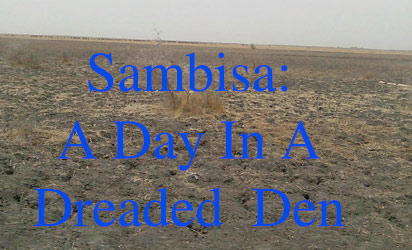
By Ndahi Marama, Maiduguri
IT would have looked like a scene from a movie. I knew it was not. I am neither an
actor, nor were the others with whom I drove into the dreaded Sambisa forest. I just wanted to have an idea of the den of the terrorists. I knew when to ask my escorts that I had seen enough.
Sambisa is a vast stretch of land that people describe from what they saw on the side they visit. How does one describe a place that borders more than 10 local government areas in Borno State alone? Chibok, Askira, Damboa, Gwoza, Kondugha, Dikwa, Bama are some of the local government areas border Sambisa.
Further traces of the forest’s 60,000 square kilometres spread to Yobe, Gombe, Bauchi, Jigawa, and Kano States.
Once famous for game reserve situated in its heart, Sambisa forest was a fortress deliberately set to tackle desertification; it is now a den of terrorists, who appropriated it after killing some of the staff. Nobody remembers Sambisa for anything again except for the attacks that are launched from it.
Who is immune to the dangers of Sambisa? The forest is terrifying. It has thick vegetation, and wild animals leave nobody in doubt that danger lurks.
Before the insurgency, little was heard about Sambisa. Those who knew it were mostly tourists who patronised the game reserve that is 50 kilometres south-east of Maiduguri. We entered Sambisa through Kawuri to Gambole, situated at the edge of the forest, picking as much speed as the pick-up van could.
Pick up vans and motorcycles are the most favoured vehicles for challenging the intricacies of the forest, depending on the part, the time of the year and the knowledge of the driver about the forest. A good knowledge of the terrain is critical.
WHAT CRITICS OF THE MILITARY DON’T KNOW
Critics of the performances of the military do not understand the complications of Sambisa. At a point, we passed through dry land, with shrubs, turning into thick forests in flashes and suddenly, we were wading through waters, then the vehicle was severally stuck in swamp.
During the rains, parts of Sambisa are like any community in the savannah. A lot of local intelligence of the forest tracks is required to navigate it, and conquer it.
The vastness of the forest means the insurgents can move around it with ease, avoiding detection. Speculations that the forest tracks had been wired with landmines were foremost in my mind as we drove through.
I spent one day in Gambole, a fishing community, before continuing the journey. The people were carrying on with life, oblivious of the dangers near them. They confirmed they heard of the attacks in other places and sometimes lost their goods to the insurgent, whose forage for food takes to them wherever they can find it.
We drove for about 15 kilometres into Sambisa before I re-considered the journey. There appeared to be no end to the forest. Wild animals of different species were making sounds like as if they were from a different planet. I might just have been watching a horror film. The only difference was that I feared an attack might occur at any time. Mercifully, there was none.
All types of animals are present in Sambisa. There are elephants, horses, donkeys, monkeys, antelopes, and snakes are in all their species, just like the birds that protest the intrusion on their privacy with shrills, some ear-shattering.
The forest is fertile supporting the production of various cash crops and those for immediate consumptions. Fruits are in abundance. The insurgent could be benefitting from these in their settlements within the forest.
A hunter from Damboa, Mallam Yusuf Gana said Sambisa would be challenging for a military operation. Before the insurgents occupied it, Gana used to hunt in Sambisa. “It is a difficult place to operate in,” he said. “Some parts are water-logged, swampy, with thick vegetation that provides adequate cover. Most of the places in Sambisa are not motorable”.
Mango Park, a Chibok youth stated that Sambisa’s vastness makes a good knowledge of it difficult.
His point was that insurgents select points from which to operate and used vehicles, motorcycles, bicycles suitable for that terrain. They prefer unmotorable parts, but know how to get to their hide-outs.
Civilian JTF, a child of circumstances, makes a strong point for the involvement of locals in the fights. Their performance drove the insurgents out of Maiduguri, restricting them mostly to the unprotected villages. In the recent Giwa Barracks attack, the civilian JTF killed some of the fleeing attackers.
The youth were saying they had had enough of relations being killed. They formed vigilante groups to fight the insurgents. Without formal training for combat, and without sophisticated weapons the attackers use, they are limited to sheer determination.
WE CAN DO MORE IF ARMED – VIGILANTE GROUPS
Civilian JTF brought relief to Maiduguri by handing over attackers, who settle with the populace, to security operatives. Modu Mustapha, 21, said he joined the civilian JTF to support the military campaigns to on terror.
“We are trying to protect our heritage and our State,” said Mallam Zarami, 30. “It is the only place we can call our own. We volunteered; when started, some ran away, thinking the sect will kill us. We want peace to return to Borno, as our parents, brothers and sisters live here. We are not happy about the violence the insurgents unleash on us. We decided to assist the security agencies in efforts to address the security challenges,” he said.
Legal Adviser of the civilian JTF, Jibrin Gunda and its spokesman, Bello Dambatta told newsmen, “The Borno State government had done its best in supporting us through training and payment of our allowances. We have structures in all the 27 local government areas and our members are highly disciplined. If we have arms, we can take the fight to the insurgents in Sambisa.
“The President once called us heroes, but has never granted us financial or logistic support. We are risking our lives to keep the country one. We want Federal Government to assist us.”
“If the military can give us a cover, we can confidently enter Sambisa. We know the terrain better than the security operatives,” Bana Bukar, a civilian JTF member said.
HOW BOKO HARAM RELOCATED TO SAMBISA
Mustapha, a hunter from Kawuri, said the sect have many professionals, like medical personnel, technicians, wielders, carpenters, and drivers, mostly those they captured and forced to work for them. He said the terrorists in Sambisa hide their weapons, food items and other valuables in tunnels.
“The attackers are not after us, hunters and some Fulani herdsmen who live in Sambisa, on several occasions sight them. They do not stop us from our work”. Mustapha said he rarely went to Sambisa after the attackers were chased out of Maiduguri and they relocated to the forest fully. “It must however be understood that even if they are well-equipped , the civilian JTF cannot do better than our military,” a retired military officer said. The motivation of the civilian JTF, he warned, should be checked. “They are revenging loss of relations, it is different from the professional manner in which the military is expected to operate”.
Abubakar Yusuf, a civilian JTF confirmed the issue of motivation. “The attackers killed my father and elder brother in Maiduguri. I will fight the insurgents even if it will cost my life. I have never been to Sambisa forest, but I heard it is difficult to penetrate. I still want to storm Sambisa with my members one day to face them,” Yusuf stressed.
The Borno State said it had spent more than N10 billion in prosecuting the war against terror. “The only support we have not provided to the military is ammunition, and that is because the laws prevent us from doing so. We do so much in mobilising citizens to support the military,” a government official said. The State employs thousands of youth volunteers called the civilian JTF, whose efforts complement the military in intelligence gathering.
Disclaimer
Comments expressed here do not reflect the opinions of Vanguard newspapers or any employee thereof.