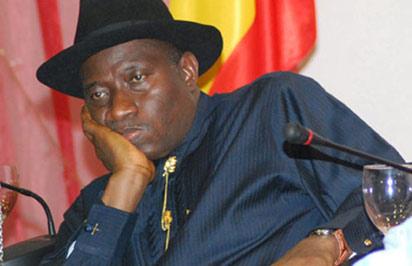
Jonathan
The forced re-design of security architecture
Dozens of condolence messages in three years
Humiliating request for assistance from abroad
By Ben Agande, Abuja
A PROMISE MISPLACED
One of the most famous quotes from the President Goodluck Jonathan campaign during the run up to the presidential election in 2011 was his reference to his humble beginning in rural Otuoke, Bayelsa State.
 While formally declaring his intention to seek election, President Jonathan delivered a passionate speech that marked the turning point ahead of the election. His speech resonated with majority of Nigerians who could identify with his story. He told Nigerians:
“I was not born rich, and in my youth, I never imagined that I would be where I am today, but not once did I ever give up. Not once did I imagine that a child from Otuoke, a small village in the Niger Delta, will one day rise to the position of President of the Federal Republic of Nigeria. I was raised by my mother and father with just enough money to meet our daily needs.
“In my early days in school, I had no shoes, no school bags. I carried my books in my hands but never despaired; no car to take me to school but I never despaired. There were days I had only one meal but I never despaired. I walked miles and crossed rivers to school every day but I never despaired. Didn’t have power, didn’t have generators, studied with lanterns but I never despaired.
“In spite of these, I finished secondary school, attended the University of Port Harcourt, and now hold a doctorate degree. Fellow Nigerians, if I could make it, you too can make it!
“My story is the story of a young Nigerian whose access to education opened up vast opportunities that enabled me to attain my present position. As I travel up and down our country, I see a nation blessed by God with rich agricultural and mineral resources and an enterprising people.
I see millions of Nigerians whose potentials for greatness are constrained by the lack of basic infrastructure. I see Nigerians who can make a difference in the service of their country but are disadvantaged by the lack of opportunities.
“My story symbolizes my dream for Nigeria. The dream that any Nigerian child from Kaura- Namoda to Duke town; from Potiskum to Nsukka, from Isale-Eko to Gboko will be able to realize his God-given potentials, unhindered by tribe or religion and unrestricted by improvised political inhibitions. My story holds out the promise of a new Nigeria. A Nigeria built on the virtues of love and respect for one another, on unity, on industry, on hard work and on good governance”.
For many Nigerians who grew up knowing that cronyism and nepotism rather than merit and hard work are essential ingredients in climbing the social, political and economic ladder in the country, Jonathan’s speech offered a ray of hope that, perhaps, Nigeria was at the threshold of being wrested from the jaws of the twin evil of cronyism and nepotism. It was the magic wand that played a very pivotal role for many Nigerians in deciding who would get their votes in the 2011 presidential election.
Good luck, it needs to be added, also played its role.
But Jonathan’s election was not made simple by the fact that many Nigerians could relate with his story. The fact that he is from a minority ethnic group; not familiar with those who have arrogated to themselves the duty of determining who rules this country, made the contest doubly difficult.
SIGNS OF BAD THINGS TO COME
Therefore, the conflagration that erupted in some parts of the country after President Jonathan was announced winner of the keenly contested presidential election was a pointer to how heated and bitter the battle for the presidency of the country was fought.
Three years into the Jonathan presidency, no singular issue or event has shaped it than the violent and brutal insurgency being waged by the shadowy terrorist group, Jama’atu Ahlis Sunna Lidda’awati wal-Jihad, popularly known as Boko Haram, because of its fierce opposition to western education and values, especially democracy.
Though the Boko Haram sect has been in existence especially in its traditional stronghold states of Borno and Yobe since 2002, the brutal crackdown on its members in 2009 and eventual alleged extra-judicial killing of its leader, Mohammed Yusuf, by security forces pushed the remaining of its members to duck for cover and take a retreat for reinforcement.
Since its resurgence with increased ferocity and brutality in attacks, the Boko Haram menace has fundamentally changed the Jonathan presidency especially its promise of providing equal opportunities for Nigerians.
MIS-READING A TERROR THREAT
 But the Boko Haram threat has not always been perceived for what it is: Terrorism, and the advancement of a global jihadist agenda. And it appears a number of circumstantial evidence conspired to blur the potency of the Jihadist threat.
In the run up to the presidential election that produced a somewhat verdant and green Jonathan, a number of prominent Nigerians, especially from the North, made open threat that the President, whom they stridently campaigned against his contesting for the election in the first place, would have a country made ungovernable if he won the election.
So when the Boko Haram group began a deliberate and sustained targeting of churches and schools in the northern part of the country as part of their bloody campaign, many Nigerians, including those in government, thought, apparently erroneously, that the promise of making the country ungovernable for a Jonathan presidency was unfolding.
It is believed that this erroneous belief, even in government circle, that the attacks by Boko Haram were more political than terror related, gave room for the well-grounding of the sanguinary activities of the terrorist group.
TERRORISTS AT THE DOOR
However, when the terror group expanded its attacks to more formal institutions like the police headquarters in Abuja and a more daring attack on the United Nations building in Abuja, the interpretation of Boko Haram attacks as a mere political campaign was no longer sustainable.
That is where the Jonathan presidency can be held derelict.
Even though the Federal Government upped the ante in confronting the Boko Haram menace, there was no end to the attacks.
Schools, banks and telecommunication facilities became easy targets for attacks, especially in the north eastern states of Borno, Yobe and Adamawa. In fact, large swathes of land were carved out of these states and became a no-go area for Nigerian security forces and government officials.
The hoisting of the flag of the group in this large area as well as the enforcement of their code of conduct on the local populace forced government to take a more drastic action in containing the rapid expansion of the spheres of influence of this group which had vowed to impose its version of Islamic law on not only its areas of immediate influence but on the whole country.
Government imposed a state of emergency in the three states at the epicentre of the brutal insurgency: Borno, Yobe and Adamawa.
In justifying his action, President Goodluck Jonathan, in a nation-wide broadcast, said the move was necessary in order to allow the military take extraordinary measures to bring the activities of the insurgents to a halt.
EMERGENCY RULE
Mr. President did not disclose why the emergency rule became imperative.
Sunday Vanguard was made to understand that some of the actions of the military in some areas of the North-east, in its war against terror, were considered criminal acts in war – read, war crimes.
In fact, President Jonathan risked being labelled an alleged war crimes perpetrator should there be no cover for the military’s activities in the area.
Therefore, the only justification for a sustained military offensive against Boko Haram in the three states was an imposition of emergency rule, a proclamation which suspends some rights and allows the military to do its job.
The state of emergency provided some sort of relief. The military flushed most of the insurgents out of their traditional stronghold of Maiduguri; arrested many of their commanders and restored some form of sanity in the affected state.
The sense of security restored emboldened members of the civilian population who formed themselves into vigilante groups to hunt down and fish out members of the sect who blended into the civilian population. A traumatised nation heaved a collective sigh of relief as normalcy appeared to have returned to the states most affected by the insurgency.
ENTRENCHING TERROR
But as subsequent events later proved, the victory appeared pyrrhic as it came with lots of casualties on both the security services and the civilian population; and the victory, short-lived.
Like the proverbial Phoenix, the Boko Haram rose again from its ashes of seeming defeat and unleashed its wave of terror on not just the local populace but on the security services.
Its daring attack on a military facility which resulted in the destruction of several fighter jets in Borno as well as several incidences of slaying school children in cold blood in their dormitories in Yobe and Borno states horrified Nigerians and other watchers of the Boko Haram insurgency.
But the abduction of over two hundred secondary school girls who were preparing for their final school examinations in Chibok, Borno State, represents the zenith of Boko Haram’s madness, as described by the Chief of the Defence Staff, Air Chief Marshal Alex Badeh. To kill innocent unarmed civilians in a conflict is bad enough.
But for innocent school girls whose only offence is that they dared to seek knowledge to be abducted and brazenly paraded by Boko Haram in a video it released while claiming responsibility for the dastardly action deservedly provoked world-wide outrage.
It marked a turning point in not only the fight against Boko Haram by the Nigerian government but also a major change in the Jonathan presidency.
With the worsening security situation in the north eastern states, security remains the major preoccupation of the Jonathan presidency.
RECORD-SETTING CONDOLENCE MESSAGES
Beyond the constant review of security measures to meet the challenge of the Boko Haram assault, the Office of the President has about 20 statements either condemning the senseless bombings by Boko Haram or expressing condolences to families that lose their loved ones in the many bombing campaigns of the Islamist group.

THE BLAST —Scene of a blast in Abuja Photos: Emma Ujah & Gbemiga Olamikan.
After the Christmas day bombing in Madalla near Abuja at the Catholic Church which claimed several lives, President Jonathan, in a statement by his Special Adviser on Media and Publicity, Dr Reuben Abati, said, “These acts of violence against innocent citizens are an unwarranted affront on our collective safety and freedom. Nigerians must stand as one to condemn them. I ask God, in His infinite mercies, to grant these innocent souls eternal rest, and give their families the fortitude to bear this painful loss.”.
In a statement after the bombing of the United Nations office in Abuja, the presidential spokesman said, “President Goodluck Ebele Jonathan and the Government of the Federal Republic of Nigeria utterly condemn the barbaric, senseless and cowardly attack on the United Nation’s Building in Abuja this morning.
The President believes that the attack is a most despicable assault on the United Nations’ objectives of global peace and security, and the sanctity of human life to which Nigeria wholly subscribes”.
If the Madalla bombing was bloody, the coordinated attack in Kano in May 2013 was far grander in scope, brutality and the number of casualties recorded. An obviously worried President Jonathan, in a statement reassuring Nigerians of government determination to protect lives and properties of Nigerians, said, “The barbaric incident would not deter the Federal Government from its strong-willed determination to overcome those who do not mean well for the nation”.
He said the Federal Government would not be stampeded into abandoning its unrelenting war against terrorists in the country, assuring Nigerians and foreigners that government would do the needful to ensure the safety of lives and property.
Before the Nyanya bus terminus bombing, the Kano coordinated attack was thought to have been the most bloody and claimed the highest number of lives. But when an explosive laden car was detonated in a crowded bus terminus in Nyanya, a suburb of Abuja, the Kano casualty became a child’s play.
Apart from the high number of casualty which many believed exceeded those of Kano, the choice of Nyanya, a crowded suburb in Abuja, was a message by the terrorist that ‘much as you try, we are getting close to you’.
For Jonathan, the message of condemnation of the heinous activities of the sect was not only a way of saying to Nigerians that ‘I am on same page with you’ but also a way of saying ‘I share your pains and anguish’.
CHANGING SECURITY ARCHITECTURE
Apart from the fact that the allocation for defence has been on upswing since the Boko Haram insurgency intensified, the frequency of meetings between the President and leaders of the security apparatuses in the country has increased from fortnightly, as it used to be, to weekly.

strategizing: The Chief of Army Staff, Lt-Gen Kenneth Minima (left); his Air Force counterpart, Air Marshal Adesola Amosu (middle) and General Officer Commanding 3rd Division, Nigerian Army, Maj. Gen John Zaruwa, aboard a Nigerian Air Force plane strategising with the aid of maps in the ongoing counter-terrorist operations in Borno, Yobe and Adamawa states, during a visit to the area.
The convening of an expanded Security Council meeting involving the heads of the security services and the governors of the 36 states of the federation represents a noble move by any serving President in Nigeria to expand the security architecture of the country.
Beyond this, the Boko Haram insurgency has increasingly put pressure on not just the President but also the heads of the security services to reassure Nigerians and indeed the international community of the safety of Nigeria and Nigerians. At different fora, the President and the Chief of the Defence Staff have given definite timelines within which the Boko Haram insurgency would be brought to an end.
That these timelines have come and gone without the insurgency being stamped out and have put further pressure on the President, to reassure Nigerians that his promise of bringing about economic turn-around for the country will be fulfilled.
FOREIGN MILITARY ASSISTANCE
Perhaps the most profound way the Boko Haram insurgency has affected the Jonathan presidency is the avalanche of foreign military assistance that has been offered by different nations to help Nigeria track and rescue the abducted Chibok schoolgirls.
In the aftermath of the abduction, the United States of America, Britain, France, Israel, Niger, Chad, Cameroun, Mali and China have offered to provide Nigeria with advanced logistics to help locate and rescue the girls.
For a country whose military was hitherto reputed to be one of the best in West Africa, the acceptance of military assistance from other countries, despite initial resistance, is a humbling admission that terrorism, especially the hue that is afflicting Nigeria, is an international menace, the fight for its eradication should not be hampered by national pride.
Indeed, President Yoweri Museveni of Uganda poured more cold water on President Jonathan when he inferred that it was not only humbling but a thing of shame for mere fundamentalists to reduce Nigeria to a nation of beggars for foreign assistance.
As the Special Adviser to the President on Media and Publicity, Dr Reuben Abati, said in an interview with Sunday Vanguard, the acceptance of assistance from other countries by Nigeria should be viewed not from the prism of failure of the Nigerian security services but from “the message which has been sent very clearly to Boko Haram and their Al Qaeda collaborators that the world has taken on this challenge as an assault against our common humanity, as an affront against human civilisation and as a threat to the entire world”.
With the expanded cooperation between Nigeria and its neighbouring countries of Niger, Chad, Cameroon and Benin Republic in fighting terrorism as agreed upon at the meeting convened by the French President Francois Hollande in Paris, Boko Haram insurgency has affected the Jonathan presidency by roping in international players into a matter that should ordinarily have been the internal affair of Nigeria.
Disclaimer
Comments expressed here do not reflect the opinions of Vanguard newspapers or any employee thereof.