BY CHARLES KUMOLU
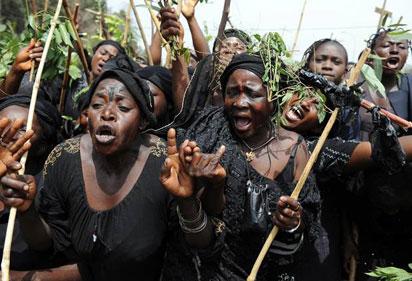
FOR indigenes of Angwan Sakwai, a rural community in Kaura Local Government Area of Kaduna State, Friday, March 14, 2014, would remain a sad day to remember.
 This is because on that fateful day, the once peaceful agrarian community was invaded by Fulani herdsmen and at the end of the attack, no fewer than 57 innocent residents were sent to their early graves. Only those who survived that deadly night could tell the tale of that gory tragedy.
The villagers who had gone to bed at 9pm were rudely jolted awake about two hours later by booming gunshots released by these murderous Fulani herdsmen.
Gideon Bughu, a survivor of that invasion, told Vanguard Features, VF that ‘’the gunmen first came on Friday night and attacked the village. The gunmen numbered over 50. As women and children scampered to escape, they were shot and later cut with machetes. They set our homes on fire. If you stayed inside, you were burnt. If you run out, they shoot at you. The men stayed inside, so most of those burnt were men. But the villagers managed to kill some of the Fulani herdsmen. Some of them wore army uniform.”
The story of Angwan Sakwai’s invasion is one in the litany of killings by Fulani herdsmen across many villages in Northern and Southern Nigeria.
Butchers of human beings: These herdsmen who are supposed to be taking care of their cattle, have unfortunately metamorphosed into butchers of human beings anywhere they make their abode. They have turned the farmlands in several states in the North into slaughter fields.
Their hosts, who ordinarily should be their friends for accommodating them, are slaughtered with reckless abandon. Hardly does a day pass without stories of the murderous activities of these nomads dotting the headlines of major newspapers in the country. They kill at the least provocation that one wonders whether they attach any value to human life at all.
Their activities coupled with those of Boko Haram, the Islamic insurgent group, have led to uncountable number of deaths of innocent Nigerians. At the last count, no fewer than 300 innocent persons have been hacked down in the last four months.
The bloody clashes between these herdsmen and farmers have been reported in states like Benue, Plateau, Kaduna, Niger, Jigawa, Sokoto, Edo, Delta, Yobe and Anambra.
Investigations by VF showed that these killings have assumed a monstrous proportion. The government which is empowered by Section 14, sub section 2b of the 1999 constitution, to ensure the security of lives and property, seems to have no ideas on how to handle the insurgents.
VF recalls that the government, after a meeting in Abuja., resolved to set up a technical committee to tackle the issue.
The closed door forum was chaired by Vice President, Mohammed Namadi Sambo. Briefing State House correspondents after the meeting, the Minister of Agriculture and Natural Resources, Akinwunmi Adesina, said that the rising livestock population and encroachment on grazing lands were some of the causes of the clashes.
National Grazing Routes: He stressed the need to increase the number of grazing reserves across the nation from the current 415. According to him, only 141grazing reserves have been gazetted with less than 20 equipped with resources for pastoralists.
The Committee had weeks within which to submit its report. The Committee’s terms of reference, according to the Minister, include looking into how to improve existing grazing reserves and designing a new financing regime for them.
The Committee headed by the Adamawa State Governor, Murtala Nyako, was mandated to work out the modalities for the establishment of grazing reserves across the country.
Grazing reserves
Since a decision on the creation of grazing sites was taken, most segments of the society, have toed divergent lines on the matter.
Those opposed to it said such a proposal would be counter-productive, while the proponents argued that grazing reserves and ranching were in line with standard best practice that ensured maximum benefit to nomads.
This is not the first time the government is making attempts at addressing the matter. The House of Representatives Committee on Agriculture in 2013, held a public hearing on a bill seeking to establish a National Grazing Route and Reserves Commission.
The bill, sponsored by Karimi Sunday Steve, representing Yagba East/Yagba West/Mopamuro Federal Constituency of Kogi State, is virtually a replica of another bill currently pending at the Senate. The version of the bill at the upper chamber of the parliament was sponsored by Senator Zainab Kure from Niger State. It would be recalled that a similar bill was thrown out during the sixth Assembly because it failed to address the crux of the matter.
The National Grazing Route and Reserve Commission, if established, would acquire and manage parcels of land across the 36 states of Nigeria for the purpose of providing pastures for these nomads and their herds of cattle.
Concept of grazing reserves: VF gathered that the concept of grazing reserves started in 1965 when the government of the Northern Region legislated upon it.
The then Minister for Agriculture in the Northern region proposed a law that empowered governments to carve out grazing reserves for livestock farmers so that they can be settled in those reserves.
Secondary inputs
The law did not stop at delineating and mapping out the grazing reserves. It also made case for secondary inputs like education, health facilities, roads, dams and livestock.
The findings of the International Livestock Centre for Africa ,ILCA, in 1978, also attested to the fact that grazing issue is age-long in Nigeria.
The ILCA established that the Middle Belt area, Central Belt of Nigeria is in the sub-humid zone and because of that it is less populated than the extreme North and South. Consequently, the researchers said that pressure on grazing land would be intense in about 30 years, adding that there would be conflicts because of unavailable land between pastoral and arable farmers.
Dr. Aliyu Ramalan, who attended many ILCA seminars regretted recently that the recommendations of the ILCA were hardly implemented.
Scarce resources
‘’In respect to the implementation of these recommendations, failures were noticed in the implementation because governments were not financing the programmes adequately. Of course, again, they were competing against scarce resources, ‘’ he lamented.
Despite appearing as the needed solution to the crisis, it would be difficult to convince some Nigerians that the creation of grazing site would put an end to the wanton killings by herdsmen.
National Coordinator of Towards a Renewed Nation, TRN, Chief Simon Onwubuya told VF that “problems should not be employed to solve problems.
‘’Historically the Fulanis use violence to achieve their aims. So, Nigerians should not be surprised with what is happening across the states now, especially in the North. One is troubled that the government is considering creating grazing reserves in other parts of the country. We will resist that, because it will amount to endangering the areas where the sites will be sited. What is the assurance or guarantee that the Fulani herdsmen will not unleash terror on the inhabitants of the villages where the sites will be established?’’ an angry Onwubuya asked.
Still fuming, he said: ‘’It does not make any sense. The North should be considered as the preferred area for the grazing sites because the South does not have historical link with the Fulanis which might guarantee a peaceful coexistence. I am not supporting their killings in the North, the government can solve the problem by aggravating it indirectly.’’
But a retired Commissioner of Police in Lagos State, Alhaji Abubakar Tsav, whose hails from Benue, one of the flashpoints of the Fulani killings, did not support the restriction of the proposed sites to the North.
For someone whose state is currently bearing the brunt of the killing spree, many are surprised with Tsav’s position. But he is not bothered by that. ‘Although some Fulanis are Chadians and other nationalities, but we must acknowledge that some are also Nigerians, they have freedom like other Nigerians,” he said.
Sake of proximity
Buttressing his argument, he told VF that: ’’In the past, the Fulanis were living happily with people. It’s wrong to say that siting grazing sites in the South will not be in the interest of the nation because the South also consumes meat. People need cows and for the sake of proximity, having grazing sites in the South will save cost of transportation.’’
Tsav, however, acknowledged thus: ‘’The Fulanis are causing troubles in most parts of Nigeria now. It is very important that they are confined to certain areas, but that should not be with immediate effect to ensure that they are properly settled.’’
He warned that the current move by the government should be free of religious and political bias. ‘’It is unfortunate that issues like this tend to assume religious and political dimension. Religious bias should not come in because we are serving one God. Why must religion become a tool for addressing national issues?’’ he asked.
Disclaimer
Comments expressed here do not reflect the opinions of Vanguard newspapers or any employee thereof.