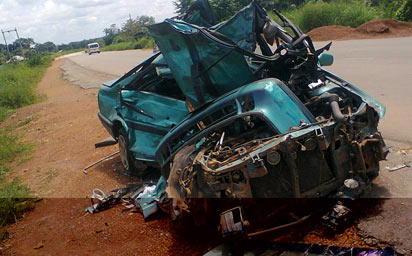
ACCIDENTED: The car in which the couple perished.
By Favour Nnabugwu
Road accidents do not just happen, they are caused.
Given the fact that Nigeria has the highest road accidents rate as well as the largest number of deaths per 10,000 vehicles, one may be tempted to believe that the level of awareness on the causes of road traffic accidents is very low among Nigerians.

File Photo: An accident scene.
Accidents in developing nations account for 50 percent of the world’s road traffic but 90 percent of the traffic fatalities. Nigeria has the worst driving record in Africa: nearly 34 deaths for every 100,000 residents, according to a 2013 World Health Organization report.
Nigeria also has one of the highest road traffic crash records in the world with the Federal Capital Territory, FCT, scoring the highest.
The killer metal is our most necessary accessory, the essential thing that gets us from here to there: the motorized vehicle. Speed limits in Abuja appear to be viewed as mere suggestions, lanes are flexible, driving against traffic is routine, and if you are caught, a little money can save you all the troubles.
In 2012 alone, a total of 4,260 deaths were recorded on Nigerian roads; an average of 12 persons daily and 20,752 injured translating to an average of 69 persons daily; 48,114 persons were involved in 6,269 documented cases.
The Federal Road Safety Commission (FRSC) data shows that FCT tops the list of road accidents in the country in the third quarter of 2013. A total of 3,247 road traffic accidents were recorded nationwide during the period with 1,533 deaths and 8,710 injuries. Of that figure, FCT recorded 176 crashes.
Some roads in the FCT are notorious for deadly accidents. Abuja-Kubwa-Zuba Expressway tops the list. The road under reconstruction, when completed, will likely be among the best and widest in the country with 10 lanes. Many Abuja motorists are ignorant of the dangers associated with smooth roads and therefore have little consideration for safety, hence avoidable accidents are commonplace. For this reason, officials of FRSC have stationed their ambulances at some locations along the expressway.
The Abuja-Lugbe-Gwagwalada Road, also being rehabilitated, is another blood sucker. When completed, it may rank among one of the best in the country. Many reckless drivers have met their deaths on that road, while several others have sustained critical injuries as a result of deadly accidents.
A green-and-white taxi sped through the road intersection, ignoring the traffic police officers there and narrowly missing an ash KIA jeep. A policewoman on duty screamed at the errant driver as he stepped on the turtle and zoomed off. The traffic officer glared helplessly at the disappearing vehicle, powerless to do anything – no ticket, no fine, nothing for reckless drivers who routinely act as though the law does not apply to them.
The slightest brush with the reckless Abuja taxi-driver will elicit “Wèrè!” (the word means lunatic in Yoruba language), his Hausa counterpart will shout ‘Wawa’ meaning fool while the Igbo man would impulsively yell ‘Onyeara’ meaning ‘mad person’.
As each day breaks in the nation’s capital, traffic officers, the police, the FRSC, and the Vehicle Inspection Officers, VIOs, prepare for infractions on Abuja roads.
The FRSC blames most of the accidents in the FCT on over speeding and tendencies of drivers to break the rules.
A private car owner says it is not just about drivers not observing the rules. The truth, he observes, is that most of them do not even know the rules. “How many of our road drivers go to driving schools before getting their driver’s licenses? To tell the truth, even me I had not perfected my driving ability when I got my driver’s license”, he explains.
The Federal Government has endorsed various policies to deal with the menace of unqualified drivers yet the same government has consistently fallen short on enforcement while people seem to always find a way around the system.
One of the most recent accidents in Abuja claimed the life of a woman, identified as Deaconess Ngozi Ike, 39, and a mother of five, who was crushed by a truck which suffered brake failure.
Another victim, Mrs Rose Awhia, aged 52 and mother of two, who, perhaps missed her way and, instead of driving a stretch to turn, chose to drive against traffic on the speed lane when a Toyota Hilux van, on speed, had a head-on collision with her car. Though the impact was more on the Hilux van and the two persons inside it, the woman died before medical attention could get to her while her sister survived.
What many motorists fail to understand is that vehicles are designed for maximum loads. It is, therefore, not surprising that when subjected to stress above the loads, accelerated wear and tear set in on the vehicles.
The net effect is deterioration in the condition of the vehicles which may result in accidents.
A police officer, who explained the possible scenarios in the accident that killed Mrs Awhia, said two things could have happened if the Hilux man had tried to avoid a head on collision with the woman’s car. One:the Hilux could have somersaulted on sudden application of the break leading to worse fatality for the driver and passenger. Two: The Hilux could have caused multiple accidents if the driver had stopped suddenly as vehicles behind could have rammed in a chain into one another and caused more deaths.
Above all, traffic laws are promulgated by legislators who seek to protect all users of the road network. In order for the laws to have the desired effects, they must be enforced by the various law enforcement agencies fairly and justly. Experience has shown that in states where enforcement has been adequately provided for in all its ramifications, road traffic accidents have been reduced.
Disclaimer
Comments expressed here do not reflect the opinions of Vanguard newspapers or any employee thereof.