By Ochereome Nnana
For now, it is still a whimper, not a bang. But the octave is beginning to rise. Nigerians are gradually, so it seems, coming to the realisation that politics of ethnicity and religion has done us more harm than good, and should be put away in the cooler.
I listened to a roundtable presentation by Nigerian teenage secondary school students drawn from schools in Abuja during the recently concluded Nigerian Economic Summit. It was shown on Nigeria’s premier news television channel, Channels Television on Thursday morning last week. The young men and women selected to feature on that programme made inspirational speeches, and one of them called for a new Nigeria where religion, tribe, “connections”, corruption and violence would no longer be used to identify our great country, Nigeria. Later that day, Kano delegates to the National Conference warned that tribe and religion must not be made the focal points of the confab. In fact, on the second day of the Conference before it was adjourned to resume today, the delegates had opted to sideline Christian and Muslim prayers, opting to go with the second stanza of our National Anthem, which is now termed our “national prayer”.
Let me mention also Mr Femi Aribisala, whose articles on his column in Vanguard have become the blunt and powerful sermons of a true nationalist. He has brought unconventional insights to wake up those who have been in ignorant slumber to the fact that Nigerians who are not members of our tribes, religions and regions are not the devils we paint them as. He is letting us know that Nigeria’s future greatness can only take place with all its constituent parts working together towards a common national purpose. I am sure you have read Aribisala. If you have not, then start today and check out back issues online. You will find it very good for your intellectual metabolism and psychic equanimity.
I remember when I wrote an article last year debunking the overvalued importance of tribalism in Nigerian politics. I postulated that even though we are first of all members of our tribes before being Nigerians, in the sense that we are born that way, and will remain that way even if Nigeria disintegrates, Nigeria remains the most important factor in the life of every Nigerian. I said that Nigeria is so important that after God who created all of us, the next most important thing to us is Nigeria, not our tribes.
This assertion drew a lot of reactions. Few really agreed with me. A retired senior naval officer called my number and asked me to come and explain myself in his office. Some of my fellow Igbo people pushing for the restoration of Biafra called me a “Nigerian sellout”. The name-callers did not bother to engage the issue raised; which is that Nigeria, not tribe or even religion, is the most important thing in the life of a Nigerian.
The proof is everywhere you care to look. Nigeria is our country; we have no other. I am not sure we want any other. Aribisala is right when says that Nigeria’s potential as a future world power will disappear if any section of the country goes away. Even those who are asking for Biafra or Islamic republic of Arewa (Boko Haram) were driven to their agitation only because Nigeria has not done well for itself and citizens. Igbos, like other Nigerians, fought for an early end of British rule, not for them to have a separate country outside Nigeria. They were pushed to secession by feelings of insecurity occasioned by the bloody events of 1966/1970. The moment the country is fairly run, everybody will forget separatism and begin to love Nigeria.
Tribalism and religion are seriously overvalued because on their own, they have very little to offer us politically. But as weapons for battling for plum slices of the National Cake, they are not only potent, they are actually weapons of mass destruction. They are only used by the privileged political elite to blackmail Nigeria. Then, they share its proceeds. The common people being used as cannon fodder end up getting nothing.
Nigeria was doing fine in the fight towards independence in the 1940s and 1950s. The National Council of Nigeria and the Cameroons, NCNC, under Dr Herbert Macaulay, and later on, Dr Nnamdi Azikiwe, was a party for all Nigerians. Under its platform, Igbos won elections in Yorubaland; Yorubas won election in the Eastern city of Port Harcourt, while a Fulani Zikist, Alhaji Umaru Altine, who originally hailed from Sokoto, won election to become the first Mayor of Enugu in 1952. Prof Eyo Ita, emerged as the Head of Government Business in an Eastern Region dominated by Igbos.
But the road to nationhood was blocked when Chief Obafemi Awolowo introduced what is now called “true federalism”, calling for a federal system that will be parcelled out to the tribes. His success in preventing the majority party in the West, the NCNC and its allies from assuming power, led to the use of tribalism by emergent elites to create new spheres of political influence for themselves. In the North, it was religion (Islam) that the Fulani ruling class riding on the back of the Hausa majority, used as their own instrument of political access and control.
Opium of religion
Ironically, millions of common-man Muslims were rendered poor and destitute even though they are always fed the opium of religion and deployed to fight, kill and die for the few at the top to walk victoriously home with their babanriga pockets full of the spoils of the war.
It is a good thing that some of us are beginning to realise the foolishness of continuing with ethnicity and religion as instruments of political engagement in our country after a century of failed experiment
It is time to lay them aside because as weapons, there is no way you bring them into the interplay of group interests without people getting hurt.
That tribalism and religion were freely used during the run-up to our independence could be understood. No group wanted to enter into independent Nigeria a slave of other tribes, and no region was willing to be caught disadvantaged. No one wanted to be second- or third-rate after the British colonialists were gone.
Unfortunately, it was precisely the struggle for supremacy among the tribes and regions that resulted in some tribes finding themselves on top only to be supplanted by other contending tribes in never ending circles of conspiracies. In the end, everyone got burnt out. Even the North that was given the mantle of dominance by the British colonialists eventually lost steam and produced the largest quota of poor and destitute Nigerians in spite of their decades of political dominance. Tribes and religions have failed all of us as weapons of political engagement.
They are things that separate us. They make us hate one another. Religion is a private affair. Let it stay there. Tribes of Nigeria are invaluable sources of cultural and social armament. We should use them to preserve our rapidly dying languages, dialects and positive values that make us unique as Africans. Let us keep them out of politics.
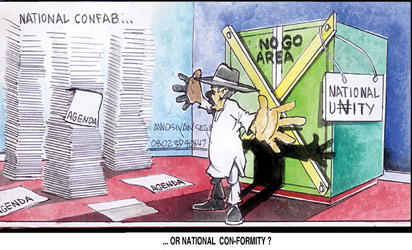
We must emphasise things that unite us; things we share in common. From today on, let us unite around our political parties. Let us assert our constitutional rights. Let us affirm our Nigerianness and refuse anyone to deny us of it. Let us go to the National Conference to decide how we can reduce the cost of governance, defeat corruption, create job opportunities for our famished youth, put suitably qualified people to work for us and demand accountability and good governance. Let us give our children good education and make Nigeria a place we all can love; a home-sweet-home for all Nigerians – irrespective of tribe and religion.
*Please go to our online edition and drop your comments, send SMS to the Glo number above or reach my mailbox. Thanks. ON.
Disclaimer
Comments expressed here do not reflect the opinions of Vanguard newspapers or any employee thereof.