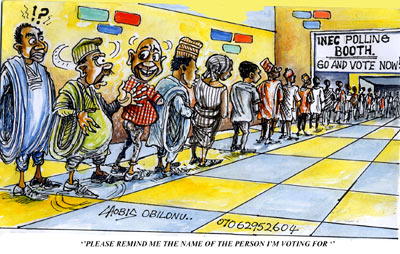
It is generally believed that the year 2015 would mean different period to several people both in Nigeria and friendly countries. However, to the local politicians, especially the Opposition, it is the year of ‘change‘. The pessimists think otherwise – the year 2015 will signify the doom of the country.
Nigerian patriots (and there are many of them) think hopefully about the era of peace and prosperity in 2015 and more years. The prayer warriors have been steadfast in their appeals to God for peace and President Jonathan has not been left behind in visits to mosques and churches to ask for that golden era of prosperity under one united nation.
The local parliamentarians, in their own traits, have demonstrated how easy or at times difficult (because of the federal system of government) to change the composition of the National Assembly in Abuja – the seat of the Federal Government.
Even the most optimistic minds would agree that Nigeria holds greater prospects of remaining politically united and economically prosperous only if right things are done at the right time. It is reasonable to expect some spectacular changes if certain measures are taken or correct policies are formulated to challenge successfully the useful prognosis of the pessimists. Heaven, they say, would help those who help themselves.
The complexity of the structure of the Nigerian nation has resurrected the ghosts of ethnicity and religious intolerance – agents of political instability. It would be to the everlasting glory of President Jonathan if the affairs of the National Conference are well managed and soundly co-ordinated that the outcome would provide Nigeria the right structure for enduring peace, prosperity and unity. This should be of more importance than the issue of second term – that euphorism for political imbecility.
A great threat to the stability of the country is the Boko Haram insurgency which has engaged fully a division of the Nigerian Army and has been met faithfully by the security forces. Any time the dreaded terrorists struck and soldiers responded, human lives were involved and invariably, innocent blood is shed.
There is no doubt that all Nigerians would want the Boko Haram terror gangs crushed soon, but with the good-will of all Nigerians irrespective political party affiliation. This should be translated into a general slogan by all political parties that, gCrushing of Boko Haram Insurgency is a duty that must be done.
It might be foolish to be carried away by the ‘mini-war‘ of the North-Eastern zone while forgetting the equally disastrous local wars constantly being waged by armed robbers (they kill innocent Nigerians by day and night and attack deposit banks as well). These nefarious activities are aided by kidnapping gangs who collect monetary rewards or kill those who could not afford. Political thugs and ritual killers abound in all political zones of the country to declare Nigeria a security risk to Nigerians and foreigners alike.
Although the economy is reported stable in the last few years with inflation reduced to 8 percent (on paper), with increasing flow of direct foreign investment and stable foreign exchange operation (Central Bank often comes to the aid of the Naira against dollar pressure), many businesses are yet to trust the economy.
Many analysts do question justifiably the concept of a stable economy with ‘rising costs of doing business, with restricted access to cheap loanable funds for industrial expansion in an atmosphere of mass unemployment.
The word Subsidy is not new to Nigeria‘s Oil Industry. It has now become romantic when it is breeding corruption, pipeline destruction and oil thefts of various dimensions. Subsidy payment on oil consumption by a well endowed oil producer looks like a stupid act of a foolish country.
When local refinery capacity is inadequate, you make arrangements with other refiners for a whole range of products to satisfy your additional required products.
If for example, the daily allocation of 450,000 barrels of crude oil is not adequate for the Nigerian market, why not increase the quantity allocated and utilize the refinery capacity in West Africa for a wide-range of products?, rather than report products in bit by bit. It would be a surprise if the NNPC also claims subsidy for the importation of kerosene as a single product.
The answer to the mess-up in the subsidy system lies in the complete deregulation of the Downstream Sector of the Oil Industry. The angry of the oil workers against the principles of deregulation is based on misunderstanding of economic factors and lack of trust of government on the sale of government properties.
The government may not sell the existing refineries to their ‘friends‘, but could ‘lease‘ them to oil marketers with international connection.
In a deregulated downstream sector of the oil industry, the federal government would limit itself to regulatory conditions and provision of infrastructural activities.
It is instructive to note that before the control of the total aspects of the oil industry, the down-stream sector worked well. As noted by me in this column, hitherto, prices of various petroleum products were agreed with government agencies by the local oil companies.
On local products, each company would buy crude oil (from government), refine to its specification at the refinery (owned by government, Shell and BP, but managed by BP) and pay agreed processing fees.
Each marketer was allowed a time-limit to evacuate its refined products into its own storage tanks in its depots throughout the country.
In its attempt to enforce the regime of ‘Uniform price‘ throughout the country, the military government had unwisely got entangled in the web of subsidy, from which it has no enough sincerity to free itself.
It must be admitted that security challenges, mass unemployment, poverty, corruption and unequal distribution of income are not created by the present government under President Jonathan (through some vice have germinated fully during the present regime).
If, as it appears, that the resolution of existing problems is beyond the capability of the present government and the Opposition (as it is presently constituted) seems disadvantaged, President Jonathan can wear the toga of statesmanship in his cabinet shake-up to evolve a national government to effectively tackle the problems. He seems not to be on the right path yet.
Disclaimer
Comments expressed here do not reflect the opinions of Vanguard newspapers or any employee thereof.