By CHARLES KUMOLU
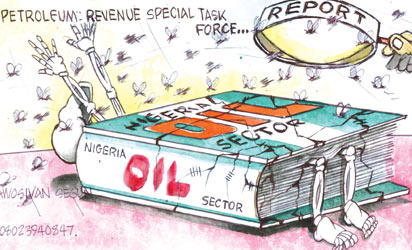
PERHAPS, the worst and the best are yet to come regarding the allegation of non- remittance of fund to the Federation Account by the Nigerian National Petroleum Corporation , NNPC.
Daily fresh revelations on the matter by the governor of the Central Bank of Nigeria,CBN, Mallam Lamido Sanusi, have correspondingly engendered controversies which have left the public more confused than enlightened.
Though, NNPC appears to be in the centre of the storm, the apex bank governor has been identified as being responsible for triggering it. Indeed, unfolding events have not helped him either, as he is being lampooned in some quarters for being statistically inconsistent in his claims.
Sanusi had in a letter to President Goodluck Jonathan dated September 25, 2013, said the NNPC had failed to honour its legal obligations, including failure to remit $49.8 billion to the Federation Account between 2012 and 2013.

The letter noted that the amount represents a whooping 76 per cent of the value of crude lifted during the period.
Surprisingly, between December and February, Sanusi has further alleged that the unremitted fund is $20bn and no more $10.8bn or $49.8bn.
How these monies keep increasing without thorough reconciliation of accounts between the CBN, the Ministry of Finance and the NNPC has been described as unbecoming.
This dilemma, perhaps, necessitated the decision of the Federal Government to hire independent forensic auditors to examine the books of the NNPC, with a view to ascertaining whether or not it has failed to remit oil revenues to the federation account.
Forensic experts necessary
“We understand that this kind of forensic audit requires experts who have some knowledge of the petroleum industry because it is very specialised. What the NNPC submitted was a mountain of documents on shipping, loading, when ships arrived and all that. It requires specialised forensic auditors to work on it,” Finance Minister and Coordinating Minister of the Economy Ngozi Okonjo Iweala noted.
And findings by Vanguard Features,VF, showed that such measures had been used to solve some high profile financial controversies in other parts of the world.
For instance, Shenna Freeman in How Forensic Accounting Works, said: ‘’The types of crimes forensic accountants investigate are classified as ‘crimes against property’. They investigate crimes such as fraud and give expert testimony in court trials. They also perform work related to civil disputes. Forensic accountants are also known as fraud investigators, investigative accountants, forensic auditors or fraud auditors.
‘’Although forensic accounting may not sound as glamorous as its other investigative counterparts, the field has received more attention in recent years. This is due in part to the high-profile, financial white-collar crimes involving large corporations such as the Enron and Adelphia Communications scandals of 2001 and 2002.’’
Another report by the United States Government Accountability Office added thus: ‘’ The Forensic Audits and Investigative Service team provides Congress with high-quality forensic audits and investigations of fraud, waste, and abuse; other special investigations; and security and vulnerability assessments. Our team also manages Fraudnet, an online system for the public to report allegations of fraud, waste, abuse, or mismanagement of federal funds.
‘’Our work addresses fiscal challenges facing our nation, organisational and individual ethics, stewardship over government resources, and issues related to homeland and national security. Our work is government-wide in scope rather than confined to one issue area.’’
Though the nation is not new to forensic matters, given that foreign experts had been recruited in the past on disputed election matters, the decision is generating mixed feelings across the country.
While some commended the move, noting that it would verify the data submitted by NNPC which the Petroleum Products Pricing and Regulatory Agency, PPPRA, had certified, a few are skeptical that the eventual outcome might advance the controversy. But the generality of the findings by VF showed that many are comfortable with the idea of bringing in forensic experts.
An expert on forensic matter and a retired Commissioner of Police, Alhaji Abubakar Tsav, believes that with forensic experts, the contentious issues might be addressed. But he expressed fears that the eventual outcome might suffer the fate of previous commissions of inquiry in the past.
‘’They may resolve the issue because they are experts and would establish the things needed to be established,’’ the retired police officer said.
Despite this confidence in the ability of the experts, he told VF: ‘’Even if they establish at the end of their findings that the money is missing, I am afraid that the outcome might go the way of other probes we had in the past. But I have no doubt in my mind that the decision to bring in experts is not a good one.’’
Tsav however threw up this poser:’’What now happens if it happens that influential members of the society are involved, will they be held responsible?’’
They remain allegations
Continuing, he added thus: ‘’Nigeria needs many forensic experts and I have always made a case for the training of forensic experts in Nigeria because they are needed when trying to resolve high profile matters. Sanusi knows what he is talking about but what he does not seem to know is the extent of the missing money; that is why there are discrepancies.’’
Another person who shares Tsav’s sentiment on the invitation of forensic auditors is the President of South East/South South Professionals,SSESSP, Mr. Emeka Ugwu-Oju.
Ugwu-Oju, an economist and retired bank executive, said there is nothing wrong in sourcing for an expert opinion in matters of such magnitude.
Accordingly, he said: ‘’For me, there is no controversy. It is a matter of allegation that was made and there is need to investigate the allegations. That is why bringing in forensic experts is commendable. In every issue, it is always good to seek expert opinion and views. With experts involved, the contentious questions will be answered, and that is the best way to handle the matter. The only issue to watch is authorisation. So, bringing in forensic experts is in order and they have to investigate.’’
He, however, cautioned that,‘’until they have concluded their job, the matter is still at the level of allegation.’’
Notwithstanding his support for the FG’s decision, he does not find the whole controversy a healthy development for the polity. Little wonder, he told VF that the CBN governor is not going about the matter in a good manner.
‘’The CBN governor has not been going about it the right way. But we should leave that. We have someone who is not an activist, but he behaves as one. I blame those who appointed him. If you are in government, you have to behave like someone in government,’’he added.
But a Senior Advocate of Nigeria,SAN, Chief Emeka Ngige, commended the CBN governor for bringing the matter into the public glare, but he added that it presented an opportunity for the President to take Nigeria to the next level.
Expatiating further, Ngige said: ‘’The implication is that the Central Bank of Nigeria,CBN has lived up to its statutory responsibility of being an adviser to the government on monetary matters and the custodian of the nation’s foreign reserves. The CBN did well by alerting the President and the National Assembly about its findings. And the NNPC is also trying to give account for the first time. This is the first time the NNPC is giving account of its financial dealings. This is an opportunity for the President to take Nigeria to the next level in the area of accountability.’’
It will be recalled that Sanusi in the letter published by an online medium said: ‘’Our analysis of the value of crude oil export proceeds based on the documentation received from pre-shipment inspectors shows that between January 2012 and July 2013, NNPC lifted 594,024,107 barrels of crude valued at $65,332,350,514.57.”
It further said: “Out of this amount, NNPC repatriated only $15,528,410,098.77 representing 24% of the value. This means the NNPC is yet to account for, and repatriate to the Federation Account, an amount in excess of $49.804 billion of the value of oil lifted in the same period.”
Violation of constitutional provisions
Drawing attention to an attached table of analysis of the crude oil liftings and repatriations as prepared by the CBN, Sanusi noted that the failure of the NNPC to repatriate the amounts constitutes not only a violation of constitutional provisions but also of both Nigeria’s foreign exchange and pre-shipment inspection of exports laws.
Also, drawing attention to previous occasions in which he had expressed concern about what appeared to be shortfalls in remittances to the Federation Account, in spite of the strong recovery in the price of oil, Sanusi said that a point of departure ought to be to insist that the NNPC account fully for all proceeds that were diverted from its accounts with the CBN and the Federation Account.
“As an indicator of how bad this situation has become, please note that in 2012 alone, the Federation Account received $28.51 billion in Petroleum Profits and related taxes but only $1013 from crude oil proceeds,” he informed President Jonathan. “In the period January-July 2013, the corresponding figures are $16.65 billion and $5.39 billion, respectively. This means, Your Excellency, that in the first seven months of the year, taxes accounted for 76% of the total inflow from this sector, while NNPC crude oil proceeds accounted for only 24%,” he noted.
Having raised the concern, Sanusi specifically asked the President to: ‘’Require NNPC to provide evidence for disposal of all proceeds of crude sales diverted from the CBN and Federation Account, investigate crude oil lifting and swap contracts as well as the financial transactions of counter-parties for equity, fairness and transparency; and authorise prosecution of suspects in money-laundering transactions, including but not limited to BDCs who are unable to account for hundreds of millions of dollars.’’
More enemies to the list of haters
Given that many Nigerians habour the belief or suspicion that the NNPC is a corrupt entity, it was therefore not surprising that the content of Sanusi’s letter was loudly hailed in several quarters. Hence, the calls for an investigation in the concerns raised by the CBN governor.
But the NNPC and the Ministry of Finance dismissed the claims, declaring that the actual amount not remitted was $10.8bn and not $49.8bn as Sanusi had earlier claimed.
While providing details on how the money was expended, the coporation said subsidy payments, pipeline repairs, associated costs of spilled and stolen crude oil, and cost of maintaining strategic reserve accounted for a chunk of the money.
A two-day high level reconciliation meeting of the NNPC, CBN, Ministries of Finance and Petroleum Resources as well as other revenue agencies of the Federal Government last month, however, established that it was $10.8 billion from domestic crude oil receipts that had not been remitted.
At a press conference in Abuja addressed by its Group Executive Director, Finance and Accounts, Bernard Otti, the corporation said: “The sum in question has been expenditures incurred as part of statutory responsibilities which the NNPC as the National Oil Company executes on behalf of the Federal Government and by extension the entire people of Nigeria.”
While insisting that the actual figure remained $10.8b as earlier discovered by a reconciliatory meeting of key stakeholders in Nigeria’s revenue management framework, the NNPC said out of the total sum, $8.49 billion was spent on subsidy claims within the period under review; $1.22 billion on management and repairs of petroleum pipelines which are constantly damaged by criminals across the country; while $0.72 billion was incurred on products and crude oil losses and another $0.37 billion expended on holding the country’s strategic products reserve.
Otti, flanked by the corporation’s GED Commercial Investment, Alhaji Dalhatu Yusuf, and GED Gas and Power, Dr. David Ige, said: “We have called you here to as usual help us inform Nigerian citizens about the state of affairs of our corporation and it is our duty at NNPC at all times to continue to inform and assure the general public that things are the way they are.
Procedures of accounting reconciliation
“What we are saying is that $10.8 billion is not missing, rather it is undergoing the normal processes and procedures of accounting reconciliation. The $10.8 billion reflects expenditures incurred by the NNPC in the period under review and are really made up of the following: subsidy claim, $8.49 billion; pipeline management and repair costs, $1.22 billion; products/crude oil loses, $0.72 billion; and cost of holding the strategic stock reserve itself, $0.37 billion”.
With that, the discomfort the matter had caused among Nigerians, nearly gave way to relative calm as the CBN governor corroborated the position of the finance ministry and the NNPC.
Disclaimer
Comments expressed here do not reflect the opinions of Vanguard newspapers or any employee thereof.