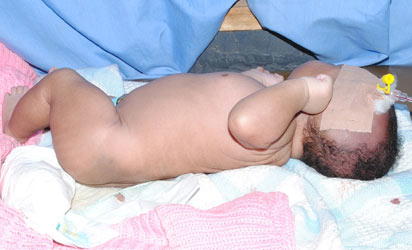
TWO MONTH OLD BOY RECEIVING TREATMENT AT 44 NIGERIAN ARMY HOSPITAL, HE WAS INJURED TOO BY THE SUICIDE BOMB BLAST ON SUNDAY AT ST.RITA’S CATHOLIC CHURUH, ANGWAN YERO, MALALI, IN KADUNA, ON MONDAY.PHOTO:OLU AJAYI.
By Sola Ogundipe
It’s no child’s play overseeing activities of a 25-bed space neonatal ward that is brimming with cutting-edge medical equipment and 16 incubators, while ensuring round-the-clock smooth-running of an ultra modern 33-bedded paediatric ward in a world-class tertiary health institution such as the Delta State University Teaching Hospital, DELSUTH, Oghara. Your work is really cut out if in coping with these, the 20-bedded children emergency ward and state-of-the-art Intensive Care Unit still make demands of your attention. This is exactly what Nurse Manager, Laura Ade, does for a living.
When a child is sick
When a child is sick, a child is sick. I can’t lie on my bed and think its all okay. These children have no advocate but me. Now I reside on the premises, but when I was living in Sapele, the distance didn’t stop me. I used to drive from Sapele down to Oghara. It didn’t matter what time of day as long as that child would live. That’s what matters. Three paediatric experts have just been employed in addition to the four on ground and there is a neonatologist employed on contract from London.
No closing time
Here, there are no specific working hours. You could be on call at anytime and indefinitely. We don’t have closing time because life is involved. You will never find a nurse here wanting to close at the specified time when there is a case at hand. We cannot go to bed or sleep. If you want a job with a closing time, go to a bank. Whenever you are called, whether at midnight or 3am, you must report for duty because life is involved. This is a specialty that is still growing in Nigeria. It’s a very different culture that we have imbibed and this is as a result of the major changes Governor Emmanuel Uduaghan is making. It involves getting the equipment to work and the staff to appreciate that this is all about life.
Pre-term babies
A common perception in this practice is that babies born under 23 weeks of gestation, that is, below six months, are not viable and so one shouldn’t even make an effort. In Nigeria, generally, they say viability begins at 28 weeks but we have had babies of 26 weeks, babies weighing 600g, which is not up to a packet of sugar in weight; and babies of 800-900g in weight, and they survived.
If I get to a delivery and the baby is breathing, then it is entitled to live. Often, it might appear that a 26-weeker is improbable, but we appreciate that the mother might not have calculated the dates right. In the locality in which we are, sometimes women could be up to three months pregnant and not know. So even if a woman who is in labour claims to be only four or five four months pregnant, it wouldn’t stop me attempting to manage that delivery. I would attempt that delivery depending on the assessment of the baby.
Referrals
Majority of babies in our neonatal units are referrals. We’ve had referrals from Bayelsa State, Edo State and other states. Referrals are coming from the Lagos University Teaching Hospital, LUTH; Lagos State University Teaching Hospital, LASUTH and the University College Hospital, UCH, Ibadan as well as several other states because of the kind of stuff we do here, a lot of which is new and not available elsewhere.
Retcam scanning for neonates
There is a Retcam here at DELSUTH. It is highly specialized equipment that scans and detects abnormalities in the retina of neonates who are prone to blindness especially if they are born too early and need to be given oxygen. There is only one of it in the country and we have just had training on it. With this machine every baby will be screened to ensure they do not develop blindness.
We are gong to call for babies from Delta and other states to come in for scanning. Treatment can be done with laser but now we want to get a cohort to see how many infants would actually need the treatment because buying the laser for treatment is quite expensive. Images generated here can be sent to the United States for second assessment if our ophthalmologists are not too sure.
Neonatal network
A lot of referrals are coming in so we are setting up the first Delta State neonatal network which Governor Uduaghan is flagging off. What this means is that clinicians will be talking to each other. We already have 100 cell phones, that will be given out to all the 65 centres that deliver babies. Every morning, my nurses will call each of these centres and when they come, their patients will get intensive care.
When their care becomes less intensive they can go back to their own home base. That makes it more comfortable for the parents. For instance, if a baby who is sick in FMC Asaba is referred here, they would be going around looking for a car. By the time they get a car, that baby is so cold. By the time they get here, this place is full and there is no bed. So that baby is jeopardized.
The reason why the neonatal network is coming into Delta state is for us to work together and manage our work together. We have been given an ambulance just for this service which means that we can go out and if a baby is too sick we can talk on the phone, and then go ventilate it and bring it into the ICU.
Service first, payment later
The Delta State government treats emergencies as emergencies. We live in an area in which the people are very poor. We are trying in every way to support them so time is a big factor for us. If a baby comes in within the first four hours and we are not able to do diagnosis, blood transfusion and stuff like that, it is very dangerous. We have to be able to support the parents to get a little bit of courtesy in the sense that we do the test while they go and look for money.
At DELSUTH, we treat before asking questions. If somebody is brought in, bleeding or has a life threatening situation, we would start treatment before asking for payment. If you are here and you watch a baby come in sick, you’ll see that the nurses only care about obtaining the referral letter so as to commence treatment. We never, ever ask for money first when a baby is brought in. When the crisis is over, we can talk about money. I am very proud to work in an institution like this.
Disclaimer
Comments expressed here do not reflect the opinions of Vanguard newspapers or any employee thereof.