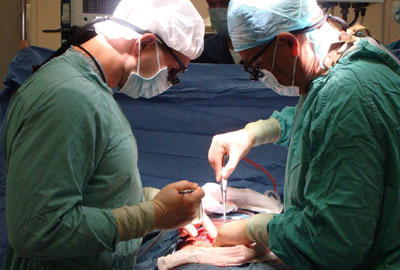
patient undergoing kidney surgery
CASES of kidney failure are alarming. Afflicted Nigerians would appreciate efforts to ameliorate the situation. The Nigerian Medical Association, NMA, said more than 5,000 Nigerians travel to India and other countries monthly for medical attention.
More than 30 million Nigerians reportedly have kidney-related illnesses. Cases of pediatric kidney failure are rampant – more children are born with abnormalities like hyperplastic kidneys, where the kidneys are not properly formed, or ballistics kidney disease. It is not unusual to see persons at 10, 12 years of age with renal failure.
Statistics on medical expenditure of Nigerians abroad are staggering. While the NMA estimates N78 billion annually with N40.94 billion going to India alone, estimates from the Organising Committee of the Nigerian Centenary Charity Ball are as high as N250 billion. Most of the cases are kidney-related.
The first successful kidney transplant of the Delta State University Teaching Hospital, Oghara, which remarkably bore the personal involvement of Governor Emmanuel Uduaghan, sets a new momentum that could be explored to make kidney treatment more accessible and affordable, instead of the mere promises improved medical services have become.
It provides an opportunity to pay more attention to kidney management, and harnessing resources at managing it. Dr. Uduaghan could have stopped at providing the resources to complete the teaching hospital that his predecessor started, but his participation in its first kidney transplant is part of his concerns for improvements in medical services. He could sustain the thrust by spearheading a co-ordinated confrontation of renal failure, as diseased kidneys are also known.
Kidney transplants in Nigeria are not new. According to the Transplant Association of Nigeria, an estimated 200 kidney transplants have been successfully carried out in Nigerian hospitals. The first kidney transplant was at St Nicholas Hospital, Lagos, in 2000. A consortium of surgeons from the teaching hospitals in Ile-Ife, Kano and Maiduguri performed one in 2010. In November 2013, doctors at Garki Hospital in Abuja successfully transplanted a kidney into a 19-year-old boy, from a 43-year-old man.
Two years ago, the Obafemi Awolowo University Teaching Hospital Complex, OAUTHC, Ile-Ife, Osun State, introduced a package of one session of haemodialysis (renal dialysis) at N15, 000, while a transplant cost N2.5 million.
Nigeria has seven federal teaching hospitals equipped with facilities and personnel to undertake kidney transplant. These are inadequate, considering the number of cases, and more importantly the cost of accessing treatment.
For the size of the country, major initiatives like the one in Oghara are essential. They should be followed up with reduction of cost of treatment. More importantly, management of factors that pre-dispose people to kidney failure is critical to reducing the number of cases.
Disclaimer
Comments expressed here do not reflect the opinions of Vanguard newspapers or any employee thereof.